Country · Asia
Pakistan
Only species with a profile on Seriously Fish are counted, whether native or introduced.
- Species
- 22
- Families
- 8
- Genera
- 15
- Found only here
- 0
- Photographed
- 22 of 22
Shares its fishes withspecies recorded in both
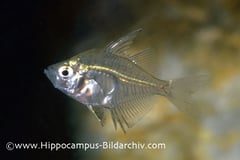
Chanda rangaIndian Glass Fish
Ambassidae · Hamilton, 1822
The Indian glass fish, Chanda ranga, is a small ambassid from South and Southeast Asia, with translucent skin that shows its bones and organs. For many years it was injected with luminous dyes on Asian fish farms and sold as 'painted' glass fish, and most injected fish do not survive more than a few months. It is found most often in freshwater, frequently soft and acidic, and needs no added salt. Parambassis lala and C. siamensis are often imported under its name.

Channa gachuaDwarf Snakehead
Channidae · (Hamilton, 1822)
The dwarf snakehead, Channa gachua, is a snakehead recorded across an enormous range from Iran to Taiwan and Bali. There is significant evidence that C. gachua as currently understood is a complex of similar-looking species in need of taxonomic review. A mouthbrooder bred regularly in captivity, it can share a well-chosen community with peaceful fishes too large to be prey, but populations should not be mixed as some may hybridise.

Chela cachiusNeon Hatchet Fish
Cyprinidae · (Hamilton, 1822)
The neon hatchet fish, Chela cachius, is a deep-bodied cyprinid mostly recorded from the Ganges and Brahmaputra systems of India and Bangladesh. Its extremely deep body means it is unlikely to be confused with any related species, and it is the only valid member of the genus. A habitat generalist, it is an active schooling fish that is best kept in a group of at least 8-10 in a tank with a tightly-fitting cover, since it is an accomplished jumper.

Esomus danricaFlying Barb
Cyprinidae · (Hamilton, 1822)
The flying barb, Esomus danrica, is a cyprinid with an enormous range across Pakistan, Nepal, Bangladesh, most of India, Myanmar and Sri Lanka. It shows a marked preference for shallow, slow-moving and standing waters such as rice paddies with dense vegetation, and is generally absent from major river channels. Reports on its suitability for community aquaria are mixed, with some keepers seeing a pronounced tendency to nip fins.

Labeo bogaViolet Shark
Cyprinidae · (Hamilton, 1822)
The violet shark, Labeo boga, is a cyprinid from most major river systems in India, Pakistan, Nepal, Bangladesh and Myanmar. It inhabits major river channels and larger tributaries and grows to 250 mm, needing a tank of at least 240 x 60 cm. It is unsuitable for most home aquaria but turns up in the trade irregularly, also as the 'violet-gilled shark' or 'blushing violet shark'. L. boga as currently recognised probably represents a complex of closely-related species.
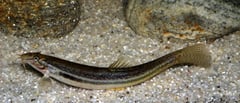
Lepidocephalichthys guntea
Cobitidae · (Hamilton, 1822)
Lepidocephalichthys guntea is a cobitid loach from the Ganges and Brahmaputra systems of northern India, Nepal and Bangladesh, and much of Myanmar. One of the most frequently-traded members of the group, it is an excellent choice for those new to keeping loaches. Males carry a solid, dark lateral stripe and females spotted flanks, and patterning varies with origin. It is also used as a food fish, eaten fresh and dried.

Pethia conchoniusRosy Barb
Cyprinidae · (Hamilton, 1822)
The rosy barb, Pethia conchonius, is a small cyprinid found from Pakistan throughout India, Nepal and Bangladesh. Generally considered one of the hardiest small cyprinids in the hobby, it is an excellent choice for newcomers. Wild specimens are not usually available and the vast majority are commercially bred, with long-finned, 'veil-tail', 'super red', 'neon' and 'golden' strains among the forms selective breeding has produced. Feral populations exist in several countries.

Pethia tictoTicto Barb
Cyprinidae · (Hamilton, 1822)
The ticto barb, Pethia ticto, is a small cyprinid widely distributed through most of the Indian subcontinent, from Pakistan and Nepal to Bangladesh. Its name is frequently misapplied to P. padamya in aquarium literature, though P. ticto is much the less colourful fish and males lack reddish-orange pigmentation on the body. Morphology and colour pattern vary by population, and some populations have already been described as distinct species.

Puntius cholaSwamp Barb
Cyprinidae · (Hamilton, 1822)
The swamp barb, Puntius chola, is a cyprinid from much of Pakistan, India, Nepal, Bhutan, Bangladesh, Sri Lanka, Myanmar and western Thailand. Sometimes called the 'chola' or 'green' barb, it has a single pair of barbels and dark blotches behind the operculum and near the caudal-fin base. It apparently prefers stiller waters over mud or silt, and makes an ideal addition to a peaceful community of riverine fishes.

Puntius terioOnespot Barb
Cyprinidae · (Hamilton, 1822)
The onespot barb, Puntius terio, is a cyprinid widely distributed from Pakistan through northern India, Nepal and Bangladesh. Its range covers parts of the Indus, Ganges and Brahmaputra drainages, where it apparently prefers stiller waters over mud or silt. Populations vary in colour pattern to an extent, but all share a diffuse yellow-golden marking on the operculum and a dark spot on the caudal peduncle.

Puntius vittatusGreenstripe Barb
Cyprinidae · Day, 1865
The greenstripe barb, Puntius vittatus, is a small cyprinid widely distributed in India, with further populations in Pakistan and Sri Lanka. Sometimes called the 'kooli barb', it lacks barbels and has a vertical black streak and an orange-marked black tip on the dorsal fin. It most commonly occurs in lowland streams, pools, irrigation channels and rice paddies over mud or silt, and is not an especially popular aquarium fish despite its wide range.

Xenentodon cancilaFreshwater Needlefish
Belonidae · (Hamilton, 1822)
The freshwater needlefish, Xenentodon cancila, is a belonid from Pakistan east through India, Bangladesh, Nepal, Sri Lanka, Myanmar and Thailand. Often called 'freshwater garfish', it only superficially resembles the true gars, and most of its relatives in the Belonidae are marine or estuarine. A near-exclusive inhabitant of the upper water column, it is surprisingly peaceful with anything too large to swallow and is best kept in numbers of four or more, in a tank of 180 ∗ 60 cm or more.

Anabas testudineusClimbing Perch
Anabantidae · (Bloch, 1792)
The climbing perch, Anabas testudineus, is a labyrinth fish found from Pakistan and Sri Lanka east to southern China, Indonesia and Singapore. It lives in almost every kind of lowland water from rice paddies to main river channels, and can cross several hundred metres of land provided it stays moist. Its taxonomy is confused, and additional taxa probably exist. Its size and predatory nature make it unsuitable for the general community.

Bagarius yarrelliGoonch
Sisoridae · Sykes, 1839
The goonch, Bagarius yarrelli, is a very large sisorid catfish recorded from the Indus in Pakistan east through Indochina to Sumatra and Borneo. Also known as the 'giant devil catfish' and 'sand shark', it reaches 1300 to 2000 mm and is fished for food across much of its range. That wide distribution appears doubtful, and Indian and Southeast Asian populations may prove not to be conspecific. It lives among boulders in the fast, turbulent rapids of large rivers.

Channa maruliusBullseye Snakehead
Channidae · (Hamilton, 1822)
The bullseye snakehead, Channa marulius, is a large snakehead recorded from Pakistan across southern Asia to southern China, Laos and Vietnam. Also called the 'giant', 'cobra' or 'Indian' snakehead, it is widely accepted to represent a complex of related species in need of further research. Reports of 120-180 cm remain to be proven, with 500-600 mm a more common adult size, and it is suitable only for public installations or the very largest private aquaria.

Chitala chitalaIndian Featherback
Notopteridae · (Hamilton, 1822)
The Indian featherback, Chitala chitala, is a very large notopterid probably restricted to Pakistan, India, Nepal and Bangladesh. Its name has been widely misapplied in the trade, most often to the Southeast Asian C. ornata, but it is very rarely exported for aquaria and is fished and cultured for food in India. Growing to 1220 mm SL, it has non-ocellated black spots above the anal fin and is the only Chitala normally showing gold or silver bars on the back.

Ctenopharyngodon idellaGrass Carp
Cyprinidae · (Valenciennes, 1844)
The grass carp, Ctenopharyngodon idella, is a large cyprinid native to the Amur River system in eastern Russia and northeastern China. Adults typically reach 800 to 1200 mm, making it a wholly unsuitable aquarium subject, though an albino form is traded. Widely introduced for aquaculture and weed control, it has caused serious damage to natural waters, and unwanted fish should never be released.

Notopterus notopterusBronze Featherback
Notopteridae · (Pallas, 1769)
The bronze featherback, Notopterus notopterus, is an air-breathing notopterid from the Indian subcontinent and Southeast Asia. Also called 'Asian knifefish' or 'ghost knifefish' in the trade, it grows to 600 mm and arguably has no place in the ornamental hobby given its adult size and specialised requirements. The single species in Notopterus is likely to represent a complex of closely-related species.

Gymnostomus ariza
Cyprinidae · (Hamilton, 1807)
Gymnostomus ariza is a cyprinid widely distributed from the Indus basin in Pakistan through India, Bangladesh and Myanmar. Growing to around 300 mm SL, it inhabits flowing streams and tributaries with clear water. It has a confusing taxonomic history, having been placed in Bangana, Cirrhinus and Labeo in recent years. It breeds in temporarily-inundated zones in the wet season and is also produced commercially for food.

Labeo angra
Cyprinidae · (Hamilton, 1822)
Labeo angra is a benthic cyprinid from Pakistan, Nepal, northern India, Bangladesh and Myanmar, described from the Brahmaputra. It can be identified by a brownish back, yellowish flanks and belly, and a black to bluish stripe from the eye to the caudal-fin base. It undertakes annual spawning migrations within its native river systems.

Labeo calbasuOrangefin Labeo
Cyprinidae · (Hamilton, 1822)
The orangefin labeo, Labeo calbasu, is a large cyprinid from Pakistan, Nepal, India, Bangladesh, Myanmar and southern China. Growing to 800 mm, it is an important food and game fish across its native range and is not a suitable subject for the home aquarium. It is known as 'black rohu' in parts of India and Bangladesh, and inhabits the lower reaches of major rivers, lakes and reservoirs.

Bagarius bagarius
Sisoridae · (Hamilton, 1822)
Bagarius bagarius is a sisorid catfish with a wide but disjointed recorded range, from the Indus in Pakistan east to the Mekong and Malay Peninsula. Its identity is confused: the name has been widely applied to a small fish said to reach only 200 mm SL, but it may be the only Bagarius in the Indian subcontinent, in which case it can reach 2 metres. It is mostly collected from fast, turbulent rapids in larger rivers, where it shelters among boulders, and is best kept alone.