Country · Asia
Sri Lanka
Only species with a profile on Seriously Fish are counted, whether native or introduced.
- Species
- 32
- Families
- 12
- Genera
- 20
- Found only here
- 11
- Photographed
- 31 of 32
Shares its fishes withspecies recorded in both
Found only here11
11 of the species on this page are recorded in Sri Lanka and in no other country. This is not the same as being endemic.
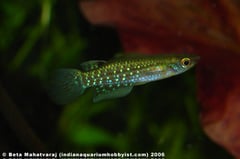
Aplocheilus blockiiGreen Panchax
Aplocheilidae · Arnold, 1911
The green panchax, Aplocheilus blockii, is a small killifish from Sri Lanka and southern India, growing to around 45 mm SL. Euryhaline, it mostly inhabits lowland, often coastal, still or slow-moving brackish or fresh water with surface vegetation or overhanging cover, and is commonly found in mangrove swamps and rice paddies.
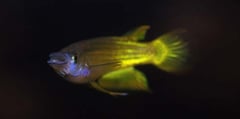
Aplocheilus lineatusStriped Panchax
Aplocheilidae · (Valenciennes, 1846)
The striped panchax, Aplocheilus lineatus, is a predatory killifish from peninsular India and northern Sri Lanka, growing to 10 cm TL. It lives in permanent water from mountain streams and lakes to swamps and rice paddies, and is not an annual species. The golden wonder panchax sold in the trade is a golden form selectively bred in the hobby that does not occur in the wild.
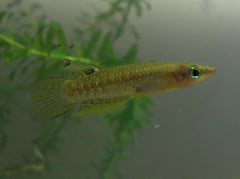
Aplocheilus parvusDwarf Panchax
Aplocheilidae · Sundara Raj, 1916
The dwarf panchax, Aplocheilus parvus, is a small killifish from Sri Lanka and Tamil Nadu state, southeastern India, growing to around 40 mm SL. Euryhaline, it mostly inhabits lowland, often coastal, still or slow-moving brackish or fresh water, and is commonly found in mangrove swamps and rice paddies.

Belontia signataCeylonese Combtail
Osphronemidae · Günther, 1861
The Ceylonese combtail, Belontia signata, is a labyrinth fish endemic to the central and southern river systems of Sri Lanka. Also referred to as the 'Ceylon fighting fish', it differs from B. hasselti in its reddish body and the absence of mosaic patterning in the unpaired fins. At least three putative phenotypes have been recorded, one described as the questionably valid subspecies B. s. jonklaasi. It is not recommended for the average community aquarium.

Butis butisCrazy Fish
Butidae · Hamilton, 1822
The crazy fish, Butis butis, is a flathead gudgeon of coastal and brackish waters across the Indo-Pacific, from eastern Africa to Fiji. The most commonly traded member of the genus, it has many other names, including crocodile fish, duckbill sleeper and upside-down sleeper. A nocturnal ambush predator, it often swims upside-down, and it is territorial and not sociable with conspecifics, so is best kept singly.

Channa gachuaDwarf Snakehead
Channidae · Hamilton, 1822
The dwarf snakehead, Channa gachua, is a snakehead recorded across an enormous range from Iran to Taiwan and Bali. There is significant evidence that C. gachua as currently understood is a complex of similar-looking species in need of taxonomic review. A mouthbrooder bred regularly in captivity, it can share a well-chosen community with peaceful fishes too large to be prey, but populations should not be mixed as some may hybridise.
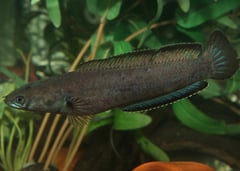
Channa orientalisCeylon snakehead
Channidae · Bloch & Schneider, 1801
The Ceylon snakehead, Channa orientalis, is a small snakehead without pelvic fins, endemic to the wet zone of southwestern Sri Lanka. Its name has been widely misapplied to Channa populations elsewhere in South and Southeast Asia, most of them now considered C. gachua. Probably endangered in the wild, it is a paternal mouthbrooder that forms lasting pair bonds, and captive breeding should be the priority when keeping it.

Devario malabaricusGiant 'Danio'
Cyprinidae · (Jerdon, 1849)
The giant 'danio', Devario malabaricus, is a deep-bodied devario from peninsular India, living in hill streams and upper parts of small rivers. Most older aquarium literature labels it D. aequipinnatus, but genetic and morphological data have shown the traded fish to be D. malabaricus. It has a blue-and-yellow colour pattern and a P stripe extending to the fork of the caudal-fin. Its true range is uncertain and may be confined to western-flowing drainages of India.
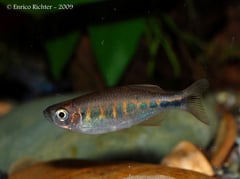
Devario pathiranaBarred 'Danio'
Cyprinidae · (Kottelat & Pethiyagoda, 1990)
The barred 'danio', Devario pathirana, is a devario known only from a few small streams in the Nilwala River watershed of southwestern Sri Lanka. It has 7 to 11 dark blue, irregular vertical bars on the front of each flank and a short horizontal stripe on the caudal peduncle. Although endangered in nature, it is bred commercially in limited numbers and is sometimes sold as the 'tiger' or 'Ceylon' danio.

Esomus danricaFlying Barb
Cyprinidae · Hamilton, 1822
The flying barb, Esomus danrica, is a cyprinid with an enormous range across Pakistan, Nepal, Bangladesh, most of India, Myanmar and Sri Lanka. It shows a marked preference for shallow, slow-moving and standing waters such as rice paddies with dense vegetation, and is generally absent from major river channels. Reports on its suitability for community aquaria are mixed, with some keepers seeing a pronounced tendency to nip fins.
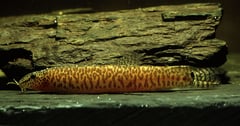
Lepidocephalichthys jonklaasi
Cobitidae · Deraniyagala, 1956
Lepidocephalichthys jonklaasi is a cobitid loach endemic to the 'wet zone' of south-western Sri Lanka, known from at least five localities. Records exist from the Gin, Kalu, Nilwala and Bentota river basins plus a small blackwater creek near the Kottawa Forest Reserve. Its conservation status perhaps precludes its suitability for the hobby. Broad dark bars on the caudal fin and large, vertically elongated black spots on the flanks identify it.
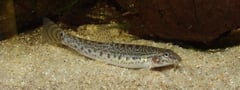
Lepidocephalichthys thermalis
Cobitidae · Valenciennes, 1846
Lepidocephalichthys thermalis is a cobitid loach from Sri Lanka and Peninsular India, described from the hot waters of Cania, Sri Lanka. Available sporadically, it makes an excellent choice for those new to keeping loaches. Unlike most of the genus it shows a preference for headwaters and clear, flowing streams. It was for a number of years included in Lepidocephalus until Havird and Page (2010) placed it in Lepidocephalichthys.

Malpulutta kretseriOrnate Paradisefish
Osphronemidae · Deraniyagala, 1937
The ornate paradisefish, Malpulutta kretseri, is a labyrinth fish from the 'wet zone' of southwestern Sri Lanka. It has been recorded from the Gin, Kelani, Kalu, Nilwala and Bentota river basins. The only member of its genus, it is protected by law in Sri Lanka although it still appears in the aquarium trade from time to time. Three colour forms exist, differing in the amount of reddish, violet or bluish pigmentation in the fins.

Oryzias dancenaIndian Ricefish
Adrianichthyidae · Hamilton, 1822
The Indian ricefish, Oryzias dancena, is widely distributed through eastern and southern India, Sri Lanka, Bangladesh and Myanmar. Mostly coastal but adaptable, it has been collected from strongly brackish mangrove swamps to acidic freshwater forest streams. It continues to be misidentified as O. melastigma, a name most recent workers consider invalid, or as O. javanicus, a valid but distinct taxon.
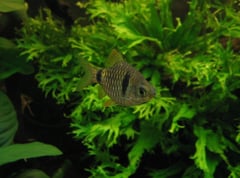
Pethia cumingiiCuming's Barb
Cyprinidae · Günther, 1868
Cuming's barb, Pethia cumingii, is a small cyprinid endemic to southwestern Sri Lanka, apparently only in the Bentara and Gin river drainages. It was long thought to occur in yellow- and red-finned forms, and the red-finned fish are now recognised as P. reval, a smaller species of sluggish lowland rivers. Reports suggest the more brightly-coloured fish are becoming scarcer, and selective collection for the aquarium trade may have altered wild populations.
Pethia nigrofasciataBlack Ruby Barb
Cyprinidae · Günther, 1868
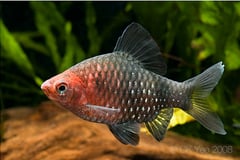
The black ruby barb, Pethia nigrofasciata, is a small cyprinid endemic to the Kelani and Nilwala river basins in the 'wet zone' of Sri Lanka. Sometimes traded as 'purple-headed barb' or 'ruby barb', it has three dark, vertical flank markings, and in spawning males the head and front of the body turn reddish-purple. Farm-raised fish are fairly adaptable in water chemistry, while wild stock are likely to prefer slightly acidic to neutral conditions.
Pethia reval
Cyprinidae · Meegaskumbura, Silva, Maduwage & Pethiyagoda, 2008
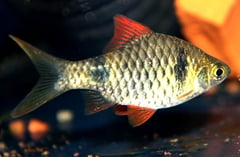
Pethia reval is a small cyprinid endemic to western Sri Lanka, known from the Kelani and Maha Oya river systems and the drainages between them. Considered a red-finned colour form of P. cumingii before its description, it is a smaller fish, to 33.6 mm SL, with red dorsal, anal and pelvic fins (pale yellow in the Kalu River population). The Mahaweli River population appears to have been introduced.

Pseudetroplus maculatusOrange Chromide
Cichlidae · (Bloch, 1795)
The orange chromide, Pseudetroplus maculatus, is a euryhaline cichlid native to peninsular India and Sri Lanka. It mostly inhabits brackish estuaries, coastal lagoons and the lower reaches of rivers, and can be kept in fresh or brackish water so long as acidic conditions are avoided. Wild examples are rarely seen in the hobby, where selectively bred strains traded as 'red' or 'yellow' chromide are widely available.

Pseudosphromenus cupanusSpiketail Paradisefish
Osphronemidae · Cuvier, 1831
The spiketail paradisefish, Pseudosphromenus cupanus, is a small labyrinth fish restricted to southern India and Sri Lanka. It lives in sluggish and still waters such as rice paddies, swamps and weedy ponds. It lacks the two dark lateral stripes of its only congener, P. dayi. A secretive bubble nester, it is peaceful but too small and timid for most community aquaria.

Puntius bimaculatusTwo-spotted Barb
Cyprinidae · Bleeker, 1863
The two-spotted barb, Puntius bimaculatus, is a small cyprinid from Sri Lanka and southern India. It lives in flowing hill streams and quieter stretches in the middle reaches of rivers, but tends to be absent from lowland environments. Also called the 'redside barb', it has 7 branched dorsal-fin rays and round dark spots at the base of the dorsal and caudal fins. Generally very peaceful, it is a schooling species and at least 6-10 should be kept.

Puntius cholaSwamp Barb
Cyprinidae · (Hamilton, 1822)
The swamp barb, Puntius chola, is a cyprinid from much of Pakistan, India, Nepal, Bhutan, Bangladesh, Sri Lanka, Myanmar and western Thailand. Sometimes called the 'chola' or 'green' barb, it has a single pair of barbels and dark blotches behind the operculum and near the caudal-fin base. It apparently prefers stiller waters over mud or silt, and makes an ideal addition to a peaceful community of riverine fishes.

Puntius titteyaCherry Barb
Cyprinidae · Deraniyagala, 1929
The cherry barb, Puntius titteya, is a small cyprinid endemic to the Kelani and Nilwala river basins in the southwestern 'wet zone' of Sri Lanka. Among the most ubiquitous small cyprinids in the hobby and an unreserved choice for beginners, it is sold mostly as commercially farmed stock, including albino and 'super red' strains. Generally very peaceful, it is a schooling species and at least 6-10 should be kept.

Puntius vittatusGreenstripe Barb
Cyprinidae · Day, 1865
The greenstripe barb, Puntius vittatus, is a small cyprinid widely distributed in India, with further populations in Pakistan and Sri Lanka. Sometimes called the 'kooli barb', it lacks barbels and has a vertical black streak and an orange-marked black tip on the dorsal fin. It most commonly occurs in lowland streams, pools, irrigation channels and rice paddies over mud or silt, and is not an especially popular aquarium fish despite its wide range.
Rasboroides vateriflorisFire Rasbora
Cyprinidae · Deraniyagala, 1930
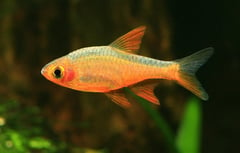
The fire rasbora, Rasboroides vaterifloris, is a small cyprinid endemic to the Kalu, Bentota, Gin and Nilwala river basins of southwestern Sri Lanka. Colour varies with locality, and red, orange and yellow-finned forms are known. Its delicate nature causes problems in shipping, and reports suggest the more highly coloured fish are becoming scarcer in the wild, possibly because selective collection for the trade has altered the structure of wild populations.

Xenentodon cancilaFreshwater Needlefish
Belonidae · Hamilton, 1822
The freshwater needlefish, Xenentodon cancila, is a belonid from Pakistan east through India, Bangladesh, Nepal, Sri Lanka, Myanmar and Thailand. Often called 'freshwater garfish', it only superficially resembles the true gars, and most of its relatives in the Belonidae are marine or estuarine. A near-exclusive inhabitant of the upper water column, it is surprisingly peaceful with anything too large to swallow and is best kept in numbers of four or more, in a tank of 180 ∗ 60 cm or more.
Xiphophorus helleriiGreen Swordtail
Poeciliidae · Heckel, 1848
The green swordtail, Xiphophorus hellerii, is a livebearer native to southeastern Mexico, Guatemala, Belize and Honduras. Among the world's most recognisable aquarium fishes, it is ubiquitous in the trade, where selective breeding and hybridisation with X. maculatus and X. variatus have produced a bewildering array of ornamental forms. The name is often misspelled X. helleri.

Anabas testudineusClimbing Perch
Anabantidae · Bloch, 1792
The climbing perch, Anabas testudineus, is a labyrinth fish found from Pakistan and Sri Lanka east to southern China, Indonesia and Singapore. It lives in almost every kind of lowland water from rice paddies to main river channels, and can cross several hundred metres of land provided it stays moist. Its taxonomy is confused, and additional taxa probably exist. Its size and predatory nature make it unsuitable for the general community.

Brachygobius nunus
Gobiidae · Hamilton, 1822
Brachygobius nunus is a bumblebee goby described from the Ganges delta near Kolkata, more likely restricted to India, Bangladesh and Sri Lanka. Reports of its wider range vary, and it may also occur in Myanmar. The name is widely misapplied to B. doriae and B. sabanus, which may give a false impression of its availability, though it looks completely different, with four black bands on the body and a black stripe through the eye. It lives in fresh and brackish lowland coastal habitats.

Channa maruliusBullseye Snakehead
Channidae · Hamilton, 1822
The bullseye snakehead, Channa marulius, is a large snakehead recorded from Pakistan across southern Asia to southern China, Laos and Vietnam. Also called the 'giant', 'cobra' or 'Indian' snakehead, it is widely accepted to represent a complex of related species in need of further research. Reports of 120-180 cm remain to be proven, with 500-600 mm a more common adult size, and it is suitable only for public installations or the very largest private aquaria.

Ctenopharyngodon idellaGrass Carp
Cyprinidae · Valenciennes, 1844
The grass carp, Ctenopharyngodon idella, is a large cyprinid native to the Amur River system in eastern Russia and northeastern China. Adults typically reach 800 to 1200 mm, making it a wholly unsuitable aquarium subject, though an albino form is traded. Widely introduced for aquaculture and weed control, it has caused serious damage to natural waters, and unwanted fish should never be released.

Etroplus suratensisGreen Chromide
Cichlidae · Bloch, 1790
The green chromide, Etroplus suratensis, is a euryhaline cichlid from peninsular India and Sri Lanka, growing to 350 mm SL. It mostly inhabits brackish estuaries, coastal lagoons and lower river reaches. Not especially popular in the hobby, it is an important food fish, and some populations have crashed through over-exploitation. In Sri Lanka's Negombo Lagoon Pseudetroplus maculatus has been seen acting as its cleaner while also eating its eggs and fry.

Puntius kamalikaKami's Barb
Cyprinidae · Silva, Maduwage & Pethiyagoda, 2008
Kami's barb, Puntius kamalika, is a cyprinid endemic to Sri Lanka, widespread in the southwestern 'wet zone' between the Kelani and Gin basins. Common throughout its range, it has been collected from rivers, streams and marshland. Before its description it was referred to as P. amphibius, a putatively valid species probably restricted to western India, and it lacks prominent markings on the body and fins.