Country · North & Central America
Panama
Only species with a profile on Seriously Fish are counted, whether native or introduced.
- Species
- 10
- Families
- 5
- Genera
- 9
- Found only here
- 3
- Photographed
- 9 of 10
Shares its fishes withspecies recorded in both
Found only here3
3 of the species on this page are recorded in Panama and in no other country. This is not the same as being endemic.
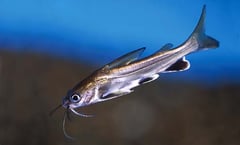
Ariopsis seemanniColombian Shark Catfish
Ariidae · Günther, 1864
The Colombian shark catfish, Ariopsis seemanni, is an ariid catfish from river mouths along the Pacific coast of the Americas, from Mexico to Peru. Usually sold as a silvery 2 to 3 inch juvenile, it grows to 350 mm SL and lives mostly in brackish water, so it is not recommended to those lacking the facilities to house it for life. Venom glands at the base of the first dorsal spine can cause a painful swelling.

Astyanax bimaculatusTwo Spot Astyanax
Characidae · Linnaeus, 1758
The two spot astyanax, Astyanax bimaculatus, is a characid ranging from Panama through most of the Amazon and Orinoco basins. It lives in a wide variety of biotopes, from swiftly-flowing rivers and streams to ponds, ditches and reservoirs. The name is currently applied to what is considered a species complex of at least four taxa, and aquarium fish most often arrive as contaminants among shipments of other species.

Cryptoheros myrnae
Cichlidae · Loiselle, 1997
Cryptoheros myrnae is a Central American cichlid from the Atlantic slope of Costa Rica and Panama. It was collected from a river with clear, shallow, swiftly flowing water over sand. Moderately aggressive, especially when breeding, it spawns in caves and breeds quite easily. Males are larger and more brightly coloured, and a spawning female turns black on her lower half with a large copper-coloured spot.

Cryptoheros nanoluteus
Cichlidae · Allgayer, 1994
Cryptoheros nanoluteus is a small Central American cichlid endemic to the Guarumo river basin in northwestern Panama. Sometimes called the 'yellow convict', it lives in well-oxygenated, moderate to fast-flowing lowland streams. It is not as aggressive as some others in the genus, though territorial when breeding. A substrate-spawner forming temporary pair bonds, both sexes turn bright yellow during courtship.

Darienheros calobrensisRedspot Cichild
Cichlidae · (Meek & Hildebrand, 1913)
The redspot cichlid, Darienheros calobrensis, is a large cichlid native to coastal rivers draining Panama's Pacific slope. It lives mostly in lakes, ponds and slow parts of rivers, swimming among the crevices of submerged rocky walls and banks. It has been placed in Cichlasoma and Amphilophus, and is occasionally listed under Astatheros. A belligerent, territorial species, it can share a tank with other large cichlids only in a very large aquarium.

'Geophagus' crassilabrisPanamanian Eartheater
Cichlidae · Steindachner, 1876
The Panamanian eartheater, Geophagus crassilabris, is a cichlid endemic to the Pacific and Atlantic slopes of central and eastern Panama. Rarely traded, it belongs to the 'G.' steindachneri group with 'G.' steindachneri and 'G.' pellegrini, and adults have a more reddish colour pattern than either, especially in the fins. Adult males are aggressive towards one another, and a single male is best kept with two or more females.
Xiphophorus helleriiGreen Swordtail
Poeciliidae · Heckel, 1848
The green swordtail, Xiphophorus hellerii, is a livebearer native to southeastern Mexico, Guatemala, Belize and Honduras. Among the world's most recognisable aquarium fishes, it is ubiquitous in the trade, where selective breeding and hybridisation with X. maculatus and X. variatus have produced a bewildering array of ornamental forms. The name is often misspelled X. helleri.
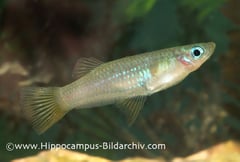
Alfaro cultratusKnife Livebearer
Poeciliidae · Regan, 1908
The knife livebearer, Alfaro cultratus, is a poeciliid from rivers, streams, ditches and backwaters in Costa Rica, Nicaragua and Panama. The common name comes from a keel of modified, paired scales running from the base of the anal fin to the caudal fin. Exceptionally hardy and adaptable, it can be aggressive, especially towards conspecifics, and breeds readily in the aquarium.

Amatitlania nigrofasciataConvict Cichlid
Cichlidae · Günther, 1867
The convict cichlid, Amatitlania nigrofasciata, is a Central American cichlid native from Guatemala to Panama. One of the most ubiquitous fish in the hobby, it is hardy and very easily bred, but aggressive and territorial, becomes violent when breeding and is best kept in a species tank. Pink, long-finned and marbled forms exist, and it has been introduced to several countries including the USA and Australia.

Ctenopharyngodon idellaGrass Carp
Cyprinidae · Valenciennes, 1844
The grass carp, Ctenopharyngodon idella, is a large cyprinid native to the Amur River system in eastern Russia and northeastern China. Adults typically reach 800 to 1200 mm, making it a wholly unsuitable aquarium subject, though an albino form is traded. Widely introduced for aquaculture and weed control, it has caused serious damage to natural waters, and unwanted fish should never be released.