Country · North & Central America
Honduras
Only species with a profile on Seriously Fish are counted, whether native or introduced.
- Species
- 6
- Families
- 4
- Genera
- 6
- Found only here
- 0
- Photographed
- 5 of 6
Shares its fishes withspecies recorded in both

Cichlasoma urophthalmusMayan Cichlid
Cichlidae · authority not recorded
The Mayan cichlid, Cichlasoma urophthalmus, is a large cichlid native to eastern parts of Mexico, Belize, Guatemala, Honduras and Nicaragua. Also known as the Mexican mojarra, it lives in swamps, marshes and coastal lagoons, can tolerate and even breed in full marine conditions, and is often seen spawning around mangroves. Territorial and fairly aggressive, it is regarded as a potential pest fish in the USA, where introduced populations exist.

Rocio octofasciataJack Dempsey Cichlid
Cichlidae · (Regan, 1903)
The Jack Dempsey cichlid, Rocio octofasciata, is native to the Atlantic slope of Central America in Mexico, Belize, Guatemala and Honduras. Its name apparently comes from the American heavyweight boxer, for its 'strong facial features' and pugnacious nature. Tankmates must be too large to be viewed as prey. A bright blue strain, the 'electric blue Jack Dempsey', tends to stay smaller and may be less aggressive.
Xiphophorus helleriiGreen Swordtail
Poeciliidae · Heckel, 1848
The green swordtail, Xiphophorus hellerii, is a livebearer native to southeastern Mexico, Guatemala, Belize and Honduras. Among the world's most recognisable aquarium fishes, it is ubiquitous in the trade, where selective breeding and hybridisation with X. maculatus and X. variatus have produced a bewildering array of ornamental forms. The name is often misspelled X. helleri.

Amatitlania nigrofasciataConvict Cichlid
Cichlidae · (Günther, 1867)
The convict cichlid, Amatitlania nigrofasciata, is a Central American cichlid native from Guatemala to Panama. One of the most ubiquitous fish in the hobby, it is hardy and very easily bred, but aggressive and territorial, becomes violent when breeding and is best kept in a species tank. Pink, long-finned and marbled forms exist, and it has been introduced to several countries including the USA and Australia.
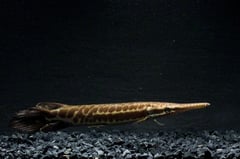
Atractosteus tropicusTropical Gar
Lepisosteidae · Gill, 1863
The tropical gar, Atractosteus tropicus, is a gar from Caribbean and Pacific-slope drainages of Central America, from southern Mexico to Costa Rica. It grows to 1250 mm SL and can live for several decades, so it should not be considered a home aquarium subject, though juveniles are occasionally offered in the trade. Like other gars it can breathe atmospheric air to a certain extent through a modified, vascularised swim bladder.

Ctenopharyngodon idellaGrass Carp
Cyprinidae · (Valenciennes, 1844)
The grass carp, Ctenopharyngodon idella, is a large cyprinid native to the Amur River system in eastern Russia and northeastern China. Adults typically reach 800 to 1200 mm, making it a wholly unsuitable aquarium subject, though an albino form is traded. Widely introduced for aquaculture and weed control, it has caused serious damage to natural waters, and unwanted fish should never be released.