Hobbyist group · Siluriformes
Antennae Catfishes & relatives
Antennae Catfishes & relatives spans 3 families.
- Species
- 20
- Families
- 3
- Genera
- 9
- Photographed
- 19 of 20
- Difficulty rated
- 20 of 20
Families
Where they come fromnative records only
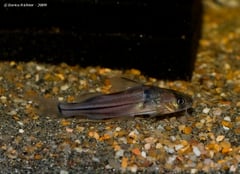
Brachyrhamdia meesi
Heptapteridae · Sands & Black, 1985
Brachyrhamdia meesi is a small heptapterid catfish described from near Belém, at the mouth of the Amazon in Brazil. Its precise distribution is unclear, with one record from the Río Madre de Dios basin in Peru. Rare in the hobby, it is normally imported as bycatch among other fishes, particularly Otocinclus, and juveniles may mimic Otocinclus or smaller Corydoras. A dark vertical bar through the eye separates it from the similar B. marthae.
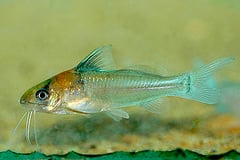
Brachyrhamdia rambarraniFalse Adolfoi
Heptapteridae · Axelrod & Burgess, 1987
The false adolfoi, Brachyrhamdia rambarrani, is a heptapterid catfish from the Rio Unini, a blackwater tributary of the lower rio Negro in Brazil. It occurs with, and mimics, Hoplisoma davidsandsi, sharing its basic colour pattern, while the common name comes from its resemblance to H. adolfoi. Rarely seen in the trade, it tends to turn up as a contaminant among shipments of other species.
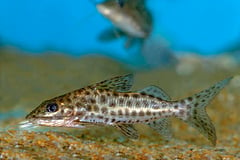
Pimelodus maculatusSpotted Pim
Pimelodidae · authority not recorded
The spotted pim, Pimelodus maculatus, is a pimelodid catfish from the Rio Paraná and Rio São Francisco basins in Brazil and Argentina. Active and shoaling, it grows to 18 cm and is a predator that will eat smaller fish, so it suits only roomy tanks with tough, active tankmates. Like other pims it is scaleless and sensitive to many medications, and the mucus on its rigid fin spines can cause a painful sting.
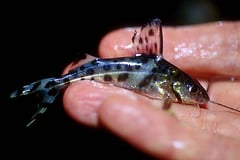
Pimelodus pictusPictus Cat
Pimelodidae · authority not recorded
The pictus cat, Pimelodus pictus, is a small pimelodid catfish from the Rio Orinoco and Amazon basins in Colombia, Venezuela, Peru and Brazil. The most popular member of the genus in the hobby, it is often sold as a bottom dweller for communities of small fish, though it is a predator that will eat neons, guppies and similarly-sized species. Colombian fish are peppered with tiny dark spots, while the Peruvian form has much larger spots on the body.
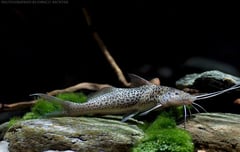
Aguarunichthys torosusBolt Catfish
Pimelodidae · Stewart, 1986
The bolt catfish, Aguarunichthys torosus, is a pimelodid catfish known only from the Río Marañón in the upper Amazon basin of Peru. It probably also occurs in some tributaries draining into Peru from Ecuador. Also traded as 'Jello Band' or 'Yellow Band' catfish, it eats fishes small enough to fit in its mouth and is aggressively territorial towards conspecifics, so is best kept singly among larger, ideally fluvial, species.
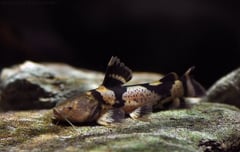
Pseudopimelodus bufoniusGiant Bumblebee Catfish
Pseudopimelodidae · Valenciennes, 1840
The giant bumblebee catfish, Pseudopimelodus bufonius, is distributed throughout northeastern South America, from Venezuela to eastern Brazil. Its range extends from the Lake Maracaibo basin, and it grows to 245 mm SL. The type locality is uncertain but probably Cayenne, French Guiana.
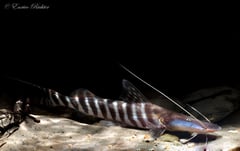
Brachyplatystoma tigrinumZebra Shovelnose
Pimelodidae · Britski, 1981
The zebra shovelnose, Brachyplatystoma tigrinum, is a pimelodid catfish from the upper Amazon basin in Brazil, Colombia and Peru. Adults appear to be obligate inhabitants of main river channels with strong flow, often around cataracts and rapids, and most aquarium fish are juveniles collected around Iquitos in Peru. It is sometimes confused with B. juruense, especially when young, but has a more well-defined colour pattern, a slenderer body and longer barbels.
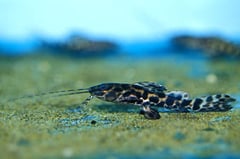
Leiarius longibarbisMarbled Pim
Pimelodidae · authority not recorded
The marbled pim, Leiarius longibarbis, is a large pimelodid catfish from the Rio Orinoco, Rio Essequibo and Amazon basins. It grows to around 80 cm and can live for well over 20 years, and whether it should be considered an aquarium subject at all is debatable. Much of the literature still lists it as L. marmoratus, a name treated as a junior synonym since a reclassification in 2003.
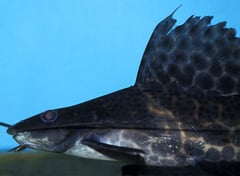
Leiarius pictusSailfin Pim
Pimelodidae · authority not recorded
The sailfin pim, Leiarius pictus, is a large pimelodid catfish from the Rio Orinoco basin in Colombia and Venezuela and the Amazon in Peru and Brazil. Also known as the painted, saddle or marbled sailfin catfish, it reaches around 60 cm and can live for well over 20 years. Juveniles are often sold without adequate information on their long-term care, and a fully-grown fish needs a tank in the region of 240 by 90 by 120 cm.
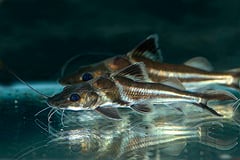
Pimelodus ornatusOrnate Pim
Pimelodidae · authority not recorded
The ornate pim, Pimelodus ornatus, is a pimelodid catfish recorded in major river systems from Colombia and Venezuela south to Paraguay and Argentina. One of the more sought-after pims imported with any regularity, it grows to 28 cm and is a predator that will eat smaller fish. It is scaleless, sensitive to many medications and often in poor shape when first imported, and its rigid fin spines can cause a painful sting.
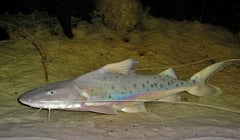
Brachyplatystoma capapretum
Pimelodidae · Lundberg & Akama, 2005
Brachyplatystoma capapretum is a large, piscivorous pimelodid catfish found throughout much of the Amazon basin, from near Belém to Iquitos in Peru. The largest recorded specimen measured 880 mm, and it is suitable only for public aquaria and a very small minority of private aquarists. It is very similar to B. filamentosum but smaller, with shorter maxillary barbels, a moderately forked caudal-fin with lobes of equal size, and adults very dark above.

Brachyplatystoma filamentosumPiraíba
Pimelodidae · Lichtenstein, 1819
The piraíba, Brachyplatystoma filamentosum, is the largest catfish of the Amazon basin, also found in the Orinoco and river systems of the Guianas. Adults typically measure 2 to 2.5 m and weigh over 150 kg. In the Amazon only fish over around 160 cm are called 'Piraíba', and smaller ones 'filhote'. It is suitable only for public aquaria and a very small minority of private aquarists.
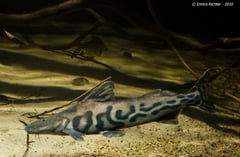
Brachyplatystoma juruenseGold Zebra Catfish
Pimelodidae · Boulenger, 1898
The gold zebra catfish, Brachyplatystoma juruense, is a large pimelodid from the middle Amazon and Orinoco basins, described from the rio Juruá. Adults have broad dark vertical, oblique or branching bands on a pale yellowish body and grow to at least 600 mm. It is sometimes confused with B. tigrinum, especially when young, but has a much less defined pattern, a deeper body and shorter barbels. It suits only public aquaria and a very small minority of private aquarists.
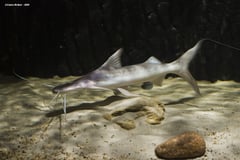
Brachyplatystoma platynemumSlobbering Catfish
Pimelodidae · Boulenger, 1898
The slobbering catfish, Brachyplatystoma platynemum, is a large migratory pimelodid catfish from the Amazon and Orinoco basins. The name refers to its relatively thick barbels, which give the impression that the fish is drooling. It travels considerable distances along deeper, flowing channels, and sexually mature adults have been observed in the upper rio Madeira basin, some 3000 km from the estuary. It grows to 1000 mm SL.

Brachyplatystoma rousseauxiiDourada
Pimelodidae · Castelnau, 1855
The dourada, Brachyplatystoma rousseauxii, is a large migratory pimelodid catfish from the Amazon and Orinoco drainages and rivers of the Guianas. Juveniles feed in the Amazon delta, while sexually mature adults are found only in the western Amazon. Some populations cover as much as 5500 km during migration from the delta, the longest known in any freshwater fish, and it is heavily fished during its upstream movement. It grows to 1900 mm SL.
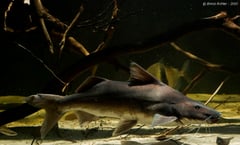
Brachyplatystoma vaillantiiPiramutaba
Pimelodidae · Valenciennes, 1840
The piramutaba, Brachyplatystoma vaillantii, is a large migratory pimelodid catfish from the Amazon and Orinoco watersheds and rivers of the Guianas. Juveniles feed in the Amazon delta before migrating upstream in massive numbers, when they are subject to intensive capture by commercial and artisanal fisheries. Sexually mature adults have been observed in the rio Caquetá basin, some 3500 km from the estuary. It grows to 1050 mm SL.
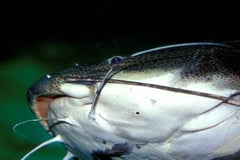
Phractocephalus hemioliopterusRed-tail Catfish
Pimelodidae · authority not recorded
The red-tail catfish, Phractocephalus hemioliopterus, is a giant pimelodid catfish from much of the Amazon and Rio Orinoco basins in South America. The largest specimen recorded by science measured 134 cm and weighed more than 40 kg, and keeping one at home is not recommended without the facilities to house it for life. Juveniles are sold cheaply, and fish dumped when they outgrow their tanks have established populations in the USA and several other countries.
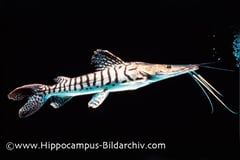
Pseudoplatystoma fasciatumBarred Shovelnose
Pimelodidae · authority not recorded
The barred shovelnose, Pseudoplatystoma fasciatum, is a large pimelodid catfish with a very wide range in South America, from Colombia to Argentina. Recorded at 104 cm and 70 kg, it reaches close to that size quickly in captivity and can live for well over 20 years, so it is debatable whether it should be considered an aquarium subject at all. It is easily confused with P. tigrinum, and both are usually sold as 'tiger shovelnose'.
Pseudoplatystoma tigrinumTiger Shovelnose
Pimelodidae · authority not recorded
The tiger shovelnose, Pseudoplatystoma tigrinum, is a large pimelodid catfish native to the Amazon and Rio Orinoco basins. It grows to around 105 cm and reaches close to that size quickly in captivity, so it is debatable whether it should be considered an aquarium subject at all. It is easily confused with P. fasciatum, which is usually sold under the same name, though P. tigrinum is generally the more uniformly striped. Hybrids with the red-tailed catfish also reach the market.
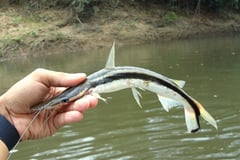
Sorubim limaDuckbill Catfish
Pimelodidae · authority not recorded
The duckbill catfish, Sorubim lima, is a pimelodid catfish recorded from rivers across South America, including the Amazon, Orinoco and Paraná. It is also known as the 'hockey stick catfish' and 'lima shovelnose', and S. elongatus is sometimes sold as it. Sorubim spp. often swim head-down among plants and roots as camouflage. It is quite peaceful but eats anything that fits in its mouth.