River
Ataran
Only species with a profile on Seriously Fish are counted.
- Species
- 13
- Families
- 6
- Photographed
- 13 of 13
- Difficulty rated
- 12 of 13
Shares fishes withspecies recorded from both
Runs through

Akysis vespaOrange-Banded Stream Catfish
Akysidae · Ng & Kottelat, 2004
The orange-banded stream catfish, Akysis vespa, appears endemic to headwaters of the Salween basin on the border between Myanmar and Thailand. One of the few members of the family exported for the hobby, it is also sold as 'wasp catfish' or 'orange micro bumblebee catfish'. Its yellow markings normally form wide bands, a pattern rarely seen in congeners, and the yellow on the snout extends to the base of the nasal barbels.
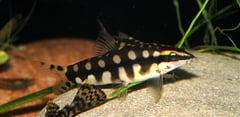
Ambastaia sidthimunkiDwarf Chain Loach
Botiidae · Klausewitz, 1959
The dwarf chain loach, Ambastaia sidthimunki, is a small botiid loach from the Mae Klong basin in western Thailand and the Ataran drainage in Myanmar. Older records from the Yom River, Laos and Cambodia refer to A. nigrolineata. Gregarious, it should be kept in a group of at least five or six and preferably ten or more, and reports conflict on whether it stays peaceful with sedentary or long-finned fishes.

Batasio feruminatus
Bagridae · Ng & Kottelat, 2008
Batasio feruminatus is a small bagrid catfish from the Ataran River system in southern Myanmar, to which it is possibly endemic. Some Ataran tributaries extend across the border into Thailand. Like its congeners it is an obligate inhabitant of shallow, fast-flowing, highly-oxygenated headwater streams. B. feruminatus alone in the genus has both an oblique dark bar in front of the dorsal fin and a thin black midlateral stripe.
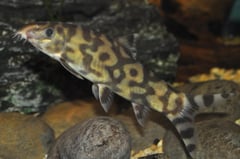
Botia histrionica
Botiidae · Blyth, 1860
Known in the trade as the 'Burmese loach', Botia histrionica is a botiid loach from Myanmar, Manipur in India and Yunnan, China. Young fish all carry five solid dark bars on each flank and are often confused with B. kubotai, but in B. histrionica the bars stay solid for longer and the central bar usually forms a 'y' shape. Adult patterning varies considerably between the Ayeyarwady, Salween, Manipur and Ataran forms, and there has been speculation that some represent distinct species.
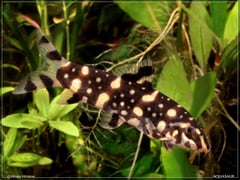
Botia kubotaiPolka-Dot Loach
Botiidae · Kottelat, 2004
The polka-dot loach, Botia kubotai, is a botiid loach that appears to be endemic to headwaters of the Salween basin in Myanmar and Thailand. It was traded before it was described and is still sold as 'angelicus', 'Burmese border loach' and 'marbled loach', among other names. Juveniles are often confused with B. histrionica, but the dark bars in B. kubotai split at a young age.

Garra sp. 'redtail'Burmese Red-tailed Garra
Cyprinidae · authority not recorded
The Burmese red-tailed garra, Garra sp. 'redtail', is a cyprinid from headwaters of the Salween basin around the border between Myanmar and Thailand. A putatively undescribed species, it is often sold as G. sp. 'burmanicus' and first appeared in the trade in 2005. A flexible, proboscis-like rostral process between the eyes becomes erect during territorial conflicts or courtship. It inhabits shady, fast-flowing stretches and riffles.

Opsarius infrafasciatus
Cyprinidae · Fowler, 1934
Opsarius infrafasciatus is a cyprinid from the Ping river in Thailand, the Ataran and Salween in Myanmar and China, and Mekong tributaries in China. Once considered synonymous with both O. ornatus and O. pulchellus, it has been treated as distinct since Tejavej (2012). It typically inhabits headwaters and minor rivers and streams with moderate to fast flow, and a small caudal spot is among the characters separating it from congeners.
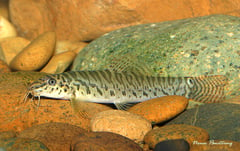
Paracanthocobitis pictilisCherry-fin Loach
Nemacheilidae · Kottelat, 2012
The cherry-fin loach, Paracanthocobitis pictilis, is a nemacheilid loach from the Ataran River, a Salween tributary on the Thailand-Myanmar border. Before its description it was traded as P. rubidipinnis, a species apparently endemic to the lower Irrawaddy. Bolder and less peaceful than other members of the genus, it inhabits shady, fast-flowing riffles, and some males become aggressive unless kept in a mixed-sex group of at least six.
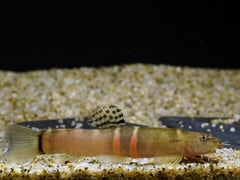
Schistura cf. balteataSumo Loach II
Nemacheilidae · authority not recorded
The sumo loach II, Schistura cf. balteata, is an apparently undescribed nemacheilid loach from the Ataran River drainage in Myanmar and Thailand. Both it and the real S. balteata have been traded as 'sumo loach', but this fish has brighter colouration, a smaller adult size and seems more peaceful. The colour pattern is highly variable, with the rear half of the body bright pink in some specimens and yellow in others.
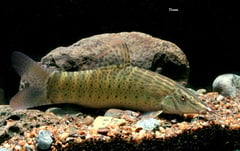
Syncrossus beaufortiChameleon Loach
Botiidae · Smith, 1931
The chameleon loach, Syncrossus beauforti, is a botiid loach from Thailand and southern Myanmar, including the Chao Phraya and the Ataran River. It has been widely mislabelled as S. berdmorei in older aquarium literature, but has 9-10 branched dorsal-fin rays and rows of small dark markings across the body and head even when young. Adults reach 160-180 mm, and wild populations appear to have declined by at least 20-29% since 1997.
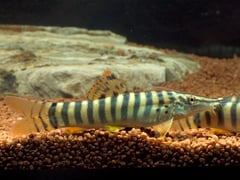
Syncrossus berdmoreiRedfin Tiger Loach
Botiidae · Blyth, 1860
The redfin tiger loach, Syncrossus berdmorei, is a botiid loach from the Irrawaddy, Sittaung and Salween systems in Myanmar and Manipur, India. It looks very similar to S. beauforti but has 11-14 branched dorsal-fin rays, and in young fish its larger dark markings appear first behind the opercle. Colour and pattern vary with locality and age, and some of these forms may turn out to be separate species.

Garra notata
Cyprinidae · Blyth, 1860
Garra notata is a cyprinid known with certainty from the Salween basin in Myanmar, China and Thailand, and the Tenasserim drainage. Records from the Western Ghats of southern India are unlikely to be accurate, and a report from the upper Irrawaddy needs confirmation. It lacks both a transverse groove and a proboscis on the snout, and has dark spots at the base of the dorsal-fin rays.

Caelatoglanis zonatus
Erethistidae · Ng & Kottelat, 2005
Caelatoglanis zonatus is an erethistid catfish known only from the Ataran River system in Kayin state, Myanmar, part of the Salween drainage. Images of the Ataran show flowing, forest-shaded headwaters with clear water, a mixed sand and rock substrate and plenty of submerged driftwood and leaf litter. The name zonatus refers to its barred colour pattern.