River
Sittaung
Only species with a profile on Seriously Fish are counted.
- Species
- 20
- Families
- 9
- Photographed
- 20 of 20
- Difficulty rated
- 20 of 20
Shares fishes withspecies recorded from both

Akysis longifilisSittaung Stream Catfish
Akysidae · Ng, 2006
The Sittaung stream catfish, Akysis longifilis, is a small akysid catfish known from the Sittaung River system in southern Myanmar. One of the few members of the family exported for the hobby, it has noticeably long nasal and maxillary barbels and two saddle-shaped light markings between the dorsal and caudal fins. The sympatric A. portellus is very similar, and differs mainly in its shorter adipose fin base and smaller mouth.

Akysis portellusSmallmouth Stream Catfish
Akysidae · Ng, 2009
The smallmouth stream catfish, Akysis portellus, is a small akysid catfish from the Sittaung River system in southern Myanmar. One of the few members of the family exported for the hobby, it grows to around 43 mm SL. It closely resembles the sympatric A. longifilis, and differs in its shorter adipose fin base, smaller mouth and more rounded head when viewed from above.

Badis ruberBurmese Badis
Badidae · Schreitmüller, 1923
The Burmese badis, Badis ruber, is a badid common throughout much of lowland Myanmar, from the Ayeyarwady and Sittaung south to the Tenasserim. Among the better known Badis in the hobby, it is also traded as 'red badis' and appears in older literature as Badis badis burmicanus. It differs from B. khwae and B. siamensis in its rows of vertically arranged dark flank markings and relatively large caudal peduncle blotch. It tends to inhabit lentic biotopes such as roadside ditches and small, well-vegetated creeks.
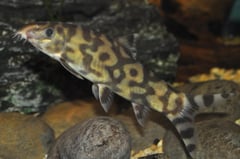
Botia histrionica
Botiidae · Blyth, 1860
Known in the trade as the 'Burmese loach', Botia histrionica is a botiid loach from Myanmar, Manipur in India and Yunnan, China. Young fish all carry five solid dark bars on each flank and are often confused with B. kubotai, but in B. histrionica the bars stay solid for longer and the central bar usually forms a 'y' shape. Adult patterning varies considerably between the Ayeyarwady, Salween, Manipur and Ataran forms, and there has been speculation that some represent distinct species.

Chagunius baileyi
Cyprinidae · Rainboth, 1986
Chagunius baileyi is a large cyprinid endemic to the Salween and Sittaung river basins in Myanmar and western Thailand. Rarely kept, it turns up occasionally as bycatch among shipments of wild fish from Thailand and Myanmar. It looks almost identical to C. chagunio and C. nicholsi, and the three are most easily separated by collection details since their ranges do not overlap. At up to 200 mm it needs a very large tank with plenty of open swimming space.

Danio nigrofasciatusDwarf Spotted Danio
Cyprinidae · (Day, 1870)
The dwarf spotted danio, Danio nigrofasciatus, is a small cyprinid endemic to central Myanmar, on both sides of the Bago Yoma range. It inhabits streams, minor rivers, ponds, ditches and rice paddies, many of them seasonal. A spotted anal-fin separates it most easily from similar species such as D. rerio and D. kyathit. Very peaceful but rather timid, it does best alone or with similarly sized species that enjoy similar conditions.

Danionella translucida
Cyprinidae · Roberts, 1986
Danionella translucida is a miniature, almost transparent cyprinid from a handful of streams draining the Bago Yoma range in Myanmar. Adults measure only 9 to 11 mm SL, and it has been referred to as 'micro glassfish' in the ornamental trade. It inhabits wide, low-altitude streams with turbid water, and it is best kept alone in a school of a dozen or more.
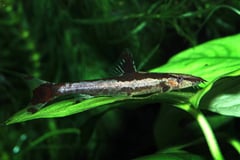
Homaloptera bilineata
Balitoridae · Blyth, 1860
Homaloptera bilineata is a 'lizard' loach from the Sittaung and Salween basins of Myanmar and tributaries of the Mae Klong in western Thailand. Uniquely in the genus, the dark markings running back from the snout form two distinct stripes meeting at the dorsal fin and do not form saddles. An obligate dweller of swift, oxygen-saturated streams, it needs clean, well-oxygenated water and is best kept in a group of six or more.
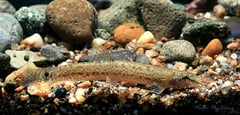
Lepidocephalichthys berdmorei
Cobitidae · Blyth, 1860
Lepidocephalichthys berdmorei is a cobitid loach found across Myanmar, Thailand, Laos, north-eastern India and Bangladesh. One of the most frequently-traded members of the genus, it is an excellent choice for those new to keeping loaches. Unlike most congeners it shows a preference for headwaters and streams with clear, flowing water, and its larger adult size separates it from the similar L. thermalis.
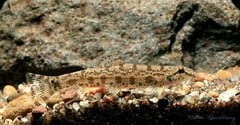
Lepidocephalichthys micropogon
Cobitidae · Blyth, 1860
Lepidocephalichthys micropogon is a cobitid loach from Myanmar, western Thailand, Bangladesh and Assam, India. Known from the Salween, Sittaung, Irrawaddy and Brahmaputra drainages and occasionally exported as bycatch, it grows to 55 mm SL and has a strongly forked caudal fin with broad, dark V-shaped bars. Kottelat (2012) treats L. manipurensis as a synonym, though Havird and Page (2010) list the two separately.

Microdevario gatesi
Cyprinidae · Herre, 1939
Microdevario gatesi is a miniature cyprinid from the lower Irrawaddy basin in Myanmar, growing to around 23 mm SL. Uncommon in the aquarium hobby, it is sometimes traded as 'Burmese golden rasbora' and can be told from its congeners by its hyaline dorsal and anal fins. It is likely to inhabit sluggish and standing waters such as rice paddies, swamps and weedy ditches, and is possibly endemic to the Irrawaddy Delta.

Microdevario nanus
Cyprinidae · Kottelat & Witte, 1999
Microdevario nanus is a miniature cyprinid from the lower Sittaung and Bago drainages of the Irrawaddy system in Myanmar. Sometimes referred to as 'green dwarf rasbora' or 'nana rasbora' in the ornamental trade, it grows to around 16 mm SL. A black blotch at the tip of the dorsal fin and a greyish marking at the tip of the anal fin immediately distinguish it from congeners.
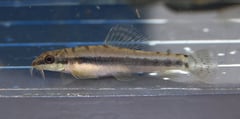
Paracanthocobitis zonalternans
Nemacheilidae · Blyth, 1860
Paracanthocobitis zonalternans is a nemacheilid loach ranging from Manipur in India through Myanmar into western and peninsular Thailand. Several species are thought to be confused under the name, and Singer and Page (2015) consider it likely to be a species complex. Among the more peaceful members of the genus, it does best in a mixed-sex group of at least half a dozen, and it has been bred in aquaria, first by UK aquarist Mick Wright.

Puntius cholaSwamp Barb
Cyprinidae · (Hamilton, 1822)
The swamp barb, Puntius chola, is a cyprinid from much of Pakistan, India, Nepal, Bhutan, Bangladesh, Sri Lanka, Myanmar and western Thailand. Sometimes called the 'chola' or 'green' barb, it has a single pair of barbels and dark blotches behind the operculum and near the caudal-fin base. It apparently prefers stiller waters over mud or silt, and makes an ideal addition to a peaceful community of riverine fishes.
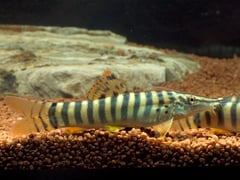
Syncrossus berdmoreiRedfin Tiger Loach
Botiidae · Blyth, 1860
The redfin tiger loach, Syncrossus berdmorei, is a botiid loach from the Irrawaddy, Sittaung and Salween systems in Myanmar and Manipur, India. It looks very similar to S. beauforti but has 11-14 branched dorsal-fin rays, and in young fish its larger dark markings appear first behind the opercle. Colour and pattern vary with locality and age, and some of these forms may turn out to be separate species.

Badis juergenschmidti
Badidae · Schindler & Linke, 2010
Badis juergenschmidti is a badid known only from the Ka Dat Chaung river system in Mon State, south-eastern Myanmar, part of the Sittaung drainage. Discovered by German aquarist Horst Linke in early 2010, it was known as B. sp. East Myanmar before its description. It has no opercular or cleithral blotch, and adult males have a broad, solid bar at the caudal-fin base and white margins to the caudal fin. The type locality is a shallow, slow-flowing river over boulders, stones and sand.

Esomus caudiocellatus
Cyprinidae · Ahl, 1924
Esomus caudiocellatus is a cyprinid from Myanmar, collected from the Salween river system in the east of the country and in northwestern Thailand. It lacks the dark lateral stripe of its congeners and has a prominent dark marking on the caudal peduncle. Like other Esomus it has greatly enlarged pectoral fins and very long maxillary barbels. Some hobbyists have recorded a wasting disease in Esomus spp. that usually kills within a couple of weeks.

Notopterus notopterusBronze Featherback
Notopteridae · Pallas, 1769
The bronze featherback, Notopterus notopterus, is an air-breathing notopterid from the Indian subcontinent and Southeast Asia. Also called 'Asian knifefish' or 'ghost knifefish' in the trade, it grows to 600 mm and arguably has no place in the ornamental hobby given its adult size and specialised requirements. The single species in Notopterus is likely to represent a complex of closely-related species.

Hemibagrus microphthalmus
Bagridae · Day, 1877
Hemibagrus microphthalmus is a very large bagrid catfish from the Salween, Irrawaddy and Sittaung systems of Myanmar and western Thailand. It also occurs in the Manipur River drainage in northeastern India. Known to reach 1500 mm SL and to live for several decades, it cannot be considered a suitable home aquarium subject, and it is likely to prove aggressively territorial.

Hemibagrus peguensis
Bagridae · Boulenger, 1894
Hemibagrus peguensis is a bagrid catfish from the Irrawaddy, Bago and Sittaung drainages of Myanmar and the Chindwin basin in northeastern India. Sometimes referred to as 'Sittang mystus', it has been widely confused with H. menoda in the past and seems virtually unknown in the aquarium hobby. It grows to 286 mm SL and can be told from H. menoda by its almost truncate snout.