River
Salween
Only species with a profile on Seriously Fish are counted.
- Species
- 57
- Families
- 15
- Photographed
- 57 of 57
- Difficulty rated
- 56 of 57
Basin
Shares fishes withspecies recorded from both
Runs through
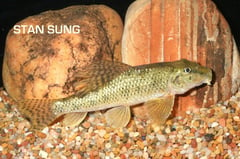
Abbottina rivularisChinese False Gudgeon
Cyprinidae · Basilewsky, 1855
The Chinese false gudgeon, Abbottina rivularis, is a small bottom-dwelling cyprinid native to China, the Korean peninsula and southern Japan. It has been widely introduced elsewhere, including the Mekong and Salween basins, Taiwan, Turkmenistan and Kyrgyzstan, and is considered invasive. It has started to appear in the aquarium trade and should never be released into natural waters outside its native range.

Akysis vespaOrange-Banded Stream Catfish
Akysidae · Ng & Kottelat, 2004
The orange-banded stream catfish, Akysis vespa, appears endemic to headwaters of the Salween basin on the border between Myanmar and Thailand. One of the few members of the family exported for the hobby, it is also sold as 'wasp catfish' or 'orange micro bumblebee catfish'. Its yellow markings normally form wide bands, a pattern rarely seen in congeners, and the yellow on the snout extends to the base of the nasal barbels.

Barbodes binotatusSpotted Barb
Cyprinidae · Valenciennes, 1842
The spotted barb, Barbodes binotatus, is a cyprinid ranging from Myanmar and Thailand through the Greater Sunda Islands to the Philippines. So ubiquitous across its range that it's often called simply 'common barb', it occurs from sea level to at least 2000 m in habitats from fast-flowing hill streams to irrigation canals and floodplain ponds. The basic pattern of a dark spot at the dorsal-fin origin and another on the caudal peduncle varies with origin.

Batasio feruminatus
Bagridae · Ng & Kottelat, 2008
Batasio feruminatus is a small bagrid catfish from the Ataran River system in southern Myanmar, to which it is possibly endemic. Some Ataran tributaries extend across the border into Thailand. Like its congeners it is an obligate inhabitant of shallow, fast-flowing, highly-oxygenated headwater streams. B. feruminatus alone in the genus has both an oblique dark bar in front of the dorsal fin and a thin black midlateral stripe.
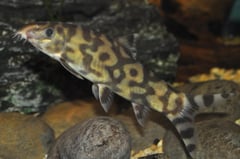
Botia histrionica
Botiidae · Blyth, 1860
Known in the trade as the 'Burmese loach', Botia histrionica is a botiid loach from Myanmar, Manipur in India and Yunnan, China. Young fish all carry five solid dark bars on each flank and are often confused with B. kubotai, but in B. histrionica the bars stay solid for longer and the central bar usually forms a 'y' shape. Adult patterning varies considerably between the Ayeyarwady, Salween, Manipur and Ataran forms, and there has been speculation that some represent distinct species.
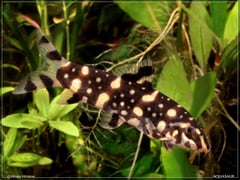
Botia kubotaiPolka-Dot Loach
Botiidae · Kottelat, 2004
The polka-dot loach, Botia kubotai, is a botiid loach that appears to be endemic to headwaters of the Salween basin in Myanmar and Thailand. It was traded before it was described and is still sold as 'angelicus', 'Burmese border loach' and 'marbled loach', among other names. Juveniles are often confused with B. histrionica, but the dark bars in B. kubotai split at a young age.

Chagunius baileyi
Cyprinidae · Rainboth, 1986
Chagunius baileyi is a large cyprinid endemic to the Salween and Sittaung river basins in Myanmar and western Thailand. Rarely kept, it turns up occasionally as bycatch among shipments of wild fish from Thailand and Myanmar. It looks almost identical to C. chagunio and C. nicholsi, and the three are most easily separated by collection details since their ranges do not overlap. At up to 200 mm it needs a very large tank with plenty of open swimming space.

Channa gachuaDwarf Snakehead
Channidae · Hamilton, 1822
The dwarf snakehead, Channa gachua, is a snakehead recorded across an enormous range from Iran to Taiwan and Bali. There is significant evidence that C. gachua as currently understood is a complex of similar-looking species in need of taxonomic review. A mouthbrooder bred regularly in captivity, it can share a well-chosen community with peaceful fishes too large to be prey, but populations should not be mixed as some may hybridise.

Danio albolineatusPearl Danio
Cyprinidae · (Blyth, 1860)
The pearl danio, Danio albolineatus, is a small cyprinid recorded from Myanmar and Indochina south to Peninsular Malaysia and Sumatra. Colour and patterning differ between localities, and doubts remain whether it is a single species or a group of closely related fish. Wild examples are rare in the trade, with most produced commercially in South East Asia or eastern Europe, and some of the fish traded are likely to be hybrids with D. roseus.

Danio margaritatusCelestial Pearl Danio
Cyprinidae · (Roberts, 2007)
The celestial pearl danio, Danio margaritatus, is a miniature cyprinid from the Salween drainage in Shan State, eastern Myanmar. First marketed as 'Galaxy Rasbora' after its discovery in 2006, it became one of the most hyped fishes the hobby has known, and Myanmar banned exports in 2007 after reports of overfishing. Intensive commercial breeding means specimens with spotted fins or deformities are now common in the ornamental trade.

Datnioides polotaSilver Tiger Perch
Datnioididae · Hamilton, 1822
The silver tiger perch, Datnioides polota, is a tiger perch widely distributed in southeastern Asia, from India and Bangladesh east to Indonesia. Mostly found in brackish habitats such as estuaries, mangroves and coastal lagoons, it has a highly variable colour pattern with up to 7 dark bars. The name D. quadrifasciatus is sometimes applied to it, but that name is a junior homonym and polota takes precedence.

Devario shanensis
Cyprinidae · (Hora, 1928)
Sometimes called the 'Hora danio' or 'Salween danio', Inlecypris shanensis is a small cyprinid from Shan state, Myanmar. Known from the Duthawadi and Salween river systems, it is most easily confused with 'I.' maetaengensis and Devario interruptus, and differs in having a P stripe that is not broken into a series of blotches. It has been collected from fast-flowing streams with clear water and substrates of rocks, pebbles and sand.

Devario sondhiiFireline Devario
Cyprinidae · (Hora & Mukerji, 1934)
The fireline devario, Devario sondhii, is a small devario from southern Shan State, Myanmar, described from a spring near Hopong. It first appeared in the trade in the mid-2000s and was initially confused with the sympatric Microrasbora cf. rubescens and with D. acuticephalus, but a dark cleithral spot behind the gill opening separates it from both. The habitat near Hopong is shallow, permanently-flooded grassland at around 1,040 metres AMSL with dense aquatic plants.

Esomus metallicusStriped Flying Barb
Cyprinidae · Ahl, 1923
The striped flying barb, Esomus metallicus, is a cyprinid found from the Salween basin in Myanmar east across Thailand to Laos and Cambodia. It is abundant over most of this range and moves into rice paddies and other flooded ground at the onset of the wet season, returning to permanent water when the flooding recedes. Its lateral stripe grows more intense towards the tail and ends at the caudal-fin base.

Folifer brevifilis
Cyprinidae · Peters, 1881
Folifer brevifilis is a large cyprinid from the Mekong, Salween and Ayeyarwady systems of southern China, Myanmar, Thailand, Laos and Vietnam. It has also been recorded from Hainan and Hong Kong. Growing to 300 mm SL, it is unsuitable for the majority of home aquaria and extremely rare in the ornamental trade. It inhabits flowing middle and lower sections of major rivers and may migrate seasonally to spawn.

Garra sp. 'redtail'Burmese Red-tailed Garra
Cyprinidae · authority not recorded
The Burmese red-tailed garra, Garra sp. 'redtail', is a cyprinid from headwaters of the Salween basin around the border between Myanmar and Thailand. A putatively undescribed species, it is often sold as G. sp. 'burmanicus' and first appeared in the trade in 2005. A flexible, proboscis-like rostral process between the eyes becomes erect during territorial conflicts or courtship. It inhabits shady, fast-flowing stretches and riffles.

Hampala salweenensis
Cyprinidae · Doi & Taki, 1994
Hampala salweenensis is a riverine cyprinid endemic to the Salween basin in northwestern Thailand and Myanmar. It has two roundish dark blotches on each flank, one beneath the dorsal-fin origin and one on the caudal peduncle, and a black marginal band on both caudal-fin lobes. It is poorly known in the aquarium hobby, and the full extent of its distribution within the watershed is unclear.
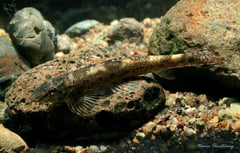
Homalopteroides modestus
Balitoridae · Vinciguerra, 1890
Homalopteroides modestus is a small hillstream loach from the Salween, Mae Klong and Tenasserim rivers of southern Myanmar and western Thailand. Randall and Page (2012) redescribed it from Mae Klong specimens that had previously been identified as the congener H. smithi. A specialised micropredator of swift, clear, oxygen-saturated streams, it needs clean, well-oxygenated water and regular meals of live or frozen food.

Labiobarbus leptocheilus
Cyprinidae · Valenciennes, 1842
Labiobarbus leptocheilus is a large cyprinid widespread in Southeast Asia, from the Mekong and Salween to the Greater Sunda Islands. Different populations vary somewhat in appearance, and it may turn out to represent a group of closely-related species. The Cambodian Mekong population has been considered a distinct species, Labiobarbus lineatus, and that name is widely used in the ornamental trade although it is currently a synonym. It grows to 260 mm SL and needs spotless, well-oxygenated water.
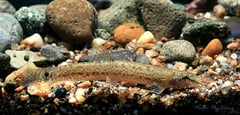
Lepidocephalichthys berdmorei
Cobitidae · Blyth, 1860
Lepidocephalichthys berdmorei is a cobitid loach found across Myanmar, Thailand, Laos, north-eastern India and Bangladesh. One of the most frequently-traded members of the genus, it is an excellent choice for those new to keeping loaches. Unlike most congeners it shows a preference for headwaters and streams with clear, flowing water, and its larger adult size separates it from the similar L. thermalis.
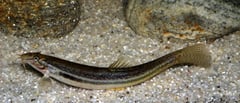
Lepidocephalichthys guntea
Cobitidae · Hamilton, 1822
Lepidocephalichthys guntea is a cobitid loach from the Ganges and Brahmaputra systems of northern India, Nepal and Bangladesh, and much of Myanmar. One of the most frequently-traded members of the group, it is an excellent choice for those new to keeping loaches. Males carry a solid, dark lateral stripe and females spotted flanks, and patterning varies with origin. It is also used as a food fish, eaten fresh and dried.
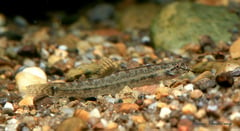
Lepidocephalichthys hasselti
Cobitidae · Valenciennes, 1846
Lepidocephalichthys hasselti is a cobitid loach described from Java and recorded from Myanmar to Vietnam, Peninsular Malaysia, Sumatra and Borneo. Its wide distribution makes it relatively common in the aquarium hobby. Colour and pattern vary with locality and have led to problems with identification, and the flanks usually show a row of dark blotches or a solid stripe with a light, unpigmented stripe above.
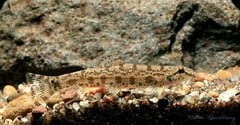
Lepidocephalichthys micropogon
Cobitidae · Blyth, 1860
Lepidocephalichthys micropogon is a cobitid loach from Myanmar, western Thailand, Bangladesh and Assam, India. Known from the Salween, Sittaung, Irrawaddy and Brahmaputra drainages and occasionally exported as bycatch, it grows to 55 mm SL and has a strongly forked caudal fin with broad, dark V-shaped bars. Kottelat (2012) treats L. manipurensis as a synonym, though Havird and Page (2010) list the two separately.

Microdevario kubotai
Cyprinidae · Kottelat & Witte, 1999
Microdevario kubotai is a miniature cyprinid from peninsular Thailand and the Salween drainage in southern Myanmar. Relatively common in the ornamental trade, it is sold under names including 'green neon rasbora' and 'yellow neon rasbora'. It apparently inhabits calm to moderately-flowing, well-oxygenated headwaters and minor tributaries. In nature it typically occurs in groups of 20-50, and at least 8-10 are recommended.

Microrasbora cf. rubescensFlame Red 'Rasbora'
Cyprinidae · authority not recorded
The flame red 'rasbora', Microrasbora cf. rubescens, is a small cyprinid from Shan State in eastern Myanmar. Possibly an undescribed species, it has been marketed as 'Asian Cardinal Rasbora', M. sp. 'rose blue line' or M. 'thuzari'. It differs from M. rubescens in its larger adult size, a greenish to bluish lateral stripe and less orange on the body, and appears to represent a distinct genetic lineage.

Mystacoleucus argenteus
Cyprinidae · Day, 1888
Mystacoleucus argenteus is a cyprinid from the Salween and middle Irrawaddy basins in Myanmar and western Thailand. It is occasionally marketed as 'Burmese rainbow barb' and differs from the similar M. obtusirostris in lacking black-edged scales on the body. Little has been published since Day's original description of 1888. Vigorous when feeding, it can upset slow-moving or timid tankmates.

Opsarius caudiocellatus
Cyprinidae · Chu, 1984
Opsarius caudiocellatus is a cyprinid known only from the Salween in southern China, Myanmar and western Thailand, and the upper Mekong in Yunnan. It is named for the black round spot at the caudal-fin base, which with its black dorsal-fin rays separates it from similar congeners. It may have appeared in the aquarium trade, though probably not under the correct name, and inhabits well-oxygenated, moderate to fast-flowing rivers and streams.

Opsarius infrafasciatus
Cyprinidae · Fowler, 1934
Opsarius infrafasciatus is a cyprinid from the Ping river in Thailand, the Ataran and Salween in Myanmar and China, and Mekong tributaries in China. Once considered synonymous with both O. ornatus and O. pulchellus, it has been treated as distinct since Tejavej (2012). It typically inhabits headwaters and minor rivers and streams with moderate to fast flow, and a small caudal spot is among the characters separating it from congeners.

Oryzias dancenaIndian Ricefish
Adrianichthyidae · Hamilton, 1822
The Indian ricefish, Oryzias dancena, is widely distributed through eastern and southern India, Sri Lanka, Bangladesh and Myanmar. Mostly coastal but adaptable, it has been collected from strongly brackish mangrove swamps to acidic freshwater forest streams. It continues to be misidentified as O. melastigma, a name most recent workers consider invalid, or as O. javanicus, a valid but distinct taxon.

Oryzias minutillusDwarf Medaka
Adrianichthyidae · Smith, 1945
The dwarf medaka, Oryzias minutillus, is a miniature ricefish from Thailand, with records from Myanmar, Cambodia and southern China. It lives only in fresh, normally standing waters such as shallow pools, ditches, rice paddies and clear water swamps. Adults reach just 17 mm SL. Traded occasionally, it is also known as the 'dwarf ricefish'.
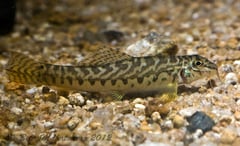
Paracanthocobitis botiaZipper Loach
Nemacheilidae · Hamilton, 1822
The zipper loach, Paracanthocobitis botia, is a nemacheilid loach from the Brahmaputra River in Assam, northeastern India. It was long thought to range from Pakistan to western Thailand, and several populations once included under the name are now treated as separate species. Relatively hardy and peaceful, it is one of the better choices for those new to nemacheilids, and its dark, eye-like ocellus at the top of the caudal peduncle is normally more intense in younger fish.
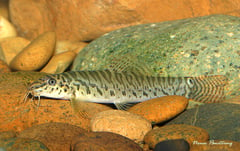
Paracanthocobitis pictilisCherry-fin Loach
Nemacheilidae · Kottelat, 2012
The cherry-fin loach, Paracanthocobitis pictilis, is a nemacheilid loach from the Ataran River, a Salween tributary on the Thailand-Myanmar border. Before its description it was traded as P. rubidipinnis, a species apparently endemic to the lower Irrawaddy. Bolder and less peaceful than other members of the genus, it inhabits shady, fast-flowing riffles, and some males become aggressive unless kept in a mixed-sex group of at least six.
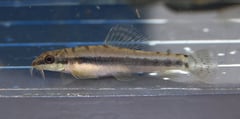
Paracanthocobitis zonalternans
Nemacheilidae · Blyth, 1860
Paracanthocobitis zonalternans is a nemacheilid loach ranging from Manipur in India through Myanmar into western and peninsular Thailand. Several species are thought to be confused under the name, and Singer and Page (2015) consider it likely to be a species complex. Among the more peaceful members of the genus, it does best in a mixed-sex group of at least half a dozen, and it has been bred in aquaria, first by UK aquarist Mick Wright.

Pethia stoliczkana
Cyprinidae · Day, 1871
Pethia stoliczkana is a small cyprinid that appears to range from Manipur state in northeastern India through Myanmar and Thailand to western Laos. Much of the literature confuses it with P. ticto, but the two do not occur in the same waters and the lateral line is complete in this species and incomplete in P. ticto. The form from Mandalay division in Myanmar is sometimes sold as Puntius sp. 'pearlscale'. It mostly inhabits shady, flowing streams and tributaries.
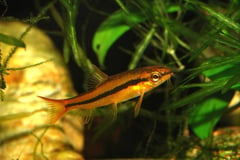
Physoschistura mangoRosy Loach
Nemacheilidae · Conway & Kottelat, 2023
The rosy loach, Physoschistura mango, is a miniature nemacheilid loach from waters around Hopong in Shan State, eastern Myanmar, where it is collected alongside Danio margaritatus. It was sold for years as an undescribed Yunnanilus or Petruichthys, as Y. sp. 'orange' or 'Burmese pink loach', and under the fictitious name 'Tuberoschistura arakensis', until Conway and Kottelat described it in 2023. Peaceful and highly gregarious, it reaches 25-30 mm and should be kept in a group of at least 8-10. Often only the colourful males are exported.

Puntius cholaSwamp Barb
Cyprinidae · (Hamilton, 1822)
The swamp barb, Puntius chola, is a cyprinid from much of Pakistan, India, Nepal, Bhutan, Bangladesh, Sri Lanka, Myanmar and western Thailand. Sometimes called the 'chola' or 'green' barb, it has a single pair of barbels and dark blotches behind the operculum and near the caudal-fin base. It apparently prefers stiller waters over mud or silt, and makes an ideal addition to a peaceful community of riverine fishes.
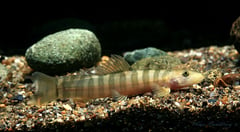
Schistura alticrista
Nemacheilidae · Kottelat, 1990
Schistura alticrista is a nemacheilid loach from the Nam Mae Yuan basin in Mae Hong Son Province, northwest Thailand, part of the Salween drainage. Very rare in the aquarium trade but available on occasion, it has conspicuous adipose crests on both the upper and lower midlines of the caudal peduncle and 8-9 dark brown bars about as wide as the paler interspaces. Its closest relatives appear to be S. disparizona and S. callidora.
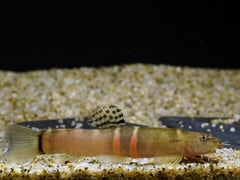
Schistura cf. balteataSumo Loach II
Nemacheilidae · authority not recorded
The sumo loach II, Schistura cf. balteata, is an apparently undescribed nemacheilid loach from the Ataran River drainage in Myanmar and Thailand. Both it and the real S. balteata have been traded as 'sumo loach', but this fish has brighter colouration, a smaller adult size and seems more peaceful. The colour pattern is highly variable, with the rear half of the body bright pink in some specimens and yellow in others.
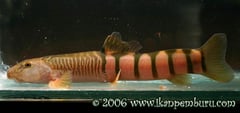
Schistura disparizona
Nemacheilidae · Zhou & Kottelat, 2005
Schistura disparizona is a nemacheilid loach known only from its type locality on the Nangun River, a Salween tributary in Yunnan Province, China. Its colour pattern of 8-11 closely-set, narrow dark bars at the front of the body and 5 wider bars behind separates it from congeners, and it has prominent adipose crests on the caudal peduncle. It inhabits shallow, narrow branches of streams over gravel or stone.
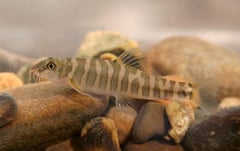
Schistura maepaiensis
Nemacheilidae · Kottelat, 1990
Schistura maepaiensis is a small nemacheilid loach from tributaries of the Salween basin in Mae Hong Son and Tak provinces, northwestern Thailand. It may also occur in the Salween system in Myanmar. Poorly known in the hobby, it can be told from congeners by its 10-13 irregular body bars with thin dark borders. The type locality was a shallow stream over rocks and boulders with moderate to swift flow.
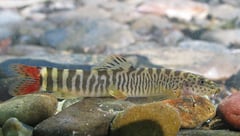
Schistura vinciguerrae
Nemacheilidae · Hora, 1935
Schistura vinciguerrae is a nemacheilid loach from the Irrawaddy, Salween and Chindwin river basins in Myanmar and northeastern India. Traded fairly regularly, it belongs to the Schistura multifasciata group, in which the anterior flank bars are divided and thinner than those behind. Males lack a suborbital flap, and this separates it from S. bella, S. mahnerti, S. reticulata and S. udomritthiruji. It inhabits clear, well-oxygenated forest streams over coarse sand, gravel, rocks and boulders.
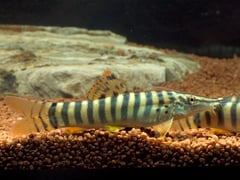
Syncrossus berdmoreiRedfin Tiger Loach
Botiidae · Blyth, 1860
The redfin tiger loach, Syncrossus berdmorei, is a botiid loach from the Irrawaddy, Sittaung and Salween systems in Myanmar and Manipur, India. It looks very similar to S. beauforti but has 11-14 branched dorsal-fin rays, and in young fish its larger dark markings appear first behind the opercle. Colour and pattern vary with locality and age, and some of these forms may turn out to be separate species.

Trichopsis vittataCroaking gourami
Osphronemidae · Cuvier, in Cuvier & Valenciennes, 1831
The croaking gourami, Trichopsis vittata, is a labyrinth fish found through much of Indochina, Peninsular Malaysia and Singapore. The largest of its genus, it produces audible sounds with a specialised pectoral mechanism unique within the Osphronemidae. Wild populations vary in colour pattern, and records from Borneo, Sumatra and Java might refer to a distinct species.

Xenentodon cancilaFreshwater Needlefish
Belonidae · Hamilton, 1822
The freshwater needlefish, Xenentodon cancila, is a belonid from Pakistan east through India, Bangladesh, Nepal, Sri Lanka, Myanmar and Thailand. Often called 'freshwater garfish', it only superficially resembles the true gars, and most of its relatives in the Belonidae are marine or estuarine. A near-exclusive inhabitant of the upper water column, it is surprisingly peaceful with anything too large to swallow and is best kept in numbers of four or more, in a tank of 180 ∗ 60 cm or more.

Bagarius yarrelliGoonch
Sisoridae · Sykes, 1839
The goonch, Bagarius yarrelli, is a very large sisorid catfish recorded from the Indus in Pakistan east through Indochina to Sumatra and Borneo. Also known as the 'giant devil catfish' and 'sand shark', it reaches 1300 to 2000 mm and is fished for food across much of its range. That wide distribution appears doubtful, and Indian and Southeast Asian populations may prove not to be conspecific. It lives among boulders in the fast, turbulent rapids of large rivers.

Crossocheilus burmanicus
Cyprinidae · Hora, 1936
Crossocheilus burmanicus is a cyprinid from Myanmar plus northeastern India and western Thailand, in rivers draining to the Irrawaddy and Salween. It lives in clear, flowing streams over boulders, pebbles, gravel and sand, browsing the biofilm on submerged surfaces. Its dark lateral stripe does not extend into the caudal fin, which separates it from the fish traded as 'Siamese algae eater' or 'SAE'.

Devario affinis
Cyprinidae · (Blyth, 1860)
Devario affinis is a poorly-known devario described from 'Tenasserim', the part of Myanmar south and east of the Irrawaddy delta. It was considered a synonym of D. aequipinnatus for a period and was revalidated by Fang in 2001. Little diagnostic detail exists beyond Blyth's description of 1860. It is likely restricted to hill streams and upper parts of small rivers with clear, well-oxygenated water.

Esomus caudiocellatus
Cyprinidae · Ahl, 1924
Esomus caudiocellatus is a cyprinid from Myanmar, collected from the Salween river system in the east of the country and in northwestern Thailand. It lacks the dark lateral stripe of its congeners and has a prominent dark marking on the caudal peduncle. Like other Esomus it has greatly enlarged pectoral fins and very long maxillary barbels. Some hobbyists have recorded a wasting disease in Esomus spp. that usually kills within a couple of weeks.

Notopterus notopterusBronze Featherback
Notopteridae · Pallas, 1769
The bronze featherback, Notopterus notopterus, is an air-breathing notopterid from the Indian subcontinent and Southeast Asia. Also called 'Asian knifefish' or 'ghost knifefish' in the trade, it grows to 600 mm and arguably has no place in the ornamental hobby given its adult size and specialised requirements. The single species in Notopterus is likely to represent a complex of closely-related species.

Bangana devdevi
Cyprinidae · Hora, 1936
Bangana devdevi is a cyprinid known with certainty from the Irrawaddy system in Manipur, India, and Myanmar, and the Salween in Myanmar and Thailand. Records from the Red River basin in Vietnam appear questionable. It presumably inhabits flowing river channels and larger tributaries and migrates seasonally, as related species do.

Garra notata
Cyprinidae · Blyth, 1860
Garra notata is a cyprinid known with certainty from the Salween basin in Myanmar, China and Thailand, and the Tenasserim drainage. Records from the Western Ghats of southern India are unlikely to be accurate, and a report from the upper Irrawaddy needs confirmation. It lacks both a transverse groove and a proboscis on the snout, and has dark spots at the base of the dorsal-fin rays.

Garra salweenica
Cyprinidae · Hora & Mukerji, 1934
Garra salweenica is a cyprinid found throughout the Salween River system in Yunnan province, China, Myanmar and western Thailand. It has a brownish body with longitudinal stripes on the rear half, a trilobed proboscis on the blunt snout, and a dark marking at the tip of the upper caudal-fin lobe. It tends to inhabit swiftly-flowing headwaters and tributaries, and grows to around 175 mm SL.

Hemibagrus microphthalmus
Bagridae · Day, 1877
Hemibagrus microphthalmus is a very large bagrid catfish from the Salween, Irrawaddy and Sittaung systems of Myanmar and western Thailand. It also occurs in the Manipur River drainage in northeastern India. Known to reach 1500 mm SL and to live for several decades, it cannot be considered a suitable home aquarium subject, and it is likely to prove aggressively territorial.

Hypsibarbus salweenensis
Cyprinidae · Rainboth, 1996
Hypsibarbus salweenensis is a large cyprinid endemic to the Salween river system in Yunnan province, China, eastern Myanmar and northwestern Thailand. It has been collected from submontane headwater streams, larger tributaries and main river channels, and appears to be abundant on a seasonal basis in the lower Salween, suggesting a migratory lifestyle. Growing to at least 300 mm, it belongs to a genus of valued food fishes.
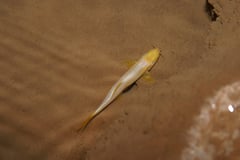
Schistura oedipus
Nemacheilidae · Kottelat, 1988
Schistura oedipus is a troglomorphic nemacheilid loach restricted to five caves in the Pang Mapha karst, Mae Hong Son province, northwest Thailand. The eyes are reduced to vestigial pits beneath the skin and the body is unpigmented. It inhabits flowing subterranean streams, often interrupted by cascades, that drain to the Salween system. Protected by Thai national law, it is included here for interest only.

Bagarius bagarius
Sisoridae · Hamilton, 1822
Bagarius bagarius is a sisorid catfish with a wide but disjointed recorded range, from the Indus in Pakistan east to the Mekong and Malay Peninsula. Its identity is confused: the name has been widely applied to a small fish said to reach only 200 mm SL, but it may be the only Bagarius in the Indian subcontinent, in which case it can reach 2 metres. It is mostly collected from fast, turbulent rapids in larger rivers, where it shelters among boulders, and is best kept alone.

Caelatoglanis zonatus
Erethistidae · Ng & Kottelat, 2005
Caelatoglanis zonatus is an erethistid catfish known only from the Ataran River system in Kayin state, Myanmar, part of the Salween drainage. Images of the Ataran show flowing, forest-shaded headwaters with clear water, a mixed sand and rock substrate and plenty of submerged driftwood and leaf litter. The name zonatus refers to its barred colour pattern.