River
Bernam
Only species with a profile on Seriously Fish are counted.
- Species
- 5
- Families
- 4
- Photographed
- 5 of 5
- Difficulty rated
- 5 of 5
Shares fishes withspecies recorded from both
Runs through
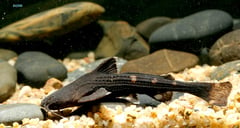
Acrochordonichthys rugosusAsian Banjo Catfish
Akysidae · Bleeker, 1846
The Asian banjo catfish, Acrochordonichthys rugosus, is an akysid catfish from Java, Sumatra, Borneo, Peninsular Malaysia and southern Thailand. The most commonly encountered member of the genus in the trade, it is still by no means common, and body colouration varies widely even among fish from a single locality. Like its congeners it can secrete a milky substance from the axillary pore when stressed, and this can quickly kill other fishes in the confines of an aquarium.

Datnioides polotaSilver Tiger Perch
Datnioididae · Hamilton, 1822
The silver tiger perch, Datnioides polota, is a tiger perch widely distributed in southeastern Asia, from India and Bangladesh east to Indonesia. Mostly found in brackish habitats such as estuaries, mangroves and coastal lagoons, it has a highly variable colour pattern with up to 7 dark bars. The name D. quadrifasciatus is sometimes applied to it, but that name is a junior homonym and polota takes precedence.

Labiobarbus leptocheilus
Cyprinidae · Valenciennes, 1842
Labiobarbus leptocheilus is a large cyprinid widespread in Southeast Asia, from the Mekong and Salween to the Greater Sunda Islands. Different populations vary somewhat in appearance, and it may turn out to represent a group of closely-related species. The Cambodian Mekong population has been considered a distinct species, Labiobarbus lineatus, and that name is widely used in the ornamental trade although it is currently a synonym. It grows to 260 mm SL and needs spotless, well-oxygenated water.
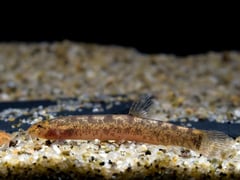
Lepidocephalichthys tomaculum
Cobitidae · Kottelat & Lim, 1992
Lepidocephalichthys tomaculum is a small cobitid loach from Peninsular Malaysia, with a single tentative record from Lampung Province, Sumatra. It inhabits shallow, slow-moving streams, swamps, oxbows and backwaters over mud, silt or peat. Occasionally available as bycatch, it has a reddish brown body with thin dark bars across the back, and where it lives with L. hasselti identification can be difficult.
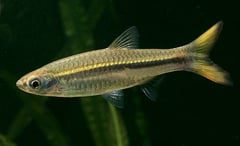
Rasbora dusonensis
Cyprinidae · Bleeker, 1850
Rasbora dusonensis is a cyprinid from Sumatra, Peninsular Malaysia and Borneo, found in larger river channels and peat swamp blackwaters. Its identity was unclear for decades before its redescription by Ng and Kottelat (2013). It is very similar to R. tornieri, which shares the Musi river with it, but has a bright yellow caudal fin with a broad dark margin, against carmine red in R. tornieri. One specimen measured 162 mm SL, although 95 to 105 mm is a more commonly reported adult size.