River
Bo (Borneo)
Only species with a profile on Seriously Fish are counted.
- Species
- 3
- Families
- 1
- Photographed
- 3 of 3
- Difficulty rated
- 3 of 3
Shares fishes withspecies recorded from both
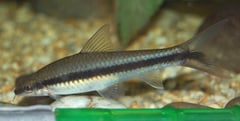
Crossocheilus nigriloba
Cyprinidae · Popta, 1904
Crossocheilus nigriloba is a cyprinid endemic to Borneo, known from the Kapuas, Belayan and Mahakam rivers in Indonesian Kalimantan. Rarely seen, it is among the near-identical congeners traded as 'Siamese algae-eater' or 'SAE' but is simple to identify: the lower caudal-fin lobe carries dark pigment suffused with red, which gave rise to the trade name 'penguin flying fox'. The lateral stripe breaks into blotches when the fish are sparring, stressed or sleeping.
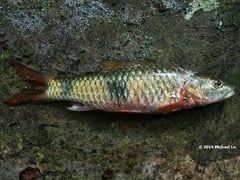
Hampala bimaculata
Cyprinidae · Popta, 1905
Hampala bimaculata is a large riverine cyprinid endemic to Borneo, recorded from Sarawak, Sabah, East Kalimantan and Brunei. Its adult size of up to 500 mm SL more-or-less precludes it as an aquarium fish, and it is poorly known in the ornamental trade. Of the Hampala species with two body blotches, it has saddle-shaped markings, with the anterior blotch beneath the posterior half of the dorsal-fin.

Luciosoma pellegrinii
Cyprinidae · Popta, 1905
Luciosoma pellegrinii is a slender, pike-like cyprinid endemic to Borneo, ranging from the Kapuas in West Kalimantan to Sabah. It is scarcely known in the aquarium trade because it comes from an area where very few commercial collections take place, but its name is misapplied on a regular basis. It has 4 to 8 distinct dark spots on the lateral line and appears to develop longer pelvic-fin filaments than any other member of the genus.