River
Japurá
Only species with a profile on Seriously Fish are counted.
- Species
- 18
- Families
- 9
- Photographed
- 18 of 18
- Difficulty rated
- 18 of 18
Basin
Also in the Amazon basinspecies recorded from both
Shares fishes with rivers elsewherespecies recorded from both
Runs through

Apistogramma eunotus
Cichlidae · Kullander, 1981
Apistogramma eunotus is a dwarf cichlid from the Río Ucayali in Peru and the Solimões/Amazon in Colombia and Brazil, as far east as the Japurá. Coded A73 under the DATZ system, it has similar-looking, possibly conspecific populations referred to as A74 to A77 depending on locality. It inhabits slow-moving streams, creeks and tributaries, and captive-raised fish are the recommended choice for the community aquarium.

Astyanax bimaculatusTwo Spot Astyanax
Characidae · Linnaeus, 1758
The two spot astyanax, Astyanax bimaculatus, is a characid ranging from Panama through most of the Amazon and Orinoco basins. It lives in a wide variety of biotopes, from swiftly-flowing rivers and streams to ponds, ditches and reservoirs. The name is currently applied to what is considered a species complex of at least four taxa, and aquarium fish most often arrive as contaminants among shipments of other species.
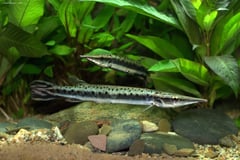
Boulengerella maculata
Ctenoluciidae · Valenciennes, 1850
Boulengerella maculata is a pelagic ctenoluciid found throughout much of the Amazon, Orinoco and Tocantins river systems. Colour pattern varies considerably, with some specimens much paler than others, and this may be correlated with water type. Random dark spots on the upper body, and a dark stripe only behind the eye when one is present, separate it from the similar B. lateristriga. It reaches 329 mm SL and needs an aquarium with base dimensions of 240 by 90 cm or more.
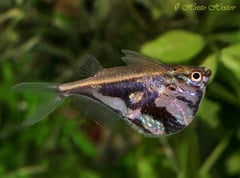
Carnegiella strigataMarbled Hatchetfish
Gasteropelecidae · Günther, 1864
The marbled hatchetfish, Carnegiella strigata, is a hatchetfish from the Amazon and Orinoco basins and coastal rivers of Guyana and Suriname. Popular in the hobby, it is collected for the trade mostly in the rio Negro basin in Brazil. Its larger size and dark, marbled pattern set it apart from congeners, though the pattern varies and the wide range may be open to question. It appears to live only in blackwater.

Colomesus asellusAmazon Puffer
Tetraodontidae · Müller & Troschel, 1849
The Amazon puffer, Colomesus asellus, is a freshwater puffer found throughout much of the Amazon basin, with records north to Guyana and Venezuela. Also traded as the South American puffer or 'SAP', it is told from congeners by a transverse row of dermal flaps across the chin. It lives mostly in well-oxygenated river habitats, is intolerant of organic waste, and forms loose aggregations, so a group of 6 or more is best, away from the general community.
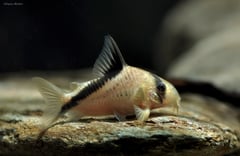
Hoplisoma meliniFalse Bandit Cory
Callichthyidae · (Lönnberg & Rendahl, 1930)
The false bandit cory, Hoplisoma melini, long known as Corydoras melini, is an armoured catfish from tributaries of the rios Negro, Caquetá and Orinoco in Brazil and Colombia. Its oblique dark bar along the back splits into two above the caudal peduncle, a feature shared only with H. davidsandsi, from which the dark markings on its flanks separate it. The rio Tiquié population is known in the hobby as 'C084', and a similar, slightly larger form from Peru as 'C085'.

Megalamphodus erythrostigmaBleeding Heart Tetra
Characidae · (Fowler, 1943)
The bleeding heart tetra, Megalamphodus erythrostigma, is a characid from the upper Amazon basin where the borders of Brazil, Peru and Colombia meet. The best-known of three similar species in the 'bleeding heart' subgroup, it has the reddish humeral spot found in no other characid. Generally peaceful, although adult males are territorial to an extent, it mostly inhabits sluggish tributaries, side arms and forest lakes.
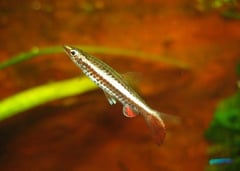
Nannostomus equesHockeystick Pencilfish
Lebiasinidae · Steindachner, 1876
The hockeystick pencilfish, Nannostomus eques, is a lebiasinid from the central and upper Amazon, the Orinoco drainage and rivers of Guyana. It swims at an oblique angle, a trait shared only with N. unifasciatus among congeners, and is also known as the 'rocket', 'diptail' or 'tubemouth' pencilfish. Genetic research on rio Negro populations raises the possibility that the species may be a complex of cryptic taxa.
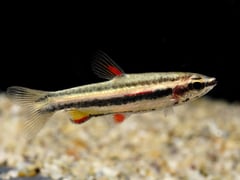
Nannostomus marginatusDwarf Pencilfish
Lebiasinidae · Eigenmann, 1909
The dwarf pencilfish, Nannostomus marginatus, is a lebiasinid of Guyana, Suriname and the middle-to-lower Amazon in Peru, Colombia and Brazil. Enduringly popular, it lacks the red body colour of males of the related N. mortenthaleri and N. rubrocaudatus, showing three dark lateral stripes with no red or purple between them. Colour varies between populations, and its small size and timid nature make it a poor community fish.
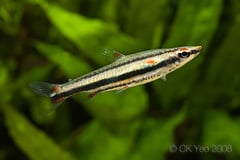
Nannostomus trifasciatusThree-lined Pencilfish
Lebiasinidae · Steindachner, 1876
The three-lined pencilfish, Nannostomus trifasciatus, is a lebiasinid widespread in the western Amazon basin in Brazil, Peru, Colombia and Bolivia. Fairly ubiquitous in the trade, it is less demanding than many congeners and a good choice for a newcomer to pencilfishes. Many fish on sale are farmed, and wild populations vary in colour pattern, one being marketed as 'super red' for its unusually long red stripe.
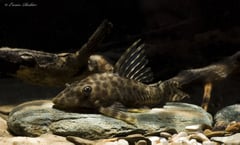
Peckoltichthys bachiL146
Loricariidae · (Boulenger, 1898)
The bola pleco, Peckoltichthys bachi, is a loricariid catfish from the upper Amazon region in Brazil, Colombia, Ecuador and Peru. It has been assigned several L-numbers, including L146 from Colombia and L232 from the Río Putumayo/Içá, and has been exported under other generic names including Hemiancistrus and Sophiancistrus. Its mottled colour pattern separates it from most Peckoltia species, and it lives among submerged grasses and branches in flowing water along the margins of medium to large rivers.

Satanoperca jurupariDemon Eartheater
Cichlidae · Heckel, 1840
The demon eartheater, Satanoperca jurupari, is a cichlid recorded throughout much of the Amazon basin in Brazil, Bolivia, Peru, Ecuador and Colombia. In aquarium literature it is frequently confused with S. leucosticta, which has prominent white spots or vermiform markings on the sides of the head. Its precise identity is a confusing issue, and populations from the Tapajós, Xingu, Araguaia and Paraná are genetically distinct and may represent separate species.

Satanoperca lilith
Cichlidae · Kullander & Ferreira, 1988
Satanoperca lilith is an eartheater cichlid known only from Brazil, where it is widely distributed along the Solimões/Amazon main channel. Despite that extensive range it is uncommon in the ornamental trade, where it is sometimes called 'one-spotted demon fish' or 'one spot eartheater'. A single dark blotch on the flank separates it from the closely similar S. daemon, which has two.
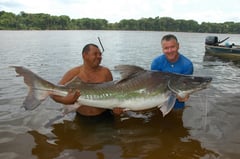
Brachyplatystoma filamentosumPiraíba
Pimelodidae · Lichtenstein, 1819
The piraíba, Brachyplatystoma filamentosum, is the largest catfish of the Amazon basin, also found in the Orinoco and river systems of the Guianas. Adults typically measure 2 to 2.5 m and weigh over 150 kg. In the Amazon only fish over around 160 cm are called 'Piraíba', and smaller ones 'filhote'. It is suitable only for public aquaria and a very small minority of private aquarists.
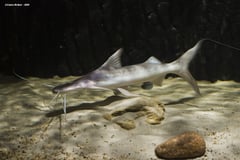
Brachyplatystoma platynemumSlobbering Catfish
Pimelodidae · Boulenger, 1898
The slobbering catfish, Brachyplatystoma platynemum, is a large migratory pimelodid catfish from the Amazon and Orinoco basins. The name refers to its relatively thick barbels, which give the impression that the fish is drooling. It travels considerable distances along deeper, flowing channels, and sexually mature adults have been observed in the upper rio Madeira basin, some 3000 km from the estuary. It grows to 1000 mm SL.

Brachyplatystoma rousseauxiiDourada
Pimelodidae · Castelnau, 1855
The dourada, Brachyplatystoma rousseauxii, is a large migratory pimelodid catfish from the Amazon and Orinoco drainages and rivers of the Guianas. Juveniles feed in the Amazon delta, while sexually mature adults are found only in the western Amazon. Some populations cover as much as 5500 km during migration from the delta, the longest known in any freshwater fish, and it is heavily fished during its upstream movement. It grows to 1900 mm SL.
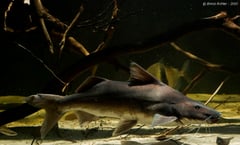
Brachyplatystoma vaillantiiPiramutaba
Pimelodidae · Valenciennes, 1840
The piramutaba, Brachyplatystoma vaillantii, is a large migratory pimelodid catfish from the Amazon and Orinoco watersheds and rivers of the Guianas. Juveniles feed in the Amazon delta before migrating upstream in massive numbers, when they are subject to intensive capture by commercial and artisanal fisheries. Sexually mature adults have been observed in the rio Caquetá basin, some 3500 km from the estuary. It grows to 1050 mm SL.
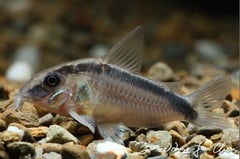
Brochis arcuataSkunk Cory; C020
Callichthyidae · (Elwin, 1938)
The skunk cory, Brochis arcuata, long known as Corydoras arcuatus, is an armoured catfish from the upper Amazon region in Brazil, Peru, Ecuador and Colombia. It is among the more popular Corydoras in the hobby and is also known as the 'arched cory' or C020. Several similar-looking congeners exist, particularly Hoplisoma urucu, in which the black body stripe ends behind the eye, and the larger C. narcissus from the rio Purus.