River
Jurua
Only species with a profile on Seriously Fish are counted.
- Species
- 18
- Families
- 9
- Photographed
- 17 of 18
- Difficulty rated
- 18 of 18
Shares fishes withspecies recorded from both

Astyanax bimaculatusTwo Spot Astyanax
Characidae · Linnaeus, 1758
The two spot astyanax, Astyanax bimaculatus, is a characid ranging from Panama through most of the Amazon and Orinoco basins. It lives in a wide variety of biotopes, from swiftly-flowing rivers and streams to ponds, ditches and reservoirs. The name is currently applied to what is considered a species complex of at least four taxa, and aquarium fish most often arrive as contaminants among shipments of other species.
Brochis leopardusLeopard Cory
Callichthyidae · (Myers, 1933)
The leopard cory, Brochis leopardus, long known as Corydoras leopardus, is a spotted armoured catfish from the western Amazon basin in Peru, Ecuador, Bolivia and Brazil. It looks very like Hoplisoma julii and H. trilineatum, but has a longer, more pointed snout and grows larger. Dias et al. (2024) moved it to the genus Brochis and put the two lookalikes in Hoplisoma, so the resemblance does not reflect a close relationship. The type specimens were aquarium imports.
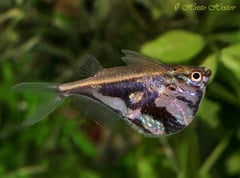
Carnegiella strigataMarbled Hatchetfish
Gasteropelecidae · Günther, 1864
The marbled hatchetfish, Carnegiella strigata, is a hatchetfish from the Amazon and Orinoco basins and coastal rivers of Guyana and Suriname. Popular in the hobby, it is collected for the trade mostly in the rio Negro basin in Brazil. Its larger size and dark, marbled pattern set it apart from congeners, though the pattern varies and the wide range may be open to question. It appears to live only in blackwater.

Colomesus asellusAmazon Puffer
Tetraodontidae · Müller & Troschel, 1849
The Amazon puffer, Colomesus asellus, is a freshwater puffer found throughout much of the Amazon basin, with records north to Guyana and Venezuela. Also traded as the South American puffer or 'SAP', it is told from congeners by a transverse row of dermal flaps across the chin. It lives mostly in well-oxygenated river habitats, is intolerant of organic waste, and forms loose aggregations, so a group of 6 or more is best, away from the general community.
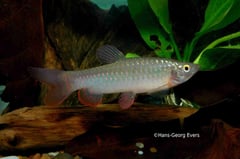
Copeina guttataRed-spotted Tetra
Lebiasinidae · Steindachner, 1876
The red-spotted tetra, Copeina guttata, is a lebiasinid from the middle and upper Amazon basin in Brazil, Peru, Ecuador and Colombia. Reaching 76 mm, it needs a tank of at least 120 x 30 cm. The eggs are apparently deposited in a shallow depression dug in the substrate and guarded by the male. Like many fishes from pristine environments it is intolerant of organic pollutants and requires spotless water.
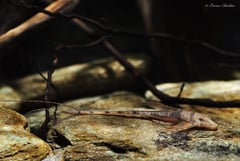
Lamontichthys filamentosusSturgeon Catfish
Loricariidae · La Monte, 1935
The sturgeon catfish, Lamontichthys filamentosus, is a loricariid from the central and western Amazon in Brazil, Peru, Ecuador and Bolivia. Above 60 mm SL the pectoral-fin spine extends into a filament that can be over four times the length of the first branched ray, and the dorsal-fin spine carries a similar extension. Relatively common in the hobby but not easy to maintain, it needs clean, well-oxygenated water and a mature aquarium with plenty of algae-covered surfaces.
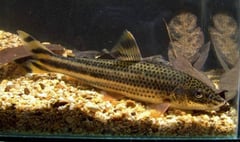
Leporellus vittatus
Anostomidae · Valenciennes, 1850
Leporellus vittatus is an anostomid with a huge natural range across the Amazon, Paraná-Paraguay, São Francisco and Orinoco river systems. Unlike most anostomids it is adapted to a benthic existence in flowing water and spends most of its time on or around the substrate. Occasionally exported, it requires quite specialised conditions, an aquarium of at least 210 by 60 cm and ideally a group of six or more.

Megalamphodus erythrostigmaBleeding Heart Tetra
Characidae · (Fowler, 1943)
The bleeding heart tetra, Megalamphodus erythrostigma, is a characid from the upper Amazon basin where the borders of Brazil, Peru and Colombia meet. The best-known of three similar species in the 'bleeding heart' subgroup, it has the reddish humeral spot found in no other characid. Generally peaceful, although adult males are territorial to an extent, it mostly inhabits sluggish tributaries, side arms and forest lakes.
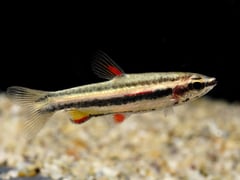
Nannostomus marginatusDwarf Pencilfish
Lebiasinidae · Eigenmann, 1909
The dwarf pencilfish, Nannostomus marginatus, is a lebiasinid of Guyana, Suriname and the middle-to-lower Amazon in Peru, Colombia and Brazil. Enduringly popular, it lacks the red body colour of males of the related N. mortenthaleri and N. rubrocaudatus, showing three dark lateral stripes with no red or purple between them. Colour varies between populations, and its small size and timid nature make it a poor community fish.
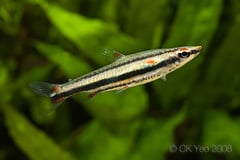
Nannostomus trifasciatusThree-lined Pencilfish
Lebiasinidae · Steindachner, 1876
The three-lined pencilfish, Nannostomus trifasciatus, is a lebiasinid widespread in the western Amazon basin in Brazil, Peru, Colombia and Bolivia. Fairly ubiquitous in the trade, it is less demanding than many congeners and a good choice for a newcomer to pencilfishes. Many fish on sale are farmed, and wild populations vary in colour pattern, one being marketed as 'super red' for its unusually long red stripe.
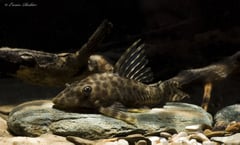
Peckoltichthys bachiL146
Loricariidae · (Boulenger, 1898)
The bola pleco, Peckoltichthys bachi, is a loricariid catfish from the upper Amazon region in Brazil, Colombia, Ecuador and Peru. It has been assigned several L-numbers, including L146 from Colombia and L232 from the Río Putumayo/Içá, and has been exported under other generic names including Hemiancistrus and Sophiancistrus. Its mottled colour pattern separates it from most Peckoltia species, and it lives among submerged grasses and branches in flowing water along the margins of medium to large rivers.

Satanoperca jurupariDemon Eartheater
Cichlidae · Heckel, 1840
The demon eartheater, Satanoperca jurupari, is a cichlid recorded throughout much of the Amazon basin in Brazil, Bolivia, Peru, Ecuador and Colombia. In aquarium literature it is frequently confused with S. leucosticta, which has prominent white spots or vermiform markings on the sides of the head. Its precise identity is a confusing issue, and populations from the Tapajós, Xingu, Araguaia and Paraná are genetically distinct and may represent separate species.
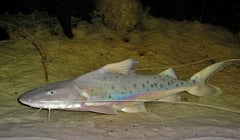
Brachyplatystoma capapretum
Pimelodidae · Lundberg & Akama, 2005
Brachyplatystoma capapretum is a large, piscivorous pimelodid catfish found throughout much of the Amazon basin, from near Belém to Iquitos in Peru. The largest recorded specimen measured 880 mm, and it is suitable only for public aquaria and a very small minority of private aquarists. It is very similar to B. filamentosum but smaller, with shorter maxillary barbels, a moderately forked caudal-fin with lobes of equal size, and adults very dark above.
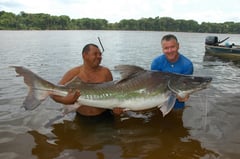
Brachyplatystoma filamentosumPiraíba
Pimelodidae · Lichtenstein, 1819
The piraíba, Brachyplatystoma filamentosum, is the largest catfish of the Amazon basin, also found in the Orinoco and river systems of the Guianas. Adults typically measure 2 to 2.5 m and weigh over 150 kg. In the Amazon only fish over around 160 cm are called 'Piraíba', and smaller ones 'filhote'. It is suitable only for public aquaria and a very small minority of private aquarists.
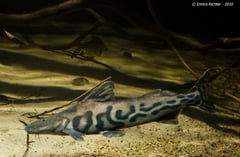
Brachyplatystoma juruenseGold Zebra Catfish
Pimelodidae · Boulenger, 1898
The gold zebra catfish, Brachyplatystoma juruense, is a large pimelodid from the middle Amazon and Orinoco basins, described from the rio Juruá. Adults have broad dark vertical, oblique or branching bands on a pale yellowish body and grow to at least 600 mm. It is sometimes confused with B. tigrinum, especially when young, but has a much less defined pattern, a deeper body and shorter barbels. It suits only public aquaria and a very small minority of private aquarists.
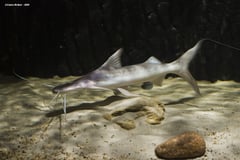
Brachyplatystoma platynemumSlobbering Catfish
Pimelodidae · Boulenger, 1898
The slobbering catfish, Brachyplatystoma platynemum, is a large migratory pimelodid catfish from the Amazon and Orinoco basins. The name refers to its relatively thick barbels, which give the impression that the fish is drooling. It travels considerable distances along deeper, flowing channels, and sexually mature adults have been observed in the upper rio Madeira basin, some 3000 km from the estuary. It grows to 1000 mm SL.
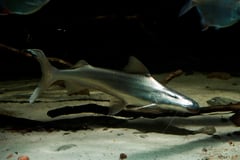
Brachyplatystoma rousseauxiiDourada
Pimelodidae · Castelnau, 1855
The dourada, Brachyplatystoma rousseauxii, is a large migratory pimelodid catfish from the Amazon and Orinoco drainages and rivers of the Guianas. Juveniles feed in the Amazon delta, while sexually mature adults are found only in the western Amazon. Some populations cover as much as 5500 km during migration from the delta, the longest known in any freshwater fish, and it is heavily fished during its upstream movement. It grows to 1900 mm SL.
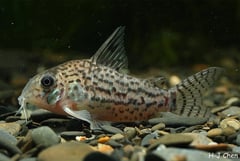
Hoplisoma acrenseAcre Cory
Callichthyidae · (Nijssen, 1972)
The Acre cory, Hoplisoma acrense, long known as Corydoras acrensis, is an armoured catfish that appears to be endemic to the rio Juruá basin in Acre State, Brazil. It was apparently described from a single specimen, and little has been written about it since. Peaceful and gregarious, it should be kept in a group of at least 4-6.