River
Huallaga
Only species with a profile on Seriously Fish are counted.
- Species
- 11
- Families
- 7
- Photographed
- 11 of 11
- Difficulty rated
- 11 of 11
Basin
Also in the Amazon basinspecies recorded from both
Shares fishes with rivers elsewherespecies recorded from both
Runs through

Apistogramma baenschiA188
Cichlidae · Römer, Hahn, Römer, Soares & Wöhler, 2004
The Inca dwarf cichlid, Apistogramma baenschi, is from tributaries of the lower Río Huallaga in the Amazonian portion of northern Peru. Coded A188 under the DATZ system, it is produced on a commercial basis and is perhaps among the most suitable Apistogramma for those new to dwarf cichlids. Wild fish come from shallow forest tributaries with very soft, tea-stained water and a pH measured between 4.1 and 6.3.

Astyanax bimaculatusTwo Spot Astyanax
Characidae · Linnaeus, 1758
The two spot astyanax, Astyanax bimaculatus, is a characid ranging from Panama through most of the Amazon and Orinoco basins. It lives in a wide variety of biotopes, from swiftly-flowing rivers and streams to ponds, ditches and reservoirs. The name is currently applied to what is considered a species complex of at least four taxa, and aquarium fish most often arrive as contaminants among shipments of other species.
Boulengerella maculata
Ctenoluciidae · Valenciennes, 1850
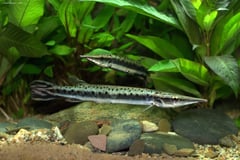
Boulengerella maculata is a pelagic ctenoluciid found throughout much of the Amazon, Orinoco and Tocantins river systems. Colour pattern varies considerably, with some specimens much paler than others, and this may be correlated with water type. Random dark spots on the upper body, and a dark stripe only behind the eye when one is present, separate it from the similar B. lateristriga. It reaches 329 mm SL and needs an aquarium with base dimensions of 240 by 90 cm or more.
Carnegiella myersiPygmy Hatchetfish
Gasteropelecidae · Fernandez-Yepes, 1950
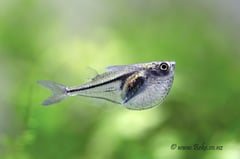
The pygmy hatchetfish, Carnegiella myersi, is a tiny freshwater hatchetfish from the Peruvian Amazon basin, with a second population in Bolivia. The smallest and most delicate of the nominal hatchetfishes, it has a shallower, rounded keel that gives it an elongate profile. It lives in small, shaded, shallow forest streams and must be kept in a group of at least six, away from active tankmates.
Cynodon gibbus
Cynodontidae · Agassiz, 1829
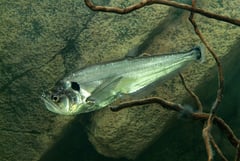
Cynodon gibbus is a cynodontid from much of the Amazon basin, the middle and lower Orinoco, and the Rupununi River in Guyana. A pelagic fish of main river channels and larger tributaries, it grows to around 280 mm SL. It is rare in the trade but arguably more suitable for the home aquarium than some of its better-known relatives, given its size and relatively docile behaviour. Being easily dominated, it is best kept alone or with similarly sized, non-aggressive fishes.
Hydrolycus scomberoidesVampire Tetra
Cynodontidae · Cuvier, 1819
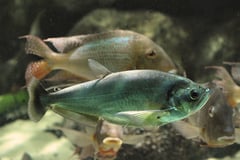
The vampire tetra, Hydrolycus scomberoides, is a predatory dogtooth characin from the central and upper Amazon in Brazil, Bolivia, Peru and Ecuador. Also sold as 'scomb' and 'sabre tooth tetra', it is regularly confused with the much larger payara, H. armatus. At up to 300 mm it still needs a huge tank and specialist care, and newly-imported specimens often refuse anything but live food.
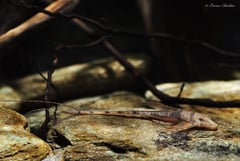
Lamontichthys filamentosusSturgeon Catfish
Loricariidae · La Monte, 1935
The sturgeon catfish, Lamontichthys filamentosus, is a loricariid from the central and western Amazon in Brazil, Peru, Ecuador and Bolivia. Above 60 mm SL the pectoral-fin spine extends into a filament that can be over four times the length of the first branched ray, and the dorsal-fin spine carries a similar extension. Relatively common in the hobby but not easy to maintain, it needs clean, well-oxygenated water and a mature aquarium with plenty of algae-covered surfaces.
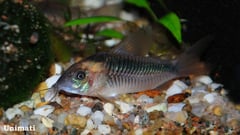
Osteogaster zygataBlack Band Cory
Callichthyidae · (Eigenmann & Allen, 1942)
The black band cory, Osteogaster zygata, long known as Corydoras zygatus, is an armoured catfish from the middle Río Marañón watershed in eastern Ecuador and northern Peru. Also known in the trade as the 'zygus cory', it looks very similar to O. rabauti. In O. zygata the broad dark stripe on the upper body stops short of the lower caudal peduncle, and in O. rabauti it extends onto it.
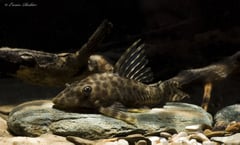
Peckoltichthys bachiL146
Loricariidae · (Boulenger, 1898)
The bola pleco, Peckoltichthys bachi, is a loricariid catfish from the upper Amazon region in Brazil, Colombia, Ecuador and Peru. It has been assigned several L-numbers, including L146 from Colombia and L232 from the Río Putumayo/Içá, and has been exported under other generic names including Hemiancistrus and Sophiancistrus. Its mottled colour pattern separates it from most Peckoltia species, and it lives among submerged grasses and branches in flowing water along the margins of medium to large rivers.

Satanoperca jurupariDemon Eartheater
Cichlidae · Heckel, 1840
The demon eartheater, Satanoperca jurupari, is a cichlid recorded throughout much of the Amazon basin in Brazil, Bolivia, Peru, Ecuador and Colombia. In aquarium literature it is frequently confused with S. leucosticta, which has prominent white spots or vermiform markings on the sides of the head. Its precise identity is a confusing issue, and populations from the Tapajós, Xingu, Araguaia and Paraná are genetically distinct and may represent separate species.
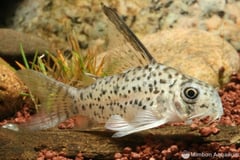
Hoplisoma armatum
Callichthyidae · (Günther, 1868)
Hoplisoma armatum, long known as Corydoras armatus, is an armoured catfish from the Río Huallaga watershed in Peru, to which it may be endemic. Fish from the upper rio Madeira in Brazil and Bolivia have been traded as C. sp. 'dorsalis' and C. sp. 'ogawae' and are officially considered conspecific, although the two areas lie almost 2500 km apart. It can also be confused with H. loretoense but has a deeper body and a longer, slightly curved dorsal-fin spine.