River
Lake Indawgyi
Only species with a profile on Seriously Fish are counted.
- Species
- 8
- Families
- 6
- Photographed
- 8 of 8
- Difficulty rated
- 8 of 8
Shares fishes withspecies recorded from both

Akysis prashadiIndawgyi Stream Catfish
Akysidae · Hora, 1936
The Indawgyi stream catfish, Akysis prashadi, is an akysid catfish from Lake Indawgyi and the upper Ayeyarwady drainage in northern Myanmar. It has also been recorded from the Lokchao river in Manipur, India. At up to 62 mm SL it ranks among the largest in the genus, and though it has been exported for the hobby it is by no means common.

Badis corycaeus
Badidae · Kullander & Britz, 2002
Badis corycaeus is a badid known only from the upper Ayeyarwady River basin in northern Myanmar, including nearby Lake Indawgyi. Its closest relative is B. pyema, but it is much the deeper, darker-bodied fish. At the type locality it lives in running water towards the margins of a clear stream, alongside B. kyar and Dario hysginon, which occupy different niches. Rare in the hobby, it is best kept alone with the emphasis on captive reproduction, and rival males can be very aggressive.

Dario hysginon
Badidae · Kullander & Britz, 2002
Dario hysginon is a tiny badid endemic to Myanmar, known from streams near Myitkyina in Kachin State and from nearby Lake Indawgyi. Traded as 'red melon Dario' or 'flame red Dario', it reaches around 20 mm in males and 15 mm in females. The barred form sold as Dario sp. 'Myanmar' is officially a colour form of this species, but it grows larger and the two will not hybridise in aquaria.

Indostomus paradoxusArmoured Stickleback
Indostomidae · Prashad & Mukerji, 1929
The armoured stickleback, Indostomus paradoxus, is a tiny fish from Myanmar, described from Lake Indawgyi and recorded in the Ayeyarwady basin. It appears to be considerably more widespread than previously thought, having been found as far south as the river's delta. It is rare in the aquarium hobby, and its name is often misapplied to the closely related I. crocodilus, in which adult males have dark bands in the dorsal and anal fins.
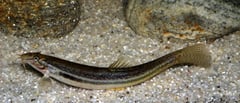
Lepidocephalichthys guntea
Cobitidae · Hamilton, 1822
Lepidocephalichthys guntea is a cobitid loach from the Ganges and Brahmaputra systems of northern India, Nepal and Bangladesh, and much of Myanmar. One of the most frequently-traded members of the group, it is an excellent choice for those new to keeping loaches. Males carry a solid, dark lateral stripe and females spotted flanks, and patterning varies with origin. It is also used as a food fish, eaten fresh and dried.

Parasphaerichthys ocellatusEyespot Gourami
Osphronemidae · Prashad & Mukerji, 1929
The eyespot gourami, Parasphaerichthys ocellatus, is a small anabantoid from the upper Ayeyarwady basin in northern Myanmar, including Lake Indawgyi. It shares the trade names 'mini chocolate gourami' and 'Burmese chocolate gourami' with P. lineatus, but grows larger, to 32 mm SL, and has an ocellus-type marking in the middle of each flank with no dark mid-lateral stripe. In nature it is subject to seasonal temperature fluctuations and is comfortable between 15 and 25 °C.

Pethia didi
Cyprinidae · Kullander & Fang, 2005
Pethia didi is a small cyprinid from the Ayeyarwady drainage around Lake Indawgyi and Myitkyina, Kachin State, where it appears to be endemic. Rare in the aquarium trade though occasionally available, it has two black, vertically-orientated flank blotches, one behind the operculum and one on the caudal peduncle, a pattern shared with several congeners. The type locality is a swift, shaded stream through bamboo forest, and the species is subject to seasonal temperature fluctuations in nature.

Pethia erythromycterLipstick Barb
Cyprinidae · Kullander, 2008
The lipstick barb, Pethia erythromycter, is a small cyprinid from the upper Ayeyarwady River basin in northern Myanmar, including Lake Indawgyi. Sometimes traded as 'Tulip barb', it first appeared in the hobby in 2006 and was described by Kullander (2008). Males have red pigmentation around the mouth and tubercules on the snout when nuptial. It may nip slow-moving or long-finned tankmates but does very well with other small, active cyprinids or nemacheilid loaches.