River · also known as Kosi
Koshi
Only species with a profile on Seriously Fish are counted.
- Species
- 19
- Families
- 8
- Photographed
- 19 of 19
- Difficulty rated
- 19 of 19
Shares fishes withspecies recorded from both
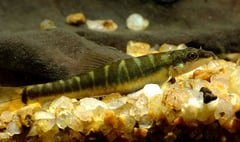
Acoura savonaHalf-banded Loach
Nemacheilidae · (Hamilton, 1822)
The half-banded loach, Acoura savona, is a nemacheilid loach from Ganges tributaries draining the eastern Himalayas in India, Nepal and Bangladesh. The species is seen in the trade fairly often and is sometimes sold as 'bicolor loach' in the United States. Its colour pattern of 9-10 thin, yellowish bars on a dark upper body, with plain whitish lower parts, separates it from similar loaches, and it is among the less aggressive of them.

Barilius shacra
Cyprinidae · Hamilton, 1822
Barilius shacra is a cyprinid from the Himalayan foothills of Nepal and northern India, in the Ganges and Brahmaputra systems, and from Bangladesh. Poorly known in the hobby but exported on occasion, it has around 12 vertical bars on each flank and a black band in the upper third of the dorsal fin. It inhabits well-oxygenated, fast-flowing rivers with gravel, cobble and boulder substrates, and is too fast and vigorous a feeder for the general community.
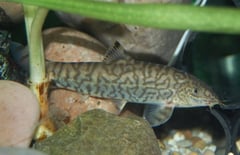
Botia almorhaeYo-Yo Loach
Botiidae · Gray, 1831
The yo-yo loach, Botia almorhae, is a botiid loach from parts of the Ganges River drainage in northern India and possibly Nepal. It is often called the 'Pakistani' loach, but that name is a misnomer. B. almorhae sensu stricto appears to belong to a group of closely-related species and has possibly never been seen in the aquarium trade, where the most commonly available members seem to be B. lohachata, B. sp. 'Kosi' and B. sp. 'Teesta', plus assorted hybrids.
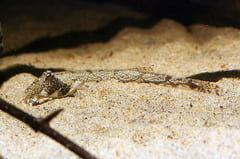
Canthophrys gongotaMoose-faced Loach
Cobitidae · Hamilton, 1822
The moose-faced loach, Canthophrys gongota, is a cobitid loach from the Ganges and Brahmaputra river systems in Nepal, northern India and Bangladesh. Often referred to as Somileptes gongota in aquarium literature, it is rarely seen in the trade, being notoriously delicate and difficult to ship. It mostly inhabits slow-moving, shallow tributaries and minor rivers over mud, sand or gravel.

Crossocheilus latius
Cyprinidae · Hamilton, 1822
Crossocheilus latius is a cyprinid widespread in India, described from the Tista River on the border with Bangladesh. It lives everywhere from boulder-strewn Himalayan hill streams to silt-laden tributaries and pools. Not often available in the trade, it sometimes turns up in shipments of Indian Garra, and its relatively plain pattern makes it unlikely to be confused with congeners. Juveniles are gregarious and active, but adults tend to become sedentary and solitary.

Danio rerioZebra Danio
Cyprinidae · (Hamilton, 1822)
The zebra danio, Danio rerio, is a small cyprinid from India and Bangladesh, found mostly in slow or still pools and mature rice paddies. Peaceful, hardy and inexpensive, it has been mass-produced for many years and quality stock can be hard to find. The spotted 'leopard danio' is a spontaneous mutation of the striped form that also occurs in the wild.

Esomus danricaFlying Barb
Cyprinidae · Hamilton, 1822
The flying barb, Esomus danrica, is a cyprinid with an enormous range across Pakistan, Nepal, Bangladesh, most of India, Myanmar and Sri Lanka. It shows a marked preference for shallow, slow-moving and standing waters such as rice paddies with dense vegetation, and is generally absent from major river channels. Reports on its suitability for community aquaria are mixed, with some keepers seeing a pronounced tendency to nip fins.

Labeo bogaViolet Shark
Cyprinidae · Hamilton, 1822
The violet shark, Labeo boga, is a cyprinid from most major river systems in India, Pakistan, Nepal, Bangladesh and Myanmar. It inhabits major river channels and larger tributaries and grows to 250 mm, needing a tank of at least 240 x 60 cm. It is unsuitable for most home aquaria but turns up in the trade irregularly, also as the 'violet-gilled shark' or 'blushing violet shark'. L. boga as currently recognised probably represents a complex of closely-related species.
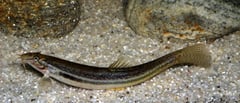
Lepidocephalichthys guntea
Cobitidae · Hamilton, 1822
Lepidocephalichthys guntea is a cobitid loach from the Ganges and Brahmaputra systems of northern India, Nepal and Bangladesh, and much of Myanmar. One of the most frequently-traded members of the group, it is an excellent choice for those new to keeping loaches. Males carry a solid, dark lateral stripe and females spotted flanks, and patterning varies with origin. It is also used as a food fish, eaten fresh and dried.
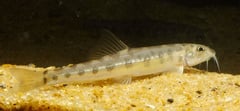
'Nemacheilus' corica
Nemacheilidae · Hamilton, 1822
Nemacheilus corica is a loach from Himalayan foothill rivers of the Ganges and Brahmaputra systems in Nepal, northern India and Bangladesh. Usually referred to Schistura in the hobby, it has been placed in Nemacheilus by most authors since the late 1970s, though its generic placement requires further study. A row of variably sized dark spots runs along the back and another along each flank, both ending in a dark blotch at the caudal-fin base.

Oreichthys cosuatis
Cyprinidae · Hamilton, 1822
Oreichthys cosuatis is a small cyprinid probably restricted to the Ganges and Brahmaputra River basins in Nepal, India and Bangladesh. Several undescribed Oreichthys spp. from India, Myanmar and Thailand continue to be traded under its name, and apparent records from those places likely represent other species. It lacks a black blotch on the caudal peduncle, and adults have a dark triangular blotch in the anal-fin.

Pethia conchoniusRosy Barb
Cyprinidae · Hamilton, 1822
The rosy barb, Pethia conchonius, is a small cyprinid found from Pakistan throughout India, Nepal and Bangladesh. Generally considered one of the hardiest small cyprinids in the hobby, it is an excellent choice for newcomers. Wild specimens are not usually available and the vast majority are commercially bred, with long-finned, 'veil-tail', 'super red', 'neon' and 'golden' strains among the forms selective breeding has produced. Feral populations exist in several countries.

Puntius cholaSwamp Barb
Cyprinidae · (Hamilton, 1822)
The swamp barb, Puntius chola, is a cyprinid from much of Pakistan, India, Nepal, Bhutan, Bangladesh, Sri Lanka, Myanmar and western Thailand. Sometimes called the 'chola' or 'green' barb, it has a single pair of barbels and dark blotches behind the operculum and near the caudal-fin base. It apparently prefers stiller waters over mud or silt, and makes an ideal addition to a peaceful community of riverine fishes.

'Puntius' guganioGlass Barb
Cyprinidae · Hamilton, 1822
The glass barb, Puntius guganio, is a small cyprinid widespread in the Ganges and Brahmaputra river systems of Bangladesh, Nepal and northern India. It lives in slow-moving or standing waters such as pools, ditches and minor rivers. Poorly known in the hobby, it is of uncertain taxonomic placement, and its stiff, serrated last dorsal-fin ray, incomplete lateral line and 36-39 lateral scales are shared only with 'P.' nangalensis.

Xenentodon cancilaFreshwater Needlefish
Belonidae · Hamilton, 1822
The freshwater needlefish, Xenentodon cancila, is a belonid from Pakistan east through India, Bangladesh, Nepal, Sri Lanka, Myanmar and Thailand. Often called 'freshwater garfish', it only superficially resembles the true gars, and most of its relatives in the Belonidae are marine or estuarine. A near-exclusive inhabitant of the upper water column, it is surprisingly peaceful with anything too large to swallow and is best kept in numbers of four or more, in a tank of 180 ∗ 60 cm or more.

Bagarius yarrelliGoonch
Sisoridae · Sykes, 1839
The goonch, Bagarius yarrelli, is a very large sisorid catfish recorded from the Indus in Pakistan east through Indochina to Sumatra and Borneo. Also known as the 'giant devil catfish' and 'sand shark', it reaches 1300 to 2000 mm and is fished for food across much of its range. That wide distribution appears doubtful, and Indian and Southeast Asian populations may prove not to be conspecific. It lives among boulders in the fast, turbulent rapids of large rivers.

Channa maruliusBullseye Snakehead
Channidae · Hamilton, 1822
The bullseye snakehead, Channa marulius, is a large snakehead recorded from Pakistan across southern Asia to southern China, Laos and Vietnam. Also called the 'giant', 'cobra' or 'Indian' snakehead, it is widely accepted to represent a complex of related species in need of further research. Reports of 120-180 cm remain to be proven, with 500-600 mm a more common adult size, and it is suitable only for public installations or the very largest private aquaria.

Chitala chitalaIndian Featherback
Notopteridae · Hamilton, 1822
The Indian featherback, Chitala chitala, is a very large notopterid probably restricted to Pakistan, India, Nepal and Bangladesh. Its name has been widely misapplied in the trade, most often to the Southeast Asian C. ornata, but it is very rarely exported for aquaria and is fished and cultured for food in India. Growing to 1220 mm SL, it has non-ocellated black spots above the anal fin and is the only Chitala normally showing gold or silver bars on the back.

Labeo angra
Cyprinidae · Hamilton, 1822
Labeo angra is a benthic cyprinid from Pakistan, Nepal, northern India, Bangladesh and Myanmar, described from the Brahmaputra. It can be identified by a brownish back, yellowish flanks and belly, and a black to bluish stripe from the eye to the caudal-fin base. It undertakes annual spawning migrations within its native river systems.