River
Madre De Dios
Only species with a profile on Seriously Fish are counted.
- Species
- 9
- Families
- 6
- Photographed
- 9 of 9
- Difficulty rated
- 9 of 9
Basin
Also in the Amazon basinspecies recorded from both
Shares fishes with rivers elsewherespecies recorded from both
Runs through
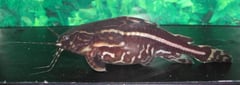
Acanthodoras cataphractusChocolate Talking Catfish
Doradidae · Linnaeus, 1758
The chocolate talking catfish, Acanthodoras cataphractus, is a doradid catfish from the northern Amazon basin and Atlantic drainages of the Guianas. It is most often exported as bycatch among Platydoras armatulus and is sold under the same trade names as A. spinosissimus, which has pale blotches on the back between the dorsal and caudal fins where this species has pale lines or no markings. Largely nocturnal and gregarious, it is best kept in a group of at least four.
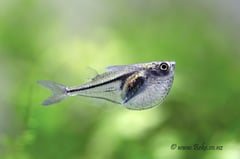
Carnegiella myersiPygmy Hatchetfish
Gasteropelecidae · Fernandez-Yepes, 1950
The pygmy hatchetfish, Carnegiella myersi, is a tiny freshwater hatchetfish from the Peruvian Amazon basin, with a second population in Bolivia. The smallest and most delicate of the nominal hatchetfishes, it has a shallower, rounded keel that gives it an elongate profile. It lives in small, shaded, shallow forest streams and must be kept in a group of at least six, away from active tankmates.
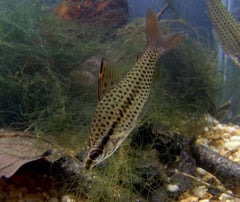
Chilodus punctatusSpotted Headstander
Chilodontidae · Müller & Troschel, 1844
The spotted headstander, Chilodus punctatus, is a headstander from much of the Amazon, the western Orinoco and coastal rivers of Guyana and Suriname. Also called the 'checkered headstander', it lives in slow-moving rivers, oxbows and floodplain lakes, and its colour pattern appears to vary with locality. Shy and peaceful, it is sensitive to dissolved organic wastes and should never be introduced to a biologically-immature aquarium.

Hyphessobrycon agulha
Characidae · Fowler, 1913
Hyphessobrycon agulha is a small tetra known with certainty only from the rio Madeira system in the Amazon basin of Brazil, Peru and Bolivia. Relatively rare in the hobby, it is occasionally traded as the 'red-tailed flag tetra'. It lends its name to a group of closely-related species with a dark lower half of the body, especially above the anal fin, and it is very peaceful.

Hyphessobrycon loretoensisLoreto Tetra
Characidae · Ladiges, 1938
The Loreto tetra, Hyphessobrycon loretoensis, is a small characid from the upper Amazon basin in Colombia, Peru and Ecuador. It is relatively popular in the hobby, but most traded fish are wild-caught, so availability can be sporadic. Most records are from forest streams and minor tributaries with tea-coloured water, overhanging vegetation and leaf litter.

Satanoperca jurupariDemon Eartheater
Cichlidae · Heckel, 1840
The demon eartheater, Satanoperca jurupari, is a cichlid recorded throughout much of the Amazon basin in Brazil, Bolivia, Peru, Ecuador and Colombia. In aquarium literature it is frequently confused with S. leucosticta, which has prominent white spots or vermiform markings on the sides of the head. Its precise identity is a confusing issue, and populations from the Tapajós, Xingu, Araguaia and Paraná are genetically distinct and may represent separate species.
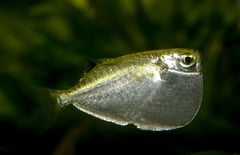
Thoracocharax stellatusSpotfin Hatchetfish
Gasteropelecidae · Kner, 1858
The spotfin hatchetfish, Thoracocharax stellatus, is the most widespread neotropical hatchetfish, recorded from much of South America. It is told from its only congener, T. securis, by a prominent dark spot in the dorsal fin, and is sometimes traded as 'platinum hatchetfish'. It feeds almost entirely on insects, and a tightly fitting cover is needed because it can clear several metres in one jump.
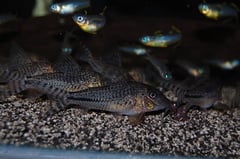
Corydoras sp.C115
Callichthyidae · authority not recorded
C115 is an unidentified armoured catfish from the upper Río Madre de Dios in southern Peru, between Manú National Park and Puerto Maldonado. It was traded as both C115 and C116, now thought to be the same species, and fish sold as C. sp. 'Manu' variants may belong here too. It grows to around 70 mm SL and is highly variable in colour pattern, particularly in the extent of dark pigmentation on the front of the body.

Hyphessobrycon eschwartzae
Characidae · Román-Valencia & Ortega, 2013
Hyphessobrycon eschwartzae is a small, laterally-striped characid known only from the Río Madre de Dios watershed in southeastern Peru. It has been collected in the Tambopata National Reserve and north of Puerto Maldonado. Lima et al. (2014) placed it in a narrowly defined H. heterorhabdus group with H. heterorhabdus and H. amapaensis, marked by a dark midlateral stripe, a red stripe above it and a red upper half to the eye.