River
Approuague
Only species with a profile on Seriously Fish are counted.
- Species
- 7
- Families
- 3
- Photographed
- 7 of 7
- Difficulty rated
- 7 of 7
Basin
Shares fishes withspecies recorded from both
Runs through

Astronotus ocellatusOscar
Cichlidae · Agassiz, 1831
The oscar, Astronotus ocellatus, is a large cichlid widely distributed in the Amazon region, recorded from Colombia and Venezuela south to Argentina. It grows to 350 mm SL and typically lives 10 to 20 years, both of which need taking into account before purchase. Most fish on sale come from commercial breeders in Eastern Europe or the Far East, in numerous ornamental strains, and genetic analyses suggest the genus contains additional, morphologically cryptic species.

Astyanax leopoldiLeopold's Tetra
Characidae · Géry, Planquette & Le Bail, 1988
Leopold's tetra, Astyanax leopoldi, is a characid native to the Approuague and Oyapock river basins in French Guiana and Brazil. It is most common in fast-flowing waters, where it swims in large shoals in marginal or calmer areas. Like most Astyanax, it is rarely offered for sale.

Geophagus camopiensisOiapoque Eartheater
Cichlidae · Pellegrin, 1903
The Oiapoque eartheater, Geophagus camopiensis, is a cichlid from the Oyapock basin on the Brazil and French Guiana border and the Approuague. Poorly known in the hobby, it is occasionally available through specialist breeders and retailers. A low E1 scale count and usually seven anal-fin rays are shared only with G. parnaibae, which may indicate a close relationship. A larger lateral marking and light caudal-fin spots separate the two.

Hyphessobrycon simulatusFalse X-ray Tetra
Characidae · Géry, 1960
The false x-ray tetra, Hyphessobrycon simulatus, is a characid endemic to French Guiana, from the Maroni to the Oyapock/Oiapoque river basins. Uncommon in the trade, it was originally described in the genus Pseudopristella. It is told from Pristella maxillaris by a larger humeral spot and black in the anal fin limited to the first ray.
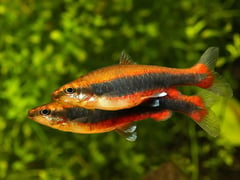
Nannostomus beckfordiGolden Pencilfish
Lebiasinidae · Günther, 1872
The golden pencilfish, Nannostomus beckfordi, is a lebiasinid widely distributed across Guyana, Suriname, French Guiana, Brazil and Venezuela. The type species of the genus and fairly ubiquitous in the trade, it is less demanding than most congeners and a good choice for a newcomer. Many fish on sale are farmed, and wild populations vary in colour pattern, several having been described as species now considered synonyms of N. beckfordi.

Satanoperca rhynchitis
Cichlidae · Kullander, 2012
Satanoperca rhynchitis is an eartheater cichlid known only from the Oyapock, Approuague and other river systems of French Guiana. Previously referred to S. jurupari, it was known in the trade as S. sp. 'red lips', and live adults have red lips. Red-lipped fish from Amapá in Brazil appear intermediate between the two, and whether they are hybrids, a distinct species or part of a cline is still unclear.

Hyphessobrycon borealis
Characidae · Zarske, Le Bail & Géry, 2006
Hyphessobrycon borealis is a small characid from French Guiana, recorded from the Oyapock/Oiapoque to the Maroni river systems. It inhabits shallow marginal zones with little current, where it forms large schools. The largest recorded specimen measured 27.8 mm, and the species lacks a humeral spot but has an oval spot on the caudal peduncle.