River
Oiapoque
Only species with a profile on Seriously Fish are counted.
- Species
- 10
- Families
- 6
- Photographed
- 10 of 10
- Difficulty rated
- 10 of 10
Shares fishes withspecies recorded from both
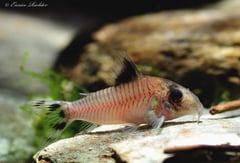
Brochis condiscipulus
Callichthyidae · (Nijssen & Isbrücker, 1980)
Brochis condiscipulus, long known as Corydoras condiscipulus, is an armoured catfish native to the Oyapock (Oiapoque) river system in French Guiana and Amapá state, Brazil. It often occurs alongside the similar-looking Hoplisoma oiapoquense, from which it differs in its larger adult size, narrower body, shorter pectoral spine and longer snout.

Geophagus camopiensisOiapoque Eartheater
Cichlidae · Pellegrin, 1903
The Oiapoque eartheater, Geophagus camopiensis, is a cichlid from the Oyapock basin on the Brazil and French Guiana border and the Approuague. Poorly known in the hobby, it is occasionally available through specialist breeders and retailers. A low E1 scale count and usually seven anal-fin rays are shared only with G. parnaibae, which may indicate a close relationship. A larger lateral marking and light caudal-fin spots separate the two.

Hyphessobrycon roseusYellow Phantom Tetra
Characidae · Géry, 1960
The yellow phantom tetra, Hyphessobrycon roseus, is a small characid from Suriname, French Guiana and the Brazilian bank of the Oyapock/Oiapoque. Although popular in the hobby, its identity is somewhat confused, and two colour forms have been traded. It inhabits forest tributaries and igarapés with acidic, brownish water, sandy substrates and leaf litter.

Hyphessobrycon simulatusFalse X-ray Tetra
Characidae · Géry, 1960
The false x-ray tetra, Hyphessobrycon simulatus, is a characid endemic to French Guiana, from the Maroni to the Oyapock/Oiapoque river basins. Uncommon in the trade, it was originally described in the genus Pseudopristella. It is told from Pristella maxillaris by a larger humeral spot and black in the anal fin limited to the first ray.
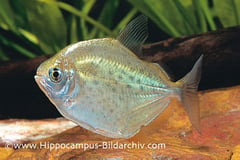
Metynnis lippincottianus
Serrasalmidae · Cope, 1870
Metynnis lippincottianus is a spotted silver dollar from Brazil and French Guiana, found in the lower and middle Amazon and the Oyapock system. It is occasionally seen for sale, sometimes as 'silver dollar', and its spotted pattern tells it apart from M. argenteus and M. hypsauchen. The spots are less pronounced than in M. maculatus, with which it shares a common name. The precise extent of its range is unclear.

Satanoperca rhynchitis
Cichlidae · Kullander, 2012
Satanoperca rhynchitis is an eartheater cichlid known only from the Oyapock, Approuague and other river systems of French Guiana. Previously referred to S. jurupari, it was known in the trade as S. sp. 'red lips', and live adults have red lips. Red-lipped fish from Amapá in Brazil appear intermediate between the two, and whether they are hybrids, a distinct species or part of a cline is still unclear.

Aequidens tetramerusSaddle Cichlid
Cichlidae · Heckel, 1840
The saddle cichlid, Aequidens tetramerus, is a cichlid found across much of northern South America, from the Amazon and Orinoco basins to the Guianas. The type species of its genus, it occurs in several colour forms, and fish from Ecuador and Peru are sought after for the red or orange colouration on the lower head and belly. As currently recognised it is likely to represent a group of related fishes, some of which may be described as distinct species.
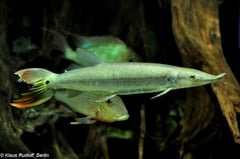
Boulengerella cuvieri
Ctenoluciidae · Spix & Agassiz, 1829
Boulengerella cuvieri is a pelagic ctenoluciid characin from much of the Amazon basin, the Río Orinoco and coastal drainages of the Guianas. The largest officially recorded specimen measured 675 mm, but it appears to grow larger, possibly beyond 800 mm. Given that size and its natural behaviour it is largely unsuitable for the home aquarium. Its entire dorsal-fin base lies ahead of the anal-fin origin, a character shared only with B. lucius and B. xyrekes among ctenoluciids.
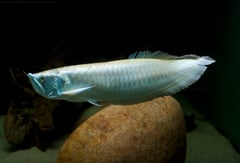
Osteoglossum bicirrhosumSilver Arowana
Osteoglossidae · Cuvier, 1829
The silver arowana, Osteoglossum bicirrhosum, is a large predator from the Amazon basin, plus river systems in Guyana and French Guiana. Reaching 80 cm, it is largely unsuitable for the home aquarium, and although juveniles are readily available, few private aquarists can house an adult long-term. Juveniles have a single dark lateral stripe, while in those of its only congener, O. ferreirai, most of the body and fins are dark.

Hyphessobrycon borealis
Characidae · Zarske, Le Bail & Géry, 2006
Hyphessobrycon borealis is a small characid from French Guiana, recorded from the Oyapock/Oiapoque to the Maroni river systems. It inhabits shallow marginal zones with little current, where it forms large schools. The largest recorded specimen measured 27.8 mm, and the species lacks a humeral spot but has an oval spot on the caudal peduncle.