River
Melawi
Only species with a profile on Seriously Fish are counted.
- Species
- 7
- Families
- 6
- Photographed
- 7 of 7
- Difficulty rated
- 7 of 7
Basin
Also in the Kapuas basinspecies recorded from both
Shares fishes with rivers elsewherespecies recorded from both
Runs through

Betta antoni
Osphronemidae · Tan & Ng, 2006
Betta antoni is a mouthbrooding labyrinth fish that appears endemic to the lower Kapuas basin in West Kalimantan, Indonesian Borneo. Known as Betta sp. 'Sanggau' before its description, it belongs to the Betta akarensis group. It inhabits quiet margins and still pools in clear, flowing forest hill streams, and live fish show blue iridescence on the body scales and a distinct black lower lip.
Gymnochanda filamentosa
Ambassidae · Fraser-Brunner, 1955
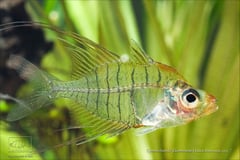
Gymnochanda filamentosa is a small glassfish known from Johor in southern Peninsular Malaysia and the Kapuas system in West Kalimantan, Borneo. Males carry filamentous dorsal and anal-fin rays, and the body is transparent to translucent yellowish-brown in life. It occurs in swampy, acidic waters over silt and peat, and has appeared in the ornamental trade but is evidently delicate and recommended only to experienced aquarists.
Hypergastromyzon humilis
Gastromyzontidae · Roberts, 1989
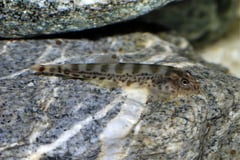
Hypergastromyzon humilis is a small hillstream loach known only from the Melawi basin of the Kapuas system in West Kalimantan, Indonesian Borneo. Not traded specifically, it sometimes turns up as bycatch among shipments of wild-collected Gastromyzon. It is told from those by its small mouth without papillae, and from H. eubranchus, the only other species in the genus, by its 7-8 cream-coloured dorsal bars.

Crossocheilus cobitis
Cyprinidae · Bleeker, 1854
Crossocheilus cobitis is a cyprinid ranging from the Mekong drainage in Laos, Vietnam and Thailand south to Sumatra, Borneo and Java. Primarily a lowland species, it lives in the turbid lower reaches of rivers over mud, close to submerged logs and similar objects. Given its wide range it has probably reached the trade as the invalid 'Crossocheilus siamensis', and it is likely to represent a group of similar-looking, closely related species.
Datnioides microlepisIndonesian Tiger Perch
Datnioididae · Bleeker, 1854
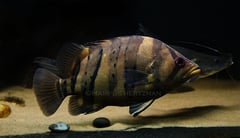
The Indonesian tiger perch, Datnioides microlepis, is a large tiger perch from Peninsular Malaysia, Sumatra and Indonesian Borneo. It has 6 to 7 wide dark bars and small body scales, lives only in large, deep lowland rivers, and grows to 500 mm SL. Juveniles may form groups, but adults are not gregarious and respond aggressively to conspecifics and similarly-shaped fishes.

Scleropages formosusAsian Arowana
Osteoglossidae · Müller & Schlegel, 1840
The Asian arowana, Scleropages formosus, is an osteoglossid from the Mekong system, eastern Thailand, Peninsular Malaysia, Sumatra and Borneo. Highly valued in the aquarium trade since the 1970s and listed on Appendix I of CITES since 1975, it is now extirpated across much of its range. It occurs in several colour forms, such as the 'super red' of the upper Kapuas, and three were described as species in 2003, though the majority view treats all of them as S. formosus pending review.
Luciosoma spilopleura
Cyprinidae · Bleeker, 1855
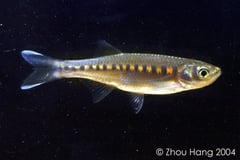
Luciosoma spilopleura is a small cyprinid known only from Sumatra and the Indonesian part of Borneo, where it prefers fast-flowing headwater streams. The species is poorly known and is not present in the ornamental trade, although its name has been widely misapplied to other Luciosoma species for decades. The largest known specimen measured 81.9 mm, so it appears to grow much smaller than its congeners.