River
Pinoh
Only species with a profile on Seriously Fish are counted.
- Species
- 6
- Families
- 4
- Photographed
- 6 of 6
- Difficulty rated
- 6 of 6
Shares fishes withspecies recorded from both
Runs through
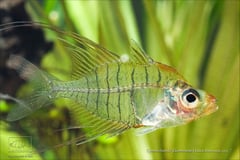
Gymnochanda filamentosa
Ambassidae · Fraser-Brunner, 1955
Gymnochanda filamentosa is a small glassfish known from Johor in southern Peninsular Malaysia and the Kapuas system in West Kalimantan, Borneo. Males carry filamentous dorsal and anal-fin rays, and the body is transparent to translucent yellowish-brown in life. It occurs in swampy, acidic waters over silt and peat, and has appeared in the ornamental trade but is evidently delicate and recommended only to experienced aquarists.
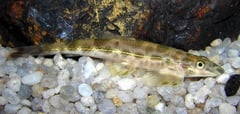
Homalopteroides stephensoni
Balitoridae · Hora, 1932
Homalopteroides stephensoni is a hillstream loach from Borneo, recorded from Kalimantan in Indonesia and from Sabah and Sarawak in Malaysia. Poorly known in the aquarium hobby, it may never have been exported for the ornamental trade. Originally described in Homaloptera, it was placed in Balitoropsis by Kottelat (2012), who subsequently followed Randall and Page (2012) in treating it as a Homalopteroides. Like its congeners it inhabits swiftly-flowing, clear, oxygen-saturated streams.

Mystacoleucus obtusirostris
Cyprinidae · Valenciennes, 1842
Mystacoleucus obtusirostris is a riverine cyprinid found from Myanmar and southwestern China to Vietnam, Borneo, Sumatra and Java. Referred to as M. marginatus for decades, it is the most widely distributed member of the genus, and populations vary somewhat in colour pattern. It is occasionally marketed as 'Burmese rainbow barb'. A group of six or more is the smallest to consider, and like all Mystacoleucus it has a forward-pointing predorsal spine that can snag in a net.

Crossocheilus cobitis
Cyprinidae · Bleeker, 1854
Crossocheilus cobitis is a cyprinid ranging from the Mekong drainage in Laos, Vietnam and Thailand south to Sumatra, Borneo and Java. Primarily a lowland species, it lives in the turbid lower reaches of rivers over mud, close to submerged logs and similar objects. Given its wide range it has probably reached the trade as the invalid 'Crossocheilus siamensis', and it is likely to represent a group of similar-looking, closely related species.

Scleropages formosusAsian Arowana
Osteoglossidae · Müller & Schlegel, 1840
The Asian arowana, Scleropages formosus, is an osteoglossid from the Mekong system, eastern Thailand, Peninsular Malaysia, Sumatra and Borneo. Highly valued in the aquarium trade since the 1970s and listed on Appendix I of CITES since 1975, it is now extirpated across much of its range. It occurs in several colour forms, such as the 'super red' of the upper Kapuas, and three were described as species in 2003, though the majority view treats all of them as S. formosus pending review.
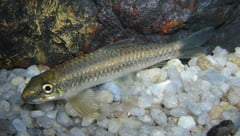
Garra borneensis
Cyprinidae · Vaillant, 1902
Garra borneensis is a cyprinid endemic to northern and western Borneo, in Kalimantan, Brunei, Sabah and Sarawak. No other member of the genus is known from the island. An obligate dweller of swiftly-flowing streams and headwaters, it lives in clear, oxygen-saturated water over gravel, rocks and bedrock carpeted with biofilm.