Basin
Kapuas basin
Only species with a profile on Seriously Fish are counted.
- Species
- 83
- Rivers
- 2
- Photographed
- 83 of 83
- Difficulty rated
- 83 of 83
Rivers in this basinspecies recorded from each
Runs through
Acanthopsoides molobrion
Cobitidae · Siebert, 1991
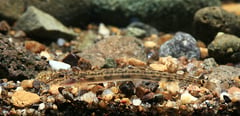
Acanthopsoides molobrion is a dwarf horse-faced loach from Borneo, Peninsular Malaysia and southern Thailand. Like others in the genus it lives in flowing, clear-water river channels over sand, fine gravel or mud, and needs a soft, sandy substrate because it spends some of its time completely buried. Several Acanthopsoides in the trade have proven very tricky to identify. This one has 10 to 15 mid-dorsal markings and three bands in the caudal fin.
Acanthopsoides robertsi
Cobitidae · Siebert, 1991
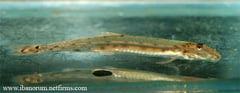
Acanthopsoides robertsi is a dwarf horse-face loach from the Kapuas River basin in West Kalimantan, Indonesian Borneo. Unlike most of its congeners it is quite easily identified, being the only species with a dark, triangular marking in the caudal fin. Very similar fish have been collected further north in the Kayan and Sambas basins. Highly gregarious, it needs soft sand to bury in and is best kept in a group of six or more.
Acantopsis dialuzonaHorseface Loach
Cobitidae · van Hasselt, 1823
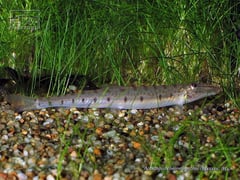
The horseface loach, Acantopsis dialuzona, is a cobitid loach from Sumatra, Borneo, Java and Peninsular Malaysia, and possibly Thailand. Most literature lists it as A. choirorhynchos, which Kottelat treats as a junior synonym, and few if any fish in the trade come from near the type locality, so they may represent an unidentified species. Juveniles are exported in large numbers but adults are uncommon in the hobby, and it needs soft sand to bury in.
Acrochordonichthys rugosusAsian Banjo Catfish
Akysidae · Bleeker, 1846
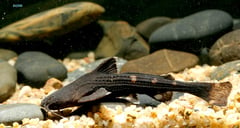
The Asian banjo catfish, Acrochordonichthys rugosus, is an akysid catfish from Java, Sumatra, Borneo, Peninsular Malaysia and southern Thailand. The most commonly encountered member of the genus in the trade, it is still by no means common, and body colouration varies widely even among fish from a single locality. Like its congeners it can secrete a milky substance from the axillary pore when stressed, and this can quickly kill other fishes in the confines of an aquarium.
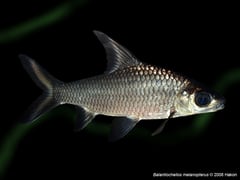
Balantiocheilos melanopterusSilver Shark
Cyprinidae · Bleeker, 1850
The silver shark, Balantiocheilos melanopterus, is a large cyprinid from Borneo, Sumatra and possibly Peninsular Malaysia. Also sold as the 'Bala shark', it is among the most commonly encountered ornamental fishes, yet it reaches 300 to 350 mm SL and long-term care is beyond most hobbyists. Wild populations have dwindled or vanished, it has been listed as Endangered by the IUCN since 1996, and fish on sale are almost certainly all commercially bred. It does not occur in Indochina.
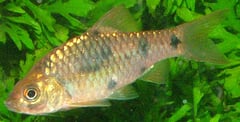
Barbodes banksi
Cyprinidae · Herre, 1940
Barbodes banksi is a cyprinid from Peninsular Malaysia, Singapore and western Borneo, plus the Anambas and Natuna islands of Indonesia. It is tentatively considered distinct from the closely related B. binotatus, differing in a dark, wedge-shaped marking below the dorsal fin in place of a midlateral spot, though the two may be colour forms of a single species. Occasionally exported as bycatch, it lives in habitats from fast hill streams to canals and floodplain ponds.
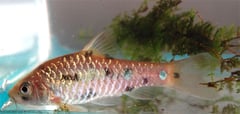
Barbodes everetti
Cyprinidae · Boulenger, 1894
Barbodes everetti is a cyprinid from Borneo, known from Sarawak and West Kalimantan, where it lives in clear forest streams in the foothills. Uncommon in the hobby, its name has been widely misapplied to the clown barb, B. dunckeri, from Peninsular Malaysia and Singapore. B. everetti is the less colourful of the two, with relatively small dark body markings, a dark blotch at the rear of the dorsal-fin base and 3½ scales above the lateral line.
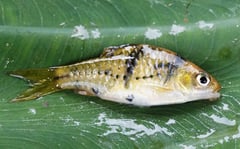
Barbodes kuchingensisFalse Spanner Barb
Cyprinidae · Herre, 1940
The false spanner barb, Barbodes kuchingensis, is a cyprinid apparently endemic to western Borneo, from Sarawak into the Kapuas system. It lives mainly in shallow, clear forest streams and is rarely exported, while subadult B. everetti and some populations of B. lateristriga are regularly traded under its name. B. kuchingensis sensu stricto has a prominent row of dark spots along the lateral line and a short streak extending from the upper part of the operculum.

Barbonymus schwanefeldiiTinfoil barb
Cyprinidae · Bleeker, 1854
The tinfoil barb, Barbonymus schwanefeldii, is a large cyprinid found across much of Southeast Asia, from the Mekong to Borneo and Sumatra. Usually sold at 50 to 75 mm, it grows to 355 mm SL, and tinfoil barbs are among the species most often returned to shops having outgrown their aquarium. Selectively-bred 'golden' and 'blushing' strains exist, and the species has also been subjected to artificial dyeing.
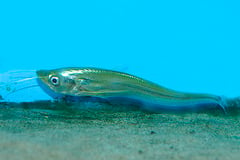
Belodontichthys dinema
Siluridae · (Bleeker, 1851)
Belodontichthys dinema is a large, open-water predatory catfish from the Malay Peninsula, Sumatra and Borneo that reaches 100 cm TL in the wild. It eats only fish and needs a very large aquarium without tankmates small enough to swallow. Fish exported from Thailand or elsewhere in Indochina under this name are likely to be B. truncatus, the species found in the Mekong and Chao Phraya basins.

Belontia hasseltiJava Combtail
Osphronemidae · Cuvier, 1831
The Java combtail, Belontia hasselti, is a labyrinth fish from peninsular Thailand, Peninsular Malaysia, Singapore, Sumatra, Borneo and Java. Also known as the 'Malay combtail', it mostly inhabits acidic forest peat swamps with little water movement. It differs from its only congener, B. signata, in its brownish grey body and the mosaic pattern in its unpaired fins. Growing to 200 mm SL, it will eat very small fishes and is not recommended for the average community aquarium.

Betta antoni
Osphronemidae · Tan & Ng, 2006
Betta antoni is a mouthbrooding labyrinth fish that appears endemic to the lower Kapuas basin in West Kalimantan, Indonesian Borneo. Known as Betta sp. 'Sanggau' before its description, it belongs to the Betta akarensis group. It inhabits quiet margins and still pools in clear, flowing forest hill streams, and live fish show blue iridescence on the body scales and a distinct black lower lip.

Betta dimidiata
Osphronemidae · Roberts, 1989
Betta dimidiata is a small mouthbrooding labyrinth fish that appears endemic to the upper Kapuas drainage in West Kalimantan, Indonesian Borneo. It is often confused in the trade with B. krataios, formerly B. sp. 'Kapuas', but the caudal fin separates them: rounded in B. krataios, spade-shaped and more extended in adult B. dimidiata. It inhabits shaded forest swamp streams and pools, some only a few centimetres deep.

Betta edithae
Osphronemidae · Vierke, 1984
Betta edithae is a paternal mouthbrooding labyrinth fish from Indonesia, recorded across Kalimantan, southern Sumatra, Bangka, Belitung and Bintan. The only member of the B. edithae group, it is separated from all other Betta spp. by its opaque or translucent branchiostegal membrane and posterior opercle. Fish from Bintan differ from Bornean specimens in several characters, and it remains unclear whether all populations are conspecific.

Betta enisae
Osphronemidae · Kottelat, 1995
Betta enisae is a paternal mouthbrooding labyrinth fish known only from parts of the River Kapuas basin in West Kalimantan, Indonesian Borneo. A member of the B. pugnax complex, whose species are notoriously difficult to tell apart, it has transverse bars in the caudal fin. Populations differ in colour and pattern and are often labelled with collection details such as Putussibau or Sentarum. It inhabits cool, shaded forest streams and swamp pools stained with humic acids.

Betta krataios
Osphronemidae · Tan & Ng, 2006
Betta krataios is a paternal mouthbrooding labyrinth fish that appears endemic to the lower River Kapuas basin in West Kalimantan, Indonesian Borneo. Traded as B. sp. 'Kapuas' before its description, it is sometimes confused with B. dimidiata, the other member of the B. dimidiata group. The two are easily told apart since the caudal fin is rounded in B. krataios and spade-shaped and more extended in B. dimidiata.

Betta lehi
Osphronemidae · Tan & Ng, 2005
Betta lehi is a paternal mouthbrooding labyrinth fish endemic to Borneo, in southwestern Sarawak and the lower River Kapuas basin in West Kalimantan. A member of the B. pugnax complex, it has green iridescent scales on the opercle and body and a light blue iridescent band on the anal fin. It inhabits forest peat swamps, acidic clearwater swamps and associated streams, where the pH can be between 3.0 and 5.5.

Betta mandor
Osphronemidae · Tan & Ng, 2006
Betta mandor is a paternal mouthbrooding labyrinth fish from near Mandor and Anjungan in the lower Kapuas basin, West Kalimantan, Borneo. Known as B. sp. 'Mandor' or B. sp. 'ninja' before its description, it belongs to the B. foerschi group. Males are black and females brown, with twin red bars on the opercle. It is sometimes traded as B. foerschi, and the two can be difficult to tell apart.

Betta midas
Osphronemidae · Tan, 2009
Betta midas is a stout-bodied labyrinth fish from the lower Kapuas basin in West Kalimantan, Indonesian Borneo, and may also occur in western Sarawak. It has been traded as B. anabatoides in the past, and most images of it are labelled as such. It has gold iridescent scales on the opercle, belly and body. The paratype series came from a blackwater river in peat swamp forest with a pH of 4.1.

Betta pinguis
Osphronemidae · Tan & Kottelat, 1998
Betta pinguis is a paternal mouthbrooding labyrinth fish known only from the middle and upper Kapuas watershed in West Kalimantan, Indonesian Borneo. A member of the B. akarensis group, it has a relatively stocky body and dense dark markings on the opercle below the postorbital stripe. The type specimens came from a small, slightly tannin-stained stream in degraded forest, where B. dimidiata and B. enisae also occur.

Betta simorum
Osphronemidae · Tan & Ng, 1996
Betta simorum is a slender bubble-nesting labyrinth fish from Sumatra and the Kapuas River system in West Kalimantan, Borneo, Indonesia. Growing to around 90 mm SL, it inhabits heavily-vegetated forest peat swamps and blackwater streams. It shares the B. bellica group with B. bellica, from which it differs in its slanted head with a concave profile behind the eye. Populations are often labelled by locality, such as Rantau Panjang or Sungai Bengkwan, to preserve pure bloodlines.

Betta taeniata
Osphronemidae · Regan, 1910
Betta taeniata is a mouthbrooding labyrinth fish endemic to Borneo, known from southern Sarawak in Malaysia and northern West Kalimantan in Indonesia. It is usually associated with clear, flowing hill streams, where it lives in quiet marginal zones and still pools among leaf litter and gravel. A member of the B. picta group, it has a yellowish body and fins and a blackish head. Populations such as Sri Aman, Serian and Kapuas are often labelled by locality to preserve pure bloodlines.
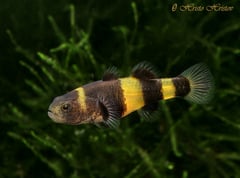
Brachygobius doriaeBumblebee Goby
Gobiidae · Günther, 1868
The bumblebee goby, Brachygobius doriae, is a small goby from western Borneo and the Natuna Islands, described from Sarawak. Among the more frequently traded members of the genus, it is often misidentified as B. nunus or B. xanthozonus and is most easily confused with B. sabanus. It lives in fresh and brackish water in lowland coastal habitats such as mangrove swamps, estuaries and tidal streams. It is best kept in a species-specific set-up.

Channa luciusForest Snakehead
Channidae · Cuvier, 1831
The forest snakehead, Channa lucius, is a predatory snakehead from Indochina, Peninsular Malaysia and the Greater Sunda Islands. Also referred to as the 'splendid' or 'shiny' snakehead, it occurs on Sumatra, Borneo and Java, grows to 400 mm SL and favours forest swamps and tributaries. Like others in the genus it breathes atmospheric air, and it needs a dimly-lit tank with plenty of cover and a tightly-fitting lid, since Channa spp. are notorious for their ability to escape.
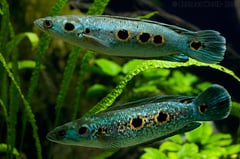
Channa pleurophthalmaOcellated Snakehead
Channidae · Bleeker, 1851
The ocellated snakehead, Channa pleurophthalma, is a snakehead native to southeastern Sumatra and the Kapuas and Barito basins of Indonesian Borneo. It lives in streams and mangroves and is among the few snakeheads known to form aggregations throughout its life. Unlike most Channa spp. it is pelagic and needs plenty of swimming room, with a tank of at least 240 x 60 cm recommended for a fish reaching 350 mm SL.
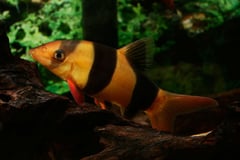
Chromobotia macracanthusClown Loach
Botiidae · Bleeker, 1852
The clown loach, Chromobotia macracanthus, is a large botiid loach native to river systems of Borneo and Sumatra in Indonesia. Widely sold, it is wholly unsuitable for smaller aquaria: a group needs a tank of at least 180 x 60 cm, and a properly kept fish can live for more than twenty years. Bornean and Sumatran populations differ slightly in pattern, and in the Batang Hari, Sumatra, drifting larvae are now collected and grown on for the trade.
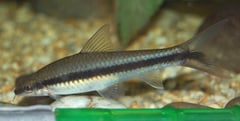
Crossocheilus nigriloba
Cyprinidae · Popta, 1904
Crossocheilus nigriloba is a cyprinid endemic to Borneo, known from the Kapuas, Belayan and Mahakam rivers in Indonesian Kalimantan. Rarely seen, it is among the near-identical congeners traded as 'Siamese algae-eater' or 'SAE' but is simple to identify: the lower caudal-fin lobe carries dark pigment suffused with red, which gave rise to the trade name 'penguin flying fox'. The lateral stripe breaks into blotches when the fish are sparring, stressed or sleeping.

Cyclocheilichthys apogonBeardless Barb
Cyprinidae · Valenciennes, 1842
The beardless barb, Cyclocheilichthys apogon, is a cyprinid ranging from Myanmar to Vietnam and south via Peninsular Malaysia to Borneo and Sumatra. Also sold as 'skinhead barb', it lacks barbels and has a black blotch at the caudal-fin base plus rows of dark spots along the scale rows. It favours slower-moving or still water and grazes the biofilm on submerged roots and branches. Rarely imported in numbers, it most often arrives as bycatch.
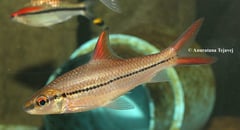
Cyclocheilichthys janthochir
Cyprinidae · Bleeker, 1854
Cyclocheilichthys janthochir is a cyprinid endemic to Borneo, known from West and Central Kalimantan in Indonesia. It inhabits black water streams and rivers associated with ancient forest peat swamps, where the water is very soft and acidic. Red markings in the dorsal and caudal fins plus a dark lateral stripe make it easy to identify. Specialised shops stock it from time to time, and it also turns up as bycatch among wild fish from Kalimantan.

Cyclocheilichthys repasson
Cyprinidae · Bleeker, 1853
Cyclocheilichthys repasson is a cyprinid with an enormous range, from the Mekong region and Myanmar through Peninsular Malaysia to Borneo and Sumatra. It grows to around 280 mm SL and favours slower-moving or still water, grazing the biofilm on submerged roots and branches. It is not often seen in the hobby. Most populations have a dark caudal peduncle spot, stripes formed by dark markings on the scales, and two pairs of barbels.
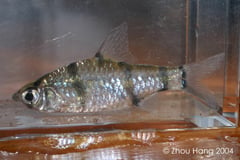
Desmopuntius endecanalis
Cyprinidae · Roberts, 1989
Desmopuntius endecanalis is a cyprinid apparently endemic to the Kapuas River basin in West Kalimantan, Borneo, including the Danau Sentarum lakes. A whitish base body colour and 8 (rarely 7) branched anal-fin rays distinguish it from congeners, and its placement in Desmopuntius was only tentative. Its habitat is unconfirmed, but related species are associated with peat swamps and black water streams.
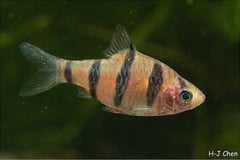
Desmopuntius hexazona'Pentazona' Barb
Cyprinidae · Weber & de Beaufort, 1912
Normally traded as the 'pentazona' barb, Desmopuntius hexazona is a cyprinid from southern Borneo, eastern Sumatra, Singapore and the Malay Peninsula. It is almost identical to D. pentazona, which has a small dark marking at the rear of the dorsal-fin base that D. hexazona lacks. Older literature may label it 'Puntius johorensis'. In Singapore it is considered highly endangered and is restricted to the Central Catchment nature reserve.
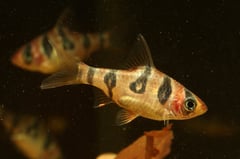
Desmopuntius rhomboocellatusSnakeskin Barb
Cyprinidae · Koumans, 1940
The snakeskin barb, Desmopuntius rhomboocellatus, is a cyprinid endemic to southern Kalimantan, the Indonesian portion of Borneo. It has been recorded from several river systems including the Kapuas, Kepayang and Barito. It most often inhabits peat swamps, black water streams and other still waters with submerged plants and dense riparian vegetation.
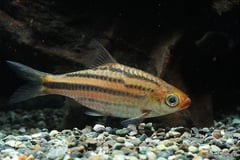
Desmopuntius trifasciatus
Cyprinidae · Kottelat, 1996
Desmopuntius trifasciatus is a cyprinid from Borneo, described from the Kapuas basin in West Kalimantan and also known from southern Sarawak. Like D. gemellus and D. johorensis, juveniles have 4 dark vertical bars, and fish over 40 mm have 3 or 4 broad lateral stripes, the central one broadest. It may also be confused with Striuntius lineatus.
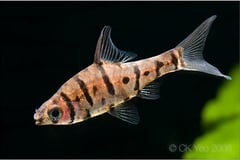
Eirmotus insignis
Cyprinidae · Tan & Kottelat, 2008
Eirmotus insignis is a small cyprinid known only from the Kapuas basin in West Kalimantan, Borneo, and Belitung Island off Sumatra. It inhabits shady, slow-moving rainforest streams and swamps with dense vegetation. One of four similar species in the genus, it is traded alongside E. octozona as the 'false eight-banded barb' and is told apart mainly by the black markings on its dorsal fin.
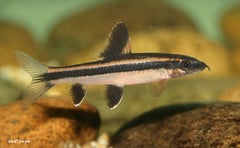
Epalzeorhynchos kalopterumFlying Fox
Cyprinidae · Bleeker, 1850
The flying fox, Epalzeorhynchos kalopterum, is a cyprinid from southern Thailand, Peninsular Malaysia and the Greater Sunda Islands. Fishes sold as 'false flying fox' or 'Siamese flying fox', such as Garra cambodgiensis and Gyrinocheilus aymonieri, are often confused with it, but it has white-edged red and black fins and two pairs of barbels. It grows increasingly territorial with age and can live for over 15 years.
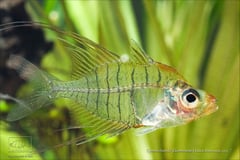
Gymnochanda filamentosa
Ambassidae · Fraser-Brunner, 1955
Gymnochanda filamentosa is a small glassfish known from Johor in southern Peninsular Malaysia and the Kapuas system in West Kalimantan, Borneo. Males carry filamentous dorsal and anal-fin rays, and the body is transparent to translucent yellowish-brown in life. It occurs in swampy, acidic waters over silt and peat, and has appeared in the ornamental trade but is evidently delicate and recommended only to experienced aquarists.

Helostoma temminkiiKissing Gourami
Helostomatidae · Cuvier, 1829
The kissing gourami, Helostoma temminkii, is an anabantoid from southern Indochina and the Malay Archipelago, and the sole member of its family. The widely traded pinkish-white form is a leucistic variant bred for ornamental purposes, and the 'balloon' variety is intentionally disfigured and much shorter-lived. Its often belligerent behaviour, adult size and life span of over 20 years make it unsuitable for most home aquaria. The 'kissing' appears at least in part related to establishing social dominance.
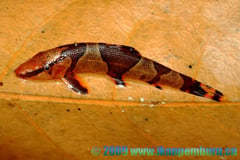
Homaloptera orthogoniataSaddle-back Loach
Balitoridae · Vaillant, 1902
The saddle-back loach, Homaloptera orthogoniata, is a 'lizard' loach endemic to Borneo, known from rivers in Sarawak and Kalimantan. It was historically said to occur across much of Indochina. It is rare in the hobby, and most images online and in the literature show H. confuzona or H. parclitella. It always has three large, saddle-shaped markings on the back, the third between the dorsal and caudal fins.
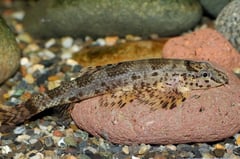
Homalopteroides tweediei
Balitoridae · Herre, 1940
Homalopteroides tweediei is a small hillstream loach from Peninsular Malaysia, the Mekong system and West Kalimantan in Indonesian Borneo. It is often confused with the congener H. smithi. Rainboth (1996) found it less likely to occur in riffles or runs than other members of the genus, and it shows a preference for moderately-flowing stretches of clear, oxygen-rich streams among patches of live or dead vegetation.
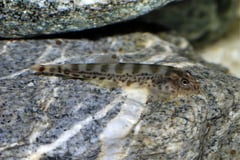
Hypergastromyzon humilis
Gastromyzontidae · Roberts, 1989
Hypergastromyzon humilis is a small hillstream loach known only from the Melawi basin of the Kapuas system in West Kalimantan, Indonesian Borneo. Not traded specifically, it sometimes turns up as bycatch among shipments of wild-collected Gastromyzon. It is told from those by its small mouth without papillae, and from H. eubranchus, the only other species in the genus, by its 7-8 cream-coloured dorsal bars.
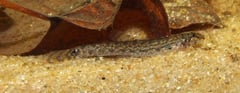
Kottelatlimia pristes
Cobitidae · Roberts, 1989
Kottelatlimia pristes is a small cobitid loach from Peninsular Malaysia, Sumatra and Borneo, the most widely-distributed member of its genus. It inhabits small, slow-moving forest streams and peat swamps with tannin-stained water, often in piles of leaf litter. It turns up occasionally in the trade, sometimes as bycatch among other species and under names such as 'Sumatran mini royal loach' or Cobitis cf. sumatranus.

Kryptopterus bicirrhis
Siluridae · Valenciennes, 1840
Kryptopterus bicirrhis is a silurid catfish from much of Southeast Asia, including the Mekong and Chao Phraya and the Greater Sunda Islands. Uncommon in the aquarium trade, its name was widely misapplied to K. vitreolus in older literature, but the two are easily told apart because K. bicirrhis does not have a transparent body in life. It tends to form schools, so four or more should be kept.
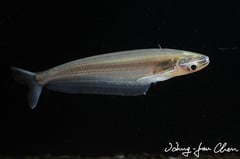
Kryptopterus cryptopterusBlue Sheatfish
Siluridae · Bleeker, 1851
The blue sheatfish, Kryptopterus cryptopterus, is a silurid catfish from the Malay Peninsula, Singapore, Sumatra, Borneo and Java. It inhabits flowing rivers and larger streams with turbid water, and is sometimes traded as 'smokey glass catfish'. Populations from Thailand, Cambodia, Laos and Vietnam once considered conspecific are now referred to K. geminus, its closest relative, from which it differs in having a wider head and a shorter snout and anal fin.

Kryptopterus limpok
Siluridae · Bleeker, 1852
Kryptopterus limpok is a silurid catfish widely distributed through Southeast Asia, including the Mekong and the Greater Sunda Islands. It can be told from its congeners by an extremely long mental barbel extending beyond the tip of the pectoral fin. It inhabits flowing rivers and larger streams with turbid water, grows to 260 mm and is almost unheard of in the ornamental trade.
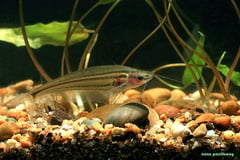
Kryptopterus macrocephalusStriped Glass Catfish
Siluridae · Bleeker, 1858
The striped glass catfish, Kryptopterus macrocephalus, is a silurid catfish from Thailand, Malaysia, Singapore and the Greater Sunda Islands. A stenotypic inhabitant of peat swamp forests and associated blackwater streams, it is also known as the false, mottled or tawny glass catfish. Striped and mottled colour forms exist that may or may not be conspecific, and the similar K. piperatus has a pale brown body with scattered dark spots.

Labiobarbus leptocheilus
Cyprinidae · Valenciennes, 1842
Labiobarbus leptocheilus is a large cyprinid widespread in Southeast Asia, from the Mekong and Salween to the Greater Sunda Islands. Different populations vary somewhat in appearance, and it may turn out to represent a group of closely-related species. The Cambodian Mekong population has been considered a distinct species, Labiobarbus lineatus, and that name is widely used in the ornamental trade although it is currently a synonym. It grows to 260 mm SL and needs spotless, well-oxygenated water.
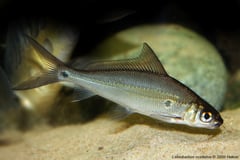
Labiobarbus ocellatus
Cyprinidae · Heckel, 1843
Labiobarbus ocellatus is a cyprinid from Peninsular Malaysia, Sumatra and Borneo, with a black spot on the shoulder and one on the caudal peduncle. It is occasionally available in the ornamental trade, typically under a name such as 'Bornean eye-spot silver shark' or the invalid scientific name Cirrhinus chinensis. A pelagic species of rivers and some lakes, it moves into seasonally inundated floodplains and forest during the wet season, and grows to 180 mm SL.
Lepidocephalus macrochir
Cobitidae · Bleeker, 1854
Lepidocephalus macrochir is a cobitid loach described from Sumatra and since recorded from Thailand, Peninsular Malaysia, Java and Borneo. It is traded sporadically as the 'pinky loach', 'deep water kuhli loach' and 'Borneo high body cave loach'. Although sometimes said to be a cave loach, Thai collectors report it from deep water, and in aquaria it spends a lot of time buried in soft substrates.

Mystacoleucus obtusirostris
Cyprinidae · Valenciennes, 1842
Mystacoleucus obtusirostris is a riverine cyprinid found from Myanmar and southwestern China to Vietnam, Borneo, Sumatra and Java. Referred to as M. marginatus for decades, it is the most widely distributed member of the genus, and populations vary somewhat in colour pattern. It is occasionally marketed as 'Burmese rainbow barb'. A group of six or more is the smallest to consider, and like all Mystacoleucus it has a forward-pointing predorsal spine that can snag in a net.
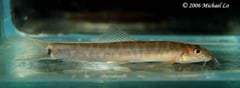
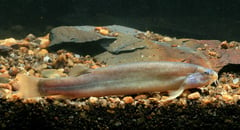
Nemacheilus saravacensis
Nemacheilidae · Boulenger, 1894
Nemacheilus saravacensis is a nemacheilid loach from Borneo, recorded from drainages in Sarawak (Malaysia) and West Kalimantan (Indonesia). It inhabits clear, tea-coloured forest streams with low mineral hardness and pH. Rare in the aquarium hobby, it may only have appeared as bycatch, and it carries 13-17 irregular dark blotches along the lateral line with a similar number of saddles across the back.
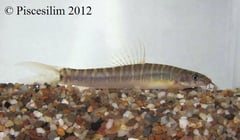
Nemacheilus selangoricus
Nemacheilidae · Duncker, 1904
Nemacheilus selangoricus is a nemacheilid loach ranging from southern Thailand through Peninsular Malaysia and Singapore to western Borneo and Sumatra. It is most common in shallow, flowing forest streams over sand, gravel and detritus. It belongs to the N. selangoricus group and is most similar to N. spiniferus, from which it differs in its 8-12 very regular dark bars on the flanks.
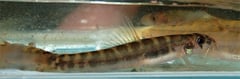
Nemacheilus spiniferus
Nemacheilidae · Kottelat, 1984
Nemacheilus spiniferus is a nemacheilid loach from Borneo, recorded from Sarawak, Brunei and Kalimantan, plus the Natuna and Anambas islands. It is most common in shallow, flowing forest streams with clear to slightly tannin-stained water. A member of the N. selangoricus group, it is rare in the aquarium hobby and differs from N. selangoricus in its 10-13 irregularly-shaped dark bars.
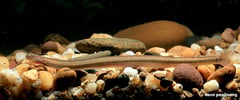
Pangio anguillaris
Cobitidae · Vaillant, 1902
Traded as 'eel loach', Pangio anguillaris is a cobitid loach from Borneo, Sumatra, Peninsular Malaysia and the Chao Phraya and Mekong basins. It has an extremely elongated, worm-like body with 69-71 vertebrae and no nasal barbels, and is most commonly available as bycatch among shipments of other fishes. The species as currently recognised appears to represent a complex of closely-related taxa.
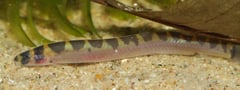
Pangio malayana
Cobitidae · Tweedie, 1956
Pangio malayana is a barred kuhli loach from Peninsular Malaysia, the Batang Hari drainage in Sumatra and the Kapuas system in Indonesian Borneo. It has 10-16 dark saddles on the upper half of the body and a black bar at the base of the caudal-fin, and looks most similar to P. cuneovirgata, which has a truncate caudal-fin. It is most often encountered as bycatch among shipments of similar-looking congeners.
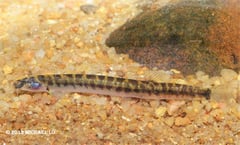
Pangio shelfordii
Cobitidae · Popta, 1903
Pangio shelfordii is a variably patterned kuhli loach from Peninsular Malaysia, Singapore, Sumatra and Borneo. Its patterning varies within and between populations, and as currently understood the species represents an assemblage containing a number of unidentified taxa. Some Sumatran and Bornean populations resemble P. piperata, which often occurs alongside it. It is exported occasionally, often as bycatch among shipments of congeners.

Parosphromenus anjunganensis
Osphronemidae · Kottelat, 1991
Parosphromenus anjunganensis is a liquorice gourami known only from a handful of localities near Anjungan in Kalimantan Barat, Indonesian Borneo. Males have uniformly reddish-brown dorsal, anal and caudal fins with a thin bluish to whitish margin. A stenotypic inhabitant of peat swamp forests and blackwater streams, it may be highly threatened, since some habitats in its range have been cleared and drained for agriculture.

Parosphromenus ornaticauda
Osphronemidae · Kottelat, 1991
Parosphromenus ornaticauda is a liquorice gourami from West Kalimantan, Indonesian Borneo, in the Kapuas drainage near Anjungan and the Pawan system. Sometimes sold as 'ornate licorice gourami', it has occasionally appeared in the trade in substantial quantities but is not easy to maintain and is often susceptible to disease post-import. Males are identified by their caudal-fin pattern and the large amount of black in the dorsal and anal fins.
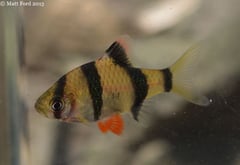
Puntigrus anchisporus
Cyprinidae · Vaillant, 1902
Puntigrus anchisporus is a small cyprinid endemic to Borneo, recorded from Kalimantan in Indonesia and much of Sarawak in Malaysia. One of the four-barred species once called the 'Puntius tetrazona group', it has a complete lateral line, a black dorsal fin with a red outer band and red pelvic fins. It occasionally appears in the hobby, but the trade relies largely on commercially-produced 'tiger barbs' of questionable origin.

'Puntius' lineatusLined Barb
Cyprinidae · Duncker, 1904
The lined barb, 'Puntius' lineatus, is a laterally-striped cyprinid from Peninsular Malaysia, Sumatra and Borneo, found mostly in peat swamps. It is most often confused with 'P.' johorensis, the two being the most common of the striped species in the trade, but it has no more than one pair of barbels, lacks vertical bars as a juvenile and grows smaller. Its habitats include black water streams stained brown with humic acids, with pH as low as 3.0 or 4.0.
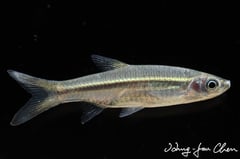
Rasbora argyrotaeniaSilver Rasbora
Cyprinidae · (Bleeker, 1849)
The silver rasbora, Rasbora argyrotaenia, is a cyprinid from Peninsular Malaysia, Singapore, Sumatra, Java, Borneo and the Palawan islands. One of the larger rasboras at up to 140 mm TL, it is a plain, silvery fish with a faint dark stripe, and fish pictured under this name with a bold black stripe are probably a regional variant of R. daniconius. A DNA barcode study found two mitochondrial lineages under the name, and the species as currently recognised is likely to be split.

Sphaerichthys osphromenoidesChocolate Gourami
Osphronemidae · Canestrini, 1860
The chocolate gourami, Sphaerichthys osphromenoides, is a small gourami from Peninsular Malaysia, Sumatra and Borneo. By far the best known member of the genus, it mostly inhabits peat swamps and black water streams where the pH can drop to 3.0 or 4.0. A maternal mouthbrooder, it is slow-moving and easily outcompeted for food by more boisterous tankmates.

Sphaerichthys vaillantiVaillant's Chocolate Gourami
Osphronemidae · Pellegrin, 1930
Vaillant's chocolate gourami, Sphaerichthys vaillanti, is a labyrinth fish that appears to be endemic to the Kapuas drainage in Indonesian Borneo. It is also traded as the 'samurai gourami', a misleading name since the fish is neither especially combative nor from Japan. Unlike S. osphromenoides and S. selatanensis it is a paternal mouthbrooder, and females carry alternating red and green vertical bars.
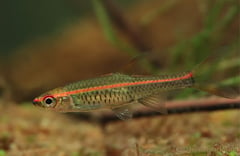
Trigonopoma pauciperforatumGlowlight Rasbora
Cyprinidae · Weber & de Beaufort, 1916
The glowlight rasbora, Trigonopoma pauciperforatum, is a small cyprinid from Peninsular Malaysia, Singapore, Borneo and Sumatra. Also sold as the 'redline' rasbora, its lateral stripe varies from deep orange to golden with locality, diet, condition and mood. It inhabits blackwater streams associated with peat swamps, where the pH can drop as low as 3.0 or 4.0, and the name R. agilis is a junior synonym of it.
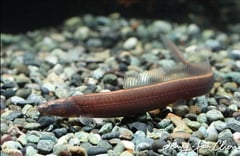
Vaillantella maassiFork-tailed Loach
Vaillantellidae · Weber & de Beaufort, 1912
The fork-tailed loach, Vaillantella maassi, is a loach from Sumatra, Borneo, Peninsular Malaysia and southern Thailand. Traded as 'chocolate scissor-tailed loach' and 'dragon loach' among other names, it has a bluish-brown body with an orange to yellow dorsal stripe. Rarely traded in numbers, it is among the more reclusive loaches and can be aggressive with its own kind and other fishes.

Xenentodon canciloides
Belonidae · Bleeker, 1854
Xenentodon canciloides is a freshwater needlefish from Borneo, Sumatra, Peninsular Malaysia and Thailand, and is considered to occur in the Mekong. Rarely seen in the ornamental trade, it is far less common there than its congener X. cancila, from which it differs in its slender, delicate jaws and smaller size, not exceeding 30 cm TL. A near-exclusive inhabitant of the upper water column, it is surprisingly peaceful with anything too large to swallow and is best kept in numbers of four or more.

Bagarius yarrelliGoonch
Sisoridae · Sykes, 1839
The goonch, Bagarius yarrelli, is a very large sisorid catfish recorded from the Indus in Pakistan east through Indochina to Sumatra and Borneo. Also known as the 'giant devil catfish' and 'sand shark', it reaches 1300 to 2000 mm and is fished for food across much of its range. That wide distribution appears doubtful, and Indian and Southeast Asian populations may prove not to be conspecific. It lives among boulders in the fast, turbulent rapids of large rivers.
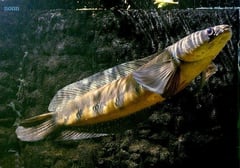
Channa marulioidesEmperor Snakehead
Channidae · Bleeker, 1851
The emperor snakehead, Channa marulioides, is a large snakehead from southern Thailand, Malaysia and Indonesia, including Borneo and Sumatra. Colour pattern varies with locality, and it is often confused with C. marulius and C. melanoptera, all three presenting taxonomic problems. Growing to 650 mm SL, it is pelagic, turns aggressive towards its own kind at sexual maturity and is suitable only for public installations or the very largest private aquaria.

Channa micropeltesGiant Snakehead
Channidae · Cuvier, 1831
The giant snakehead, Channa micropeltes, is a predatory fish from Southeast Asia that grows to well over a metre. Juveniles are sold as 'red' or 'redline' snakehead, but it is suitable only for public installations or the very largest private aquaria. Unlike most Channa species it is pelagic and needs plenty of room to swim, and adults become aggressive at sexual maturity.

Crossocheilus cobitis
Cyprinidae · Bleeker, 1854
Crossocheilus cobitis is a cyprinid ranging from the Mekong drainage in Laos, Vietnam and Thailand south to Sumatra, Borneo and Java. Primarily a lowland species, it lives in the turbid lower reaches of rivers over mud, close to submerged logs and similar objects. Given its wide range it has probably reached the trade as the invalid 'Crossocheilus siamensis', and it is likely to represent a group of similar-looking, closely related species.

Cyclocheilos enoplos
Cyprinidae · Bleeker, 1849
Cyclocheilos enoplos is a large cyprinid from the Mekong region and Thailand south through Peninsular Malaysia to Borneo, Sumatra and Java. Growing to around 750 mm SL, it is clearly unsuitable for aquaria and scarce to non-existent in the ornamental trade. In the Mekong it makes long seasonal migrations, and adults move upstream above Khone Falls in what appear to be spawning migrations.
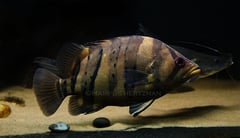
Datnioides microlepisIndonesian Tiger Perch
Datnioididae · Bleeker, 1854
The Indonesian tiger perch, Datnioides microlepis, is a large tiger perch from Peninsular Malaysia, Sumatra and Indonesian Borneo. It has 6 to 7 wide dark bars and small body scales, lives only in large, deep lowland rivers, and grows to 500 mm SL. Juveniles may form groups, but adults are not gregarious and respond aggressively to conspecifics and similarly-shaped fishes.

Hampala macrolepidotaHampala Barb
Cyprinidae · Kuhl & van Hasselt, 1823
The hampala barb, Hampala macrolepidota, is a cyprinid ranging from Myanmar through Thailand to the Mekong, and south to Borneo, Sumatra and Java. Also known as 'jungle perch' or 'sidebar barb', it can grow to over 2 feet and 5 kg and is a powerful, pelagic predator and not an aquarium subject in all but the most extreme circumstances. Prized as a food and sport fish, it has been introduced to numerous water bodies.

Hemibagrus wyckiiCrystal-eyed Catfish
Bagridae · Bleeker, 1858
The crystal-eyed catfish, Hemibagrus wyckii, is a bagrid with an enormous distribution across central Indochina and western Indonesia. Juveniles are sometimes available in the aquarium trade, but buying them is strongly discouraged: it reaches 710 mm SL, is aggressively territorial and can live for several decades. Despite the common name, the blue eye is not given as a distinguishing character in any diagnosis we've seen.

Labeo chrysophekadionBlack Shark
Cyprinidae · Bleeker, 1849
The black shark, Labeo chrysophekadion, is a large cyprinid from Southeast Asia, including the Mekong, Chao Phraya and the Greater Sunda Islands. Also known as the black sharkminnow, it reaches 600 mm and is aggressively territorial towards conspecifics and similarly-shaped fishes. It continues to be sold despite its patent unsuitability for the home aquarium, and an albino form has been selectively bred for the trade.
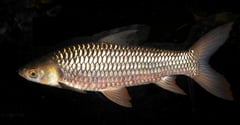
Leptobarbus hoeveniiMad Barb
Cyprinidae · Bleeker, 1851
The mad barb, Leptobarbus hoevenii, is a large pelagic cyprinid apparently native to Peninsular Malaysia, Borneo, Sumatra and Java. A popular sport fish growing to 800 to 1000 mm, it is wholly unsuitable for private aquaria but is readily available at 100 to 150 mm. The congener L. rubripinna was referred to as L. hoevenii for decades and both are traded under the same name. L. hoevenii lacks the broad dark midlateral stripe and has dark grey pelvic and anal fins.

Macrochirichthys macrochirusGiant Sword Minnow
Cyprinidae · Valenciennes, 1844
The giant sword minnow, Macrochirichthys macrochirus, is a large pelagic cyprinid widespread in Southeast Asia, from the Mekong to Borneo and Sumatra. Growing to 600 to 800 mm and becoming increasingly piscivorous as it grows, it is unsuitable for the majority of private aquaria, although juveniles are traded on occasion. It is thought to have been extirpated from the Chao Phraya, Mae Klong, Lake Songkhla and Java, and the Mekong populations have been drastically reduced.

Phalacronotus apogon
Siluridae · Bleeker, 1851
Phalacronotus apogon is a large silurid catfish from much of Southeast Asia, including Thailand, the Mekong basin and the Greater Sunda Islands. It reaches 700 mm and arguably should not be considered a home aquarium subject at all, but juveniles are sometimes sold as 'blue neon sheatfish' or 'metallic cheatfish' without adequate information on long-term care. It is an important food fish across much of its native range.

Scleropages formosusAsian Arowana
Osteoglossidae · Müller & Schlegel, 1840
The Asian arowana, Scleropages formosus, is an osteoglossid from the Mekong system, eastern Thailand, Peninsular Malaysia, Sumatra and Borneo. Highly valued in the aquarium trade since the 1970s and listed on Appendix I of CITES since 1975, it is now extirpated across much of its range. It occurs in several colour forms, such as the 'super red' of the upper Kapuas, and three were described as species in 2003, though the majority view treats all of them as S. formosus pending review.
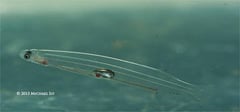
Sundasalanx microps
Sundasalangidae · Roberts, 1981
Sundasalanx microps is a miniature clupeiform from Borneo, in Indonesia and Malaysia, described from the Kapuas River. Adults are sexually mature at less than 20 mm SL and resemble the larval form of their larger ancestors. It has a small eye, less than 4% of SL. Sundasalanx species inhabit turbid, slow to moderately flowing water over silt, sand or mud in the lower parts of river basins, and little else is known of their ecology.
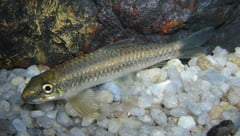
Garra borneensis
Cyprinidae · Vaillant, 1902
Garra borneensis is a cyprinid endemic to northern and western Borneo, in Kalimantan, Brunei, Sabah and Sarawak. No other member of the genus is known from the island. An obligate dweller of swiftly-flowing streams and headwaters, it lives in clear, oxygen-saturated water over gravel, rocks and bedrock carpeted with biofilm.
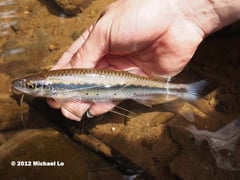
Luciosoma pellegrinii
Cyprinidae · Popta, 1905
Luciosoma pellegrinii is a slender, pike-like cyprinid endemic to Borneo, ranging from the Kapuas in West Kalimantan to Sabah. It is scarcely known in the aquarium trade because it comes from an area where very few commercial collections take place, but its name is misapplied on a regular basis. It has 4 to 8 distinct dark spots on the lateral line and appears to develop longer pelvic-fin filaments than any other member of the genus.
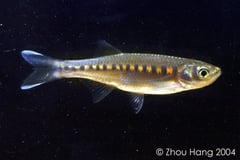
Luciosoma spilopleura
Cyprinidae · Bleeker, 1855
Luciosoma spilopleura is a small cyprinid known only from Sumatra and the Indonesian part of Borneo, where it prefers fast-flowing headwater streams. The species is poorly known and is not present in the ornamental trade, although its name has been widely misapplied to other Luciosoma species for decades. The largest known specimen measured 81.9 mm, so it appears to grow much smaller than its congeners.