River
Pahang
Only species with a profile on Seriously Fish are counted.
- Species
- 14
- Families
- 6
- Photographed
- 14 of 14
- Difficulty rated
- 14 of 14
Basin
Shares fishes withspecies recorded from both
Runs through

Barbonymus schwanefeldiiTinfoil barb
Cyprinidae · Bleeker, 1854
The tinfoil barb, Barbonymus schwanefeldii, is a large cyprinid found across much of Southeast Asia, from the Mekong to Borneo and Sumatra. Usually sold at 50 to 75 mm, it grows to 355 mm SL, and tinfoil barbs are among the species most often returned to shops having outgrown their aquarium. Selectively-bred 'golden' and 'blushing' strains exist, and the species has also been subjected to artificial dyeing.

Belontia hasseltiJava Combtail
Osphronemidae · Cuvier, 1831
The Java combtail, Belontia hasselti, is a labyrinth fish from peninsular Thailand, Peninsular Malaysia, Singapore, Sumatra, Borneo and Java. Also known as the 'Malay combtail', it mostly inhabits acidic forest peat swamps with little water movement. It differs from its only congener, B. signata, in its brownish grey body and the mosaic pattern in its unpaired fins. Growing to 200 mm SL, it will eat very small fishes and is not recommended for the average community aquarium.
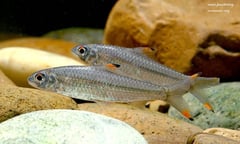
Discherodontus halei
Cyprinidae · Duncker, 1904
Discherodontus halei is a cyprinid with an apparently disjunct range: Pahang in Peninsular Malaysia, and the Mae Klong and Chao Phraya in Thailand. It inhabits clear, fast-flowing minor rivers and forest streams, and orange pigmentation in the dorsal and caudal fins helps separate it from congeners. Like others in the genus it is notoriously delicate and difficult to ship, losing scales very easily when removed from the water.

Hypsibarbus wetmorei
Cyprinidae · Smith, 1931
Hypsibarbus wetmorei is a cyprinid widespread in mainland Southeast Asia, from the lower Mekong basin south to the Pahang River in Malaysia. Its orange to red pectoral, pelvic and anal fins separate it from the very similar H. vernayi (yellow), and yellow-finned fish traded as H. wetmorei or 'lemon fin barb' appear likely to be that species. It prefers flowing water with abundant riparian vegetation and grows to 250 mm.
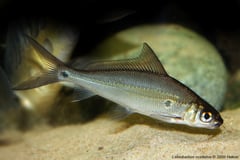
Labiobarbus ocellatus
Cyprinidae · Heckel, 1843
Labiobarbus ocellatus is a cyprinid from Peninsular Malaysia, Sumatra and Borneo, with a black spot on the shoulder and one on the caudal peduncle. It is occasionally available in the ornamental trade, typically under a name such as 'Bornean eye-spot silver shark' or the invalid scientific name Cirrhinus chinensis. A pelagic species of rivers and some lakes, it moves into seasonally inundated floodplains and forest during the wet season, and grows to 180 mm SL.

Laubuka siamensis
Cyprinidae · Fowler, 1939
Laubuka siamensis is a cyprinid from the Mekong, the Chao Phraya and Mae Klong in Thailand, and smaller drainages south to Peninsular Malaysia. Long considered synonymous with L. laubuca, it seems likely to be the species behind many of the fish entering the trade under that name. A conspicuous dark stripe, iridescent blue in life, runs uninterrupted along the rear of the body to an oval blotch on the caudal peduncle. It swims in groups at or just below the surface and is an accomplished jumper.
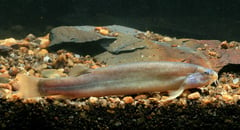
Lepidocephalus macrochir
Cobitidae · Bleeker, 1854
Lepidocephalus macrochir is a cobitid loach described from Sumatra and since recorded from Thailand, Peninsular Malaysia, Java and Borneo. It is traded sporadically as the 'pinky loach', 'deep water kuhli loach' and 'Borneo high body cave loach'. Although sometimes said to be a cave loach, Thai collectors report it from deep water, and in aquaria it spends a lot of time buried in soft substrates.
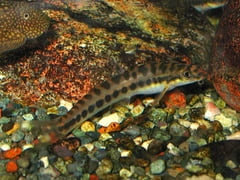
Nemacheilus masyaeArrow Loach
Nemacheilidae · Smith, 1933
Nemacheilus masyae is a nemacheilid loach from Thailand and Peninsular Malaysia. Its flanks carry 14-18 short dark bars and its back 12-17 saddles. It occurs in both small blackwater forest streams and turbid main river channels. It is very similar to N. pallidus but has a more slender body, and its dark bars and saddles are wider than the light interspaces between them.
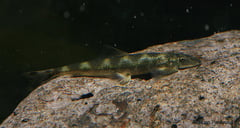
Pseudohomaloptera leonardi
Balitoridae · Hora, 1941
Pseudohomaloptera leonardi is a 'lizard' loach ranging through Peninsular Malaysia and north into Thailand as far as the Tapi river drainage. Seriously Fish referred to it as Homaloptera sp. 'H01' before its identity was established. It is very similar to P. sexmaculata, and both are sometimes misidentified as H. yunnanensis. Naturally reclusive, it needs clean, fast-flowing, well-oxygenated water and a group of four or more.

Puntigrus partipentazona
Cyprinidae · Fowler, 1934
Puntigrus partipentazona is a small cyprinid recorded from numerous river basins in Vietnam, Cambodia, Laos, Thailand and Peninsular Malaysia. It is easily told from congeners because the dark blotch on its dorsal fin extends onto the body. Typically found in heavily vegetated parts of rivers and sluggish streams, it is generally peaceful, though rival males continually battle for position within the group.
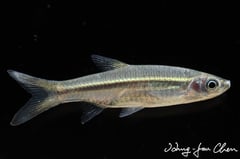
Rasbora argyrotaeniaSilver Rasbora
Cyprinidae · (Bleeker, 1849)
The silver rasbora, Rasbora argyrotaenia, is a cyprinid from Peninsular Malaysia, Singapore, Sumatra, Java, Borneo and the Palawan islands. One of the larger rasboras at up to 140 mm TL, it is a plain, silvery fish with a faint dark stripe, and fish pictured under this name with a bold black stripe are probably a regional variant of R. daniconius. A DNA barcode study found two mitochondrial lineages under the name, and the species as currently recognised is likely to be split.

Trichopsis vittataCroaking gourami
Osphronemidae · Cuvier, in Cuvier & Valenciennes, 1831
The croaking gourami, Trichopsis vittata, is a labyrinth fish found through much of Indochina, Peninsular Malaysia and Singapore. The largest of its genus, it produces audible sounds with a specialised pectoral mechanism unique within the Osphronemidae. Wild populations vary in colour pattern, and records from Borneo, Sumatra and Java might refer to a distinct species.

Hemibagrus wyckiiCrystal-eyed Catfish
Bagridae · Bleeker, 1858
The crystal-eyed catfish, Hemibagrus wyckii, is a bagrid with an enormous distribution across central Indochina and western Indonesia. Juveniles are sometimes available in the aquarium trade, but buying them is strongly discouraged: it reaches 710 mm SL, is aggressively territorial and can live for several decades. Despite the common name, the blue eye is not given as a distinguishing character in any diagnosis we've seen.
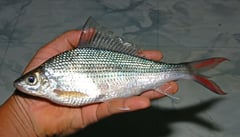
Labiobarbus fasciatus
Cyprinidae · Bleeker, 1853
Labiobarbus fasciatus is a labeonin cyprinid from the Pahang River system in Peninsular Malaysia and the islands of Sumatra and Borneo. It has a red caudal fin with a thin dark stripe along each lobe, and longitudinal stripes formed by spots on the scales. Like other Labiobarbus it has two pairs of well-developed barbels and an extremely long dorsal fin, and the genus was known as Dangila for over 100 years.