River
Pindaré
Only species with a profile on Seriously Fish are counted.
- Species
- 4
- Families
- 4
- Photographed
- 4 of 4
- Difficulty rated
- 4 of 4
Basin
Shares fishes withspecies recorded from both
Runs through

Geophagus sp. 'Pindaré'
Cichlidae · authority not recorded
Geophagus sp. 'Pindaré' is an undescribed cichlid known only from the rio Pindaré in Maranhão state, north-eastern Brazil. It appears to belong to the G. surinamensis group and is quite easily identified by its deep head and body and proportionately large eye. The trade name G. sp. 'Pindare' (Parnaíba) is confusing, because G. sp. 'Parnaíba' is now described as G. parnaibae. Parts of the Pindaré have been heavily degraded by siltation.
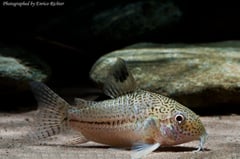
Hoplisoma juliiJulii Cory
Callichthyidae · (Steindachner, 1906)
The julii cory, Hoplisoma julii, long known as Corydoras julii, is an armoured catfish from coastal river systems south of the Amazon delta in northeastern Brazil. Also known as 'leopard cory' or 'three-lined cory', it is often confused with H. trilineatum from the upper Amazon, and many fish traded as C. julii are that species. H. julii has numerous small, distinct spots on the head, where H. trilineatum has vermiform markings, though some H. trilineatum are spotted too.

Hyphessobrycon heterorhabdusFlag Tetra
Characidae · (Ulrey, 1894)
The flag tetra, Hyphessobrycon heterorhabdus, is a characid from Pará and Maranhão states in eastern Brazil, also known as 'Belgian flag tetra'. Its name has been misapplied to similar fishes across much of the Amazon, the Orinoco and the Guianas, and the true species may reach no further upstream than the rio Tapajós. It lives almost exclusively in small, shaded forest streams called igarapés.
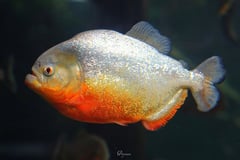
Pygocentrus nattereriRed Bellied Piranha
Serrasalmidae · Kner, 1858
The red bellied piranha, Pygocentrus nattereri, occurs through much of the Amazon basin and south into the Paraná and Uruguay river systems. Famed as a rapacious predator, it is among the most notorious freshwater fishes in the world. According to Herbert Axelrod (1976), the myth began with a feeding frenzy staged for Theodore Roosevelt in Brazil in 1913. Usually only juveniles form aggregations, and the species is relatively easy to breed in the aquarium.