River
Guamá
Only species with a profile on Seriously Fish are counted.
- Species
- 8
- Families
- 6
- Photographed
- 8 of 8
- Difficulty rated
- 8 of 8
Shares fishes withspecies recorded from both
Runs through

Apistogramma agassiziiAgassiz's Dwarf Cichlid
Cichlidae · Steindachner, 1875
Apistogramma agassizii is a dwarf cichlid found through much of the Amazon/Solimões basin, from the Río Ucayali in Peru to the Capim River in Brazil. Colour and pattern vary considerably with locality, and numerous ornamental forms have been selectively bred for the trade. It inhabits slower-moving tributaries and creeks where leaf litter collects. Captive-raised fish suit the community aquarium, while wild fish are best kept alone or with small dither fishes.
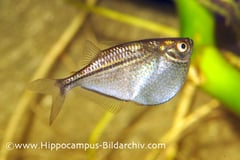
Gasteropelecus levisSilver Hatchetfish
Gasteropelecidae · Eigenmann, 1909
The silver hatchetfish (Gasteropelecus levis) is a freshwater hatchetfish found only in the lower Amazon basin in the state of Pará, Brazil. It spends almost all of its time at or just below the surface, and can leap from the water and glide for several metres to catch flying insects or escape predators. It lives in open water of larger igarapés, streams and floodplain lakes.
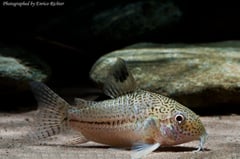
Hoplisoma juliiJulii Cory
Callichthyidae · (Steindachner, 1906)
The julii cory, Hoplisoma julii, long known as Corydoras julii, is an armoured catfish from coastal river systems south of the Amazon delta in northeastern Brazil. Also known as 'leopard cory' or 'three-lined cory', it is often confused with H. trilineatum from the upper Amazon, and many fish traded as C. julii are that species. H. julii has numerous small, distinct spots on the head, where H. trilineatum has vermiform markings, though some H. trilineatum are spotted too.
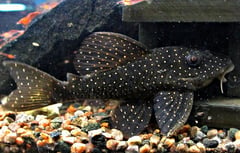
Hypancistrus sp.L004
Loricariidae · authority not recorded
L004, the angelicus pleco, is an undescribed Hypancistrus from tributaries of the lower Amazon near its mouth in Pará state, northern Brazil. It is sometimes traded under the false name 'Peckoltia angelicus', and the codes L004, L005, L028 and L073 represent distinct populations from the Tocantins, Guamá and Pará rivers. Peaceful but territorial towards its own kind, it has been bred in aquaria many times.

Hyphessobrycon heterorhabdusFlag Tetra
Characidae · Ulrey, 1894
The flag tetra, Hyphessobrycon heterorhabdus, is a characid from Pará and Maranhão states in eastern Brazil, also known as 'Belgian flag tetra'. Its name has been misapplied to similar fishes across much of the Amazon, the Orinoco and the Guianas, and the true species may reach no further upstream than the rio Tapajós. It lives almost exclusively in small, shaded forest streams called igarapés.
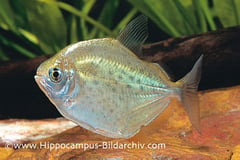
Metynnis lippincottianus
Serrasalmidae · Cope, 1870
Metynnis lippincottianus is a spotted silver dollar from Brazil and French Guiana, found in the lower and middle Amazon and the Oyapock system. It is occasionally seen for sale, sometimes as 'silver dollar', and its spotted pattern tells it apart from M. argenteus and M. hypsauchen. The spots are less pronounced than in M. maculatus, with which it shares a common name. The precise extent of its range is unclear.
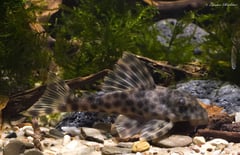
Peckoltia oligospilaL006
Loricariidae · Günther, 1864
The brown dot peckoltia (Peckoltia oligospila), also known as L006, is a suckermouth catfish from the rios Tocantins and Capim in Brazil. Only faint spots and saddles mark its body, a pattern it shares among congeners with P. bachi and some specimens of P. furcata alone. Relatively peaceful but territorial with conspecifics, it is a cave-spawner and does best in a tank designed to simulate a flowing stream.

Retroculus lapidifer
Cichlidae · Castelnau, 1855
Retroculus lapidifer is a rheophilic cichlid from the rio Tocantins and Araguaia systems and nearby coastal drainages of northeastern Brazil. It lives in rapids and fast-flowing stretches of clear water rivers, and needs a set-up designed to resemble a flowing river, with a base of at least 210 by 60 cm and water of 26 to 32 °C. A biparental substrate-spawner, it has been bred in aquaria and is available in the trade on a sporadic basis.