River
Parnaíba
Only species with a profile on Seriously Fish are counted.
- Species
- 10
- Families
- 6
- Photographed
- 10 of 10
- Difficulty rated
- 10 of 10
Shares fishes withspecies recorded from both
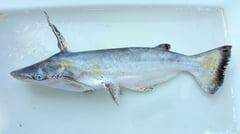
Ageneiosus inermisManduba
Auchenipteridae · Linnaeus, 1766
The manduba, Ageneiosus inermis, is a large auchenipterid catfish found throughout much of South America east of the Andes. At around 470 mm SL it would need an aquarium in excess of 400 x 120 cm as an adult and is largely unsuitable for private aquaria. An obligate carnivore, it can take surprisingly large prey, and the larger Ageneiosus species are often used as food fishes in their native countries.
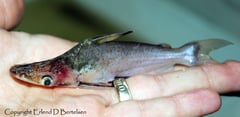
Ageneiosus ucayalensisDuck Catfish
Auchenipteridae · Castelnau, 1855
The duck catfish, Ageneiosus ucayalensis, is an auchenipterid catfish described from Peru and recorded across the Amazon, Orinoco and Guianas. Body patterning apparently varies with locality, and fish from black water habitats, particularly on the Guiana Shield, tend to be darker. Growing to around 290 mm SL and capable of taking large prey, it is safe only with similarly sized catfishes or large pelagic characins, mostly a combination for public aquaria.

Apistogramma agassiziiAgassiz's Dwarf Cichlid
Cichlidae · Steindachner, 1875
Apistogramma agassizii is a dwarf cichlid found through much of the Amazon/Solimões basin, from the Río Ucayali in Peru to the Capim River in Brazil. Colour and pattern vary considerably with locality, and numerous ornamental forms have been selectively bred for the trade. It inhabits slower-moving tributaries and creeks where leaf litter collects. Captive-raised fish suit the community aquarium, while wild fish are best kept alone or with small dither fishes.

Geophagus parnaibae
Cichlidae · Staeck & Schindler, 2006
Geophagus parnaibae is a comparatively small cichlid endemic to the rio Parnaíba drainage in Piauí and Maranhão, northeastern Brazil. Only described in 2006, it has been in the hobby since at least 1988, traded as G. sp. 'Parnaíba'. The undescribed G. sp. 'Pindaré' is sometimes labelled with the Parnaíba name but is totally distinct. Maroon and whitish horizontal bands in the caudal fin help identify it.
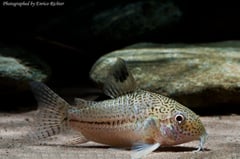
Hoplisoma juliiJulii Cory
Callichthyidae · (Steindachner, 1906)
The julii cory, Hoplisoma julii, long known as Corydoras julii, is an armoured catfish from coastal river systems south of the Amazon delta in northeastern Brazil. Also known as 'leopard cory' or 'three-lined cory', it is often confused with H. trilineatum from the upper Amazon, and many fish traded as C. julii are that species. H. julii has numerous small, distinct spots on the head, where H. trilineatum has vermiform markings, though some H. trilineatum are spotted too.
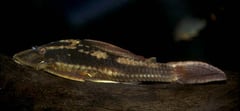
Hypostomus sp.L077
Loricariidae · authority not recorded
L077, the rusty, bruno or violet plec, is an undescribed wood-eating suckermouth catfish of the Hypostomus cochliodon complex from the rio Parnaíba basin in north-eastern Brazil. It grows to around 300 mm SL.
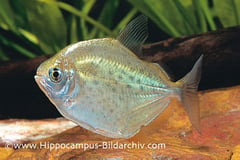
Metynnis lippincottianus
Serrasalmidae · Cope, 1870
Metynnis lippincottianus is a spotted silver dollar from Brazil and French Guiana, found in the lower and middle Amazon and the Oyapock system. It is occasionally seen for sale, sometimes as 'silver dollar', and its spotted pattern tells it apart from M. argenteus and M. hypsauchen. The spots are less pronounced than in M. maculatus, with which it shares a common name. The precise extent of its range is unclear.
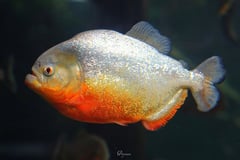
Pygocentrus nattereriRed Bellied Piranha
Serrasalmidae · Kner, 1858
The red bellied piranha, Pygocentrus nattereri, occurs through much of the Amazon basin and south into the Paraná and Uruguay river systems. Famed as a rapacious predator, it is among the most notorious freshwater fishes in the world. According to Herbert Axelrod (1976), the myth began with a feeding frenzy staged for Theodore Roosevelt in Brazil in 1913. Usually only juveniles form aggregations, and the species is relatively easy to breed in the aquarium.

Aequidens tetramerusSaddle Cichlid
Cichlidae · Heckel, 1840
The saddle cichlid, Aequidens tetramerus, is a cichlid found across much of northern South America, from the Amazon and Orinoco basins to the Guianas. The type species of its genus, it occurs in several colour forms, and fish from Ecuador and Peru are sought after for the red or orange colouration on the lower head and belly. As currently recognised it is likely to represent a group of related fishes, some of which may be described as distinct species.
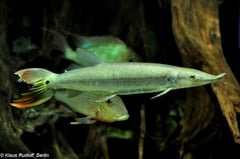
Boulengerella cuvieri
Ctenoluciidae · Spix & Agassiz, 1829
Boulengerella cuvieri is a pelagic ctenoluciid characin from much of the Amazon basin, the Río Orinoco and coastal drainages of the Guianas. The largest officially recorded specimen measured 675 mm, but it appears to grow larger, possibly beyond 800 mm. Given that size and its natural behaviour it is largely unsuitable for the home aquarium. Its entire dorsal-fin base lies ahead of the anal-fin origin, a character shared only with B. lucius and B. xyrekes among ctenoluciids.