River
Potaro
Only species with a profile on Seriously Fish are counted.
- Species
- 6
- Families
- 5
- Photographed
- 6 of 6
- Difficulty rated
- 6 of 6
Basin
Also in the Essequibo basinspecies recorded from both
Shares fishes with rivers elsewherespecies recorded from both
Runs through
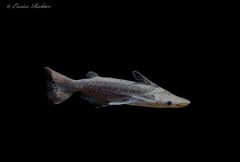
Ageneiosus marmoratusBottlenose Catfish
Auchenipteridae · Eigenmann, 1912
The bottlenose catfish, Ageneiosus marmoratus, is a predatory auchenipterid catfish from Guyana, Suriname and the upper Amazon in Peru and Ecuador. Also sold as 'Guyana slopehead', 'dolphin' or 'hammerhead' catfish, it loses much of its black-blotched juvenile patterning as it grows. Surprisingly peaceful with anything too large to swallow, it is active and sometimes skittish, and needs a tank of at least 150 x 60 cm.
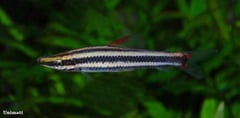
Anostomus anostomusStriped Headstander
Anostomidae · Linnaeus, 1758
The striped headstander, Anostomus anostomus, is an anostomid from the Amazon and Orinoco river systems in Peru, Brazil, Venezuela and Guyana. It lives along rocky shores of fast-flowing rivers, grazing algae and small invertebrates from the rocks. Although it shoals in nature, it is very quarrelsome with conspecifics when only a few are kept, so it is best kept singly or in a group of 6 or more in a larger tank.
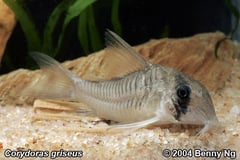
Hoplisoma griseum
Callichthyidae · (Holly, 1940)
Hoplisoma griseum, long known as Corydoras griseus, is an armoured catfish from Guyana, where it may be restricted to the Potaro River in the Essequibo watershed. It was described from aquarium specimens said to come from 'very small water courses of the Amazon', and the type locality was later corrected to the Potaro by Nijssen and Isbrücker (1980). Similar-looking fishes from Rondônia state, Brazil, carry the 'C' numbers C040 and C073, and C134 from Amapá state is also comparable.
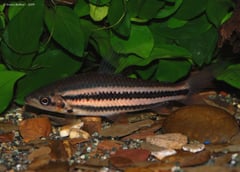
Leporinus arcusLipstick Leporinus
Anostomidae · Eigenmann, 1912
The lipstick leporinus, Leporinus arcus, is an anostomid from the Orinoco, Essequibo and upper Courantyne basins in Venezuela and the Guianas. It grows to 250 to 300 mm and needs an aquarium with base dimensions of at least 210 by 60 cm.
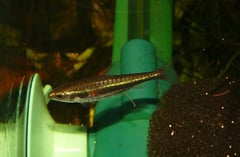
Nannostomus minimusLeast Pencilfish
Lebiasinidae · Eigenmann, 1909
The least pencilfish, Nannostomus minimus, is a tiny lebiasinid from the Potaro and Mazaruni systems of the Essequibo basin in Guyana. The second-smallest member of the genus after N. anduzei, it is poorly known in the hobby and has been exported under the name N. marilynae. In the Mazaruni it occurs with N. espei in sluggish blackwater habitats but tends to keep to marginal zones with abundant cover.

Satanoperca leucostictaWhitespot Eartheater
Cichlidae · Müller & Troschel, 1849
The whitespot eartheater, Satanoperca leucosticta, is a cichlid from the Guiana Shield in Guyana, Suriname, eastern Venezuela and northern Brazil. Farmed in several countries, it is frequently available in the ornamental trade. It is often confused with S. jurupari but is easily recognised by the prominent white spots or vermiform markings on the sides of the head. A larvophilous maternal mouthbrooder, it has been bred in aquaria.