River
Caura
Only species with a profile on Seriously Fish are counted.
- Species
- 14
- Families
- 6
- Photographed
- 14 of 14
- Difficulty rated
- 14 of 14
Basin
Also in the Orinoco basinspecies recorded from both
Shares fishes with rivers elsewherespecies recorded from both
Runs through
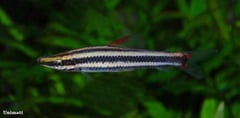
Anostomus anostomusStriped Headstander
Anostomidae · Linnaeus, 1758
The striped headstander, Anostomus anostomus, is an anostomid from the Amazon and Orinoco river systems in Peru, Brazil, Venezuela and Guyana. It lives along rocky shores of fast-flowing rivers, grazing algae and small invertebrates from the rocks. Although it shoals in nature, it is very quarrelsome with conspecifics when only a few are kept, so it is best kept singly or in a group of 6 or more in a larger tank.
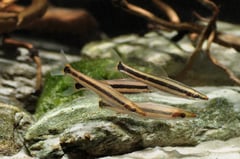
Anostomus ternetziGold-Striped Headstander
Anostomidae · Fernández-Yépez, 1949
The gold-striped headstander, Anostomus ternetzi, is an anostomid from the Río Orinoco system and coastal Guyana, Suriname and French Guiana. It lives in rocky areas at the edge of fast-flowing rivers and streams, grazing algae and small invertebrates. Like A. anostomus, it is quarrelsome with conspecifics when only a few are kept. Its distribution in Brazil is unclear, with patchy records from the Araguaia and Xingu basins.

Apistogramma hoignei
Cichlidae · Meinken, 1965
Apistogramma hoignei is a dwarf cichlid from the Río Orinoco basin in Venezuela, including the Apure, Arauca and Caura drainages. It is also known from much of the lower Orinoco mainstream. Coded A116 under the DATZ system, it has similar-looking, possibly conspecific populations referred to as A117 or A118, and inhabits slower-moving tributaries, backwaters and creeks where leaf litter collects.

Brachychalcinus orbicularisDiscus Tetra
Characidae · Valenciennes, 1850
The discus tetra, Brachychalcinus orbicularis, is a deep-bodied characid generally considered endemic to coastal watersheds of Guyana and Suriname. Recent records suggest it, or a similar congener, may also occur in the Orinoco and Negro drainages. The genus is often referred to collectively as 'silver dollar tetras', and although B. orbicularis is normally said to be the species in the trade, identification is challenging.

Geophagus abalios
Cichlidae · López-Fernández & Taphorn, 2004
Geophagus abalios is a cichlid from black and clear water tributaries of the río Orinoco in Venezuela, across the Llanos and south to the Casiquiare. One of the more commonly-traded members of the genus, it is rarely sold under the correct name and usually misidentified as G. altifrons or G. surinamensis. Juveniles are available cheaply because it is one of the few Geophagus bred commercially. Vertically split anterior flank bars separate it from the very similar G. brokopondo.

Geophagus dicrozoster
Cichlidae · López-Fernández & Taphorn, 2004
Geophagus dicrozoster is a cichlid from tributaries of the río Orinoco in Venezuela, extending to the Casiquiare and the headwaters of the Negro. Commonly traded but rarely under the correct name, it is usually sold as G. altifrons or G. surinamensis, and it is one of the few Geophagus bred commercially. Seven flank bars, the fourth and fifth meeting in a 'Y', and a relatively elongate profile identify it. It appears restricted to acidic blackwater.

Geophagus taeniopareius
Cichlidae · Kullander & Royero, 1992
Geophagus taeniopareius is a cichlid from the Venezuelan upper Río Orinoco, recorded from tributaries including the Caura, Cataniapo and Ocamo. Known in Germany as the 'Wangenstrich-Erdfresser' (cheek-stripe eartheater), it has been in the hobby since the late 1970s. A dark stripe runs from the eye to the corner of the opercle. It is markedly more aggressive than most congeners and spawns on the substrate.

Iguanodectes spilurusGreen Line Lizard Tetra
Iguanodectidae · Günther, 1864
The green line lizard tetra, Iguanodectes spilurus, is a characin found throughout the Amazon, Orinoco, Essequibo and Tocantins river systems. The most widespread Iguanodectes species, it has also been called the 'slender', 'spindle' or 'iguana' tetra, and differs from its congeners in its translucent dorsal and anal fins, lack of a red lateral stripe and prominent dark caudal-fin marking. It is sensitive to poor water conditions.
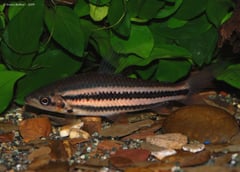
Leporinus arcusLipstick Leporinus
Anostomidae · Eigenmann, 1912
The lipstick leporinus, Leporinus arcus, is an anostomid from the Orinoco, Essequibo and upper Courantyne basins in Venezuela and the Guianas. It grows to 250 to 300 mm and needs an aquarium with base dimensions of at least 210 by 60 cm.
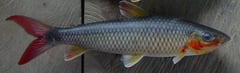
Leporinus brunneus
Anostomidae · Myers, 1950
Leporinus brunneus is an anostomid from the rios Madeira and Negro in Brazil, the Orinoco in Venezuela and Colombia, and the Casiquiare canal. The largest officially recorded specimen measured 256 mm, and an aquarium with base dimensions of at least 210 by 60 cm is needed.

Megalamphodus sweglesiRed Phantom Tetra
Characidae · Géry, 1961
The red phantom tetra, Megalamphodus sweglesi, is a small characid endemic to the upper and middle Río Orinoco watershed in Colombia and Venezuela. It apparently favours minor tributaries, oxbows and flooded forests, and in Venezuela is often found in morichals. Bred commercially in several countries, it has been traded in more than one colour form, and Zarske (2014) concluded that the particularly red form sold as 'red' or 'var. rubra' is conspecific.

Satanoperca mapiritensis
Cichlidae · Fernández-Yépez, 1950
Satanoperca mapiritensis is an eartheater cichlid native to the lower Río Orinoco basin in northern Venezuela, including the ríos Caura and Caroní. Uncommon in the aquarium trade, its name is frequently misapplied to S. leucosticta and similar, unidentified forms. Adults have white spots and vermiculations on the head, most intense on the operculum, and pale orange lips. Genetic research suggests it may turn out to be conspecific with S. jurupari and S. rhynchitis.
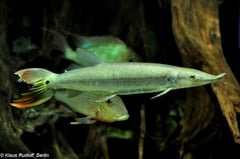
Boulengerella cuvieri
Ctenoluciidae · Spix & Agassiz, 1829
Boulengerella cuvieri is a pelagic ctenoluciid characin from much of the Amazon basin, the Río Orinoco and coastal drainages of the Guianas. The largest officially recorded specimen measured 675 mm, but it appears to grow larger, possibly beyond 800 mm. Given that size and its natural behaviour it is largely unsuitable for the home aquarium. Its entire dorsal-fin base lies ahead of the anal-fin origin, a character shared only with B. lucius and B. xyrekes among ctenoluciids.
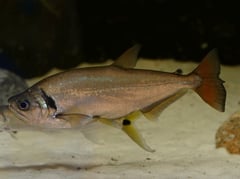
Hydrolycus tatauaia
Cynodontidae · Toledo-Piza, Menezes & Santos, 1999
Hydrolycus tatauaia is a large, predatory dogtooth characin from the lower and central Amazon, the upper Orinoco and coastal drainages of Guyana. A pelagic species of flowing main river channels, it performs long upstream migrations to spawn. Its adult size and natural behaviour mean only a handful of private aquarists have the facilities to house it long-term.