River
Mazaruni
Only species with a profile on Seriously Fish are counted.
- Species
- 12
- Families
- 8
- Photographed
- 12 of 12
- Difficulty rated
- 12 of 12
Shares fishes withspecies recorded from both
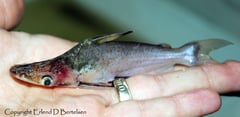
Ageneiosus ucayalensisDuck Catfish
Auchenipteridae · Castelnau, 1855
The duck catfish, Ageneiosus ucayalensis, is an auchenipterid catfish described from Peru and recorded across the Amazon, Orinoco and Guianas. Body patterning apparently varies with locality, and fish from black water habitats, particularly on the Guiana Shield, tend to be darker. Growing to around 290 mm SL and capable of taking large prey, it is safe only with similarly sized catfishes or large pelagic characins, mostly a combination for public aquaria.
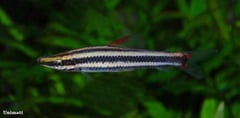
Anostomus anostomusStriped Headstander
Anostomidae · Linnaeus, 1758
The striped headstander, Anostomus anostomus, is an anostomid from the Amazon and Orinoco river systems in Peru, Brazil, Venezuela and Guyana. It lives along rocky shores of fast-flowing rivers, grazing algae and small invertebrates from the rocks. Although it shoals in nature, it is very quarrelsome with conspecifics when only a few are kept, so it is best kept singly or in a group of 6 or more in a larger tank.
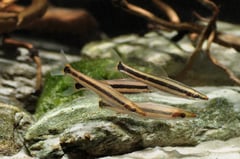
Anostomus ternetziGold-Striped Headstander
Anostomidae · Fernández-Yépez, 1949
The gold-striped headstander, Anostomus ternetzi, is an anostomid from the Río Orinoco system and coastal Guyana, Suriname and French Guiana. It lives in rocky areas at the edge of fast-flowing rivers and streams, grazing algae and small invertebrates. Like A. anostomus, it is quarrelsome with conspecifics when only a few are kept. Its distribution in Brazil is unclear, with patchy records from the Araguaia and Xingu basins.

Colomesus asellusAmazon Puffer
Tetraodontidae · Müller & Troschel, 1849
The Amazon puffer, Colomesus asellus, is a freshwater puffer found throughout much of the Amazon basin, with records north to Guyana and Venezuela. Also traded as the South American puffer or 'SAP', it is told from congeners by a transverse row of dermal flaps across the chin. It lives mostly in well-oxygenated river habitats, is intolerant of organic waste, and forms loose aggregations, so a group of 6 or more is best, away from the general community.
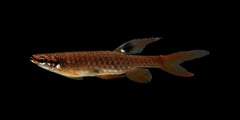
Copella arnoldiSplash Tetra
Lebiasinidae · Regan, 1912
The splash tetra, Copella arnoldi, is a lebiasinid from the lower Amazon basin in Brazil and coastal drainages of Guyana, Suriname and French Guiana. It spawns out of the water: a pair leap together onto overhanging vegetation and cling there while the eggs are laid. Zarske (2011) treats the Guianas populations as C. carsevennensis, restricting C. arnoldi sensu stricto to the lower Amazon, though Mol (2012) considers the two synonymous.

Iguanodectes spilurusGreen Line Lizard Tetra
Iguanodectidae · Günther, 1864
The green line lizard tetra, Iguanodectes spilurus, is a characin found throughout the Amazon, Orinoco, Essequibo and Tocantins river systems. The most widespread Iguanodectes species, it has also been called the 'slender', 'spindle' or 'iguana' tetra, and differs from its congeners in its translucent dorsal and anal fins, lack of a red lateral stripe and prominent dark caudal-fin marking. It is sensitive to poor water conditions.
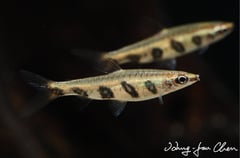
Nannostomus espeiBarred Pencilfish
Lebiasinidae · Meinken, 1956
The barred pencilfish, Nannostomus espei, is a lebiasinid considered endemic to the Mazaruni River system in Guyana. The only member of the genus to show a vertically-barred pattern permanently, it has five dark bar-like markings on each flank where congeners have horizontal stripes. It inhabits sluggish blackwater habitats where pH can be as low as 4.0, and its small size and timid nature suit a tank of its own or diminutive tankmates.
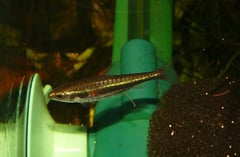
Nannostomus minimusLeast Pencilfish
Lebiasinidae · Eigenmann, 1909
The least pencilfish, Nannostomus minimus, is a tiny lebiasinid from the Potaro and Mazaruni systems of the Essequibo basin in Guyana. The second-smallest member of the genus after N. anduzei, it is poorly known in the hobby and has been exported under the name N. marilynae. In the Mazaruni it occurs with N. espei in sluggish blackwater habitats but tends to keep to marginal zones with abundant cover.

Satanoperca leucostictaWhitespot Eartheater
Cichlidae · Müller & Troschel, 1849
The whitespot eartheater, Satanoperca leucosticta, is a cichlid from the Guiana Shield in Guyana, Suriname, eastern Venezuela and northern Brazil. Farmed in several countries, it is frequently available in the ornamental trade. It is often confused with S. jurupari but is easily recognised by the prominent white spots or vermiform markings on the sides of the head. A larvophilous maternal mouthbrooder, it has been bred in aquaria.

Aequidens tetramerusSaddle Cichlid
Cichlidae · Heckel, 1840
The saddle cichlid, Aequidens tetramerus, is a cichlid found across much of northern South America, from the Amazon and Orinoco basins to the Guianas. The type species of its genus, it occurs in several colour forms, and fish from Ecuador and Peru are sought after for the red or orange colouration on the lower head and belly. As currently recognised it is likely to represent a group of related fishes, some of which may be described as distinct species.
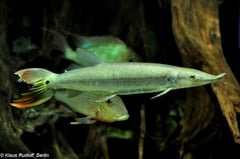
Boulengerella cuvieri
Ctenoluciidae · Spix & Agassiz, 1829
Boulengerella cuvieri is a pelagic ctenoluciid characin from much of the Amazon basin, the Río Orinoco and coastal drainages of the Guianas. The largest officially recorded specimen measured 675 mm, but it appears to grow larger, possibly beyond 800 mm. Given that size and its natural behaviour it is largely unsuitable for the home aquarium. Its entire dorsal-fin base lies ahead of the anal-fin origin, a character shared only with B. lucius and B. xyrekes among ctenoluciids.
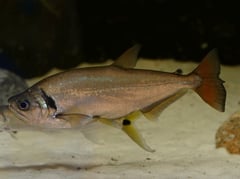
Hydrolycus tatauaia
Cynodontidae · Toledo-Piza, Menezes & Santos, 1999
Hydrolycus tatauaia is a large, predatory dogtooth characin from the lower and central Amazon, the upper Orinoco and coastal drainages of Guyana. A pelagic species of flowing main river channels, it performs long upstream migrations to spawn. Its adult size and natural behaviour mean only a handful of private aquarists have the facilities to house it long-term.