River
Preto
Only species with a profile on Seriously Fish are counted.
- Species
- 5
- Families
- 3
- Photographed
- 5 of 5
- Difficulty rated
- 5 of 5
Shares fishes withspecies recorded from both
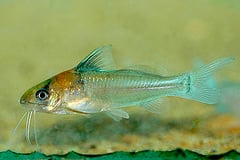
Brachyrhamdia rambarraniFalse Adolfoi
Heptapteridae · Axelrod & Burgess, 1987
The false adolfoi, Brachyrhamdia rambarrani, is a heptapterid catfish from the Rio Unini, a blackwater tributary of the lower rio Negro in Brazil. It occurs with, and mimics, Hoplisoma davidsandsi, sharing its basic colour pattern, while the common name comes from its resemblance to H. adolfoi. Rarely seen in the trade, it tends to turn up as a contaminant among shipments of other species.

Hyphessobrycon amapaensisAmapá Tetra
Characidae · Zarske & Géry, 1998
The Amapá tetra, Hyphessobrycon amapaensis, is a small characid from the rio Preto and rio Maraca drainages in Amapá state, northeastern Brazil. Also known as the 'red line' or 'scarlet' tetra, it is very similar to the flag tetra, H. heterorhabdus, but has a broader red stripe and a white or creamy central stripe. It comes from clear, light brown savanna streams over sand and gravel.

Paracheirodon axelrodiCardinal Tetra
Characidae · Schultz, 1956
The cardinal tetra, Paracheirodon axelrodi, is a small characid from the rio Negro and Orinoco drainages of Brazil, Colombia and Venezuela. Immensely popular in the hobby, it is now commercially bred on a large scale, but a significant proportion of trade fish are still wild caught or come from community-led projects such as Project Piaba. Rio Negro and Orinoco populations differ in colour pattern, and wild fish are less tolerant of deteriorating water conditions than commercially-produced ones.
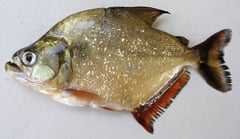
Serrasalmus brandtiiWhite Piranha
Serrasalmidae · Lütken, 1875
The white piranha, Serrasalmus brandtii, may be restricted to the rio São Francisco watershed in eastern Brazil. Also known as 'green piranha' or 'Brandt's pirambeba', it appears infrequently in the trade, and its name is sometimes misapplied to the distantly related Pygopristis denticulata. Adults are uniformly golden-bronze with dark fin margins and a concave head profile above the eye. It is best kept alone as a single specimen.
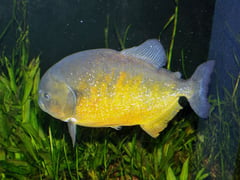
Pygocentrus pirayaPiraya
Serrasalmidae · Cuvier, 1819
The piraya, Pygocentrus piraya, is a piranha restricted to the rio São Francisco watershed in eastern Brazil. It can be identified by bright yellow-orange pigmentation on the lower jaw, opercle and flanks in life, and larger specimens have rays in the adipose fin. It is best maintained alone because mature individuals are reported to be extremely aggressive towards one another when space is limited.