River
Inírida
Only species with a profile on Seriously Fish are counted.
- Species
- 15
- Families
- 9
- Photographed
- 15 of 15
- Difficulty rated
- 15 of 15
Basin
Also in the Orinoco basinspecies recorded from both
Shares fishes with rivers elsewherespecies recorded from both
Runs through
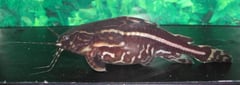
Acanthodoras cataphractusChocolate Talking Catfish
Doradidae · (Linnaeus, 1758)
The chocolate talking catfish, Acanthodoras cataphractus, is a doradid catfish from the northern Amazon basin and Atlantic drainages of the Guianas. It is most often exported as bycatch among Platydoras armatulus and is sold under the same trade names as A. spinosissimus, which has pale blotches on the back between the dorsal and caudal fins where this species has pale lines or no markings. Largely nocturnal and gregarious, it is best kept in a group of at least four.
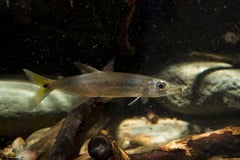
Acestrorhynchus microlepisPike Tetra
Acestrorhynchidae · (Jardine, 1841)
The pike tetra, Acestrorhynchus microlepis, is a predatory acestrorhynchid from northern Amazon drainages and the Orinoco. It also occurs in coastal rivers of Guyana, Suriname and French Guiana. A member of the A. microlepis group, it has a small blackish spot behind the gill cover and is separable from the very similar A. grandoculis only by counts. It tends to take smaller prey such as tetras, and acestrorhynchids are cannibalistic, so a group must be of comparable size.

Apistogramma sp. 'breitbinden'A164
Cichlidae · authority not recorded
Apistogramma sp. 'breitbinden' is an undescribed dwarf cichlid from the upper Rio Negro in Brazil, the Venezuelan Orinoco and the Inirida in Colombia. The German name means 'broad-banded' and refers to the uniformly broad suborbital stripe of males. Known in the hobby for several decades, it is often imported as bycatch among shipments of wild-collected A. iniridae, and some populations carry the DATZ codes A164, A165 and A167.
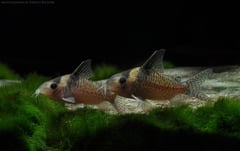
Brochis delphax
Callichthyidae · (Nijssen & Isbrücker, 1983)
Brochis delphax, long known as Corydoras delphax, is an armoured catfish from the Río Inírida and other parts of the upper Orinoco basin in Colombia. The name is used often in the trade, sometimes for misidentified congeners, while B. delphax itself is often traded as C. punctatus. A relatively elongated snout, body spots that fade in adults and spots in the caudal fin are said to separate it from B. agassizii, Hoplisoma brevirostre and others.
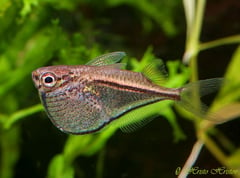
Carnegiella marthaeBlackwing Hatchetfish
Gasteropelecidae · Myers, 1927
The blackwing hatchetfish, Carnegiella marthae, is a small freshwater hatchetfish from the upper Orinoco in Venezuela and the rio Negro in Brazil. It appears to be a stenotypic inhabitant of blackwater, found in igapó and igarapé habitats with overhanging vegetation and leaf litter. Very peaceful but small and timid, it is best kept in a group of 10 or more with similarly sized, peaceful fishes.
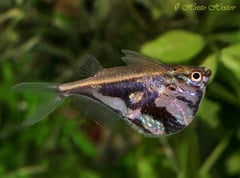
Carnegiella strigataMarbled Hatchetfish
Gasteropelecidae · (Günther, 1864)
The marbled hatchetfish, Carnegiella strigata, is a hatchetfish from the Amazon and Orinoco basins and coastal rivers of Guyana and Suriname. Popular in the hobby, it is collected for the trade mostly in the rio Negro basin in Brazil. Its larger size and dark, marbled pattern set it apart from congeners, though the pattern varies and the wide range may be open to question. It appears to live only in blackwater.

Hyphessobrycon metaePurple Tetra
Characidae · Eigenmann & Henn, 1914
The purple tetra, Hyphessobrycon metae, is a characid endemic to the middle Río Orinoco watershed in Colombia and Venezuela. Also known as 'Río Meta tetra', it is often misidentified, and H. peruvianus has repeatedly appeared under its name. The dark band on the caudal peduncle, without a broad dark band along the lower body, separates it from H. peruvianus and H. loretoensis.

Megalamphodus sweglesiRed Phantom Tetra
Characidae · Géry, 1961
The red phantom tetra, Megalamphodus sweglesi, is a small characid endemic to the upper and middle Río Orinoco watershed in Colombia and Venezuela. It apparently favours minor tributaries, oxbows and flooded forests, and in Venezuela is often found in morichals. Bred commercially in several countries, it has been traded in more than one colour form, and Zarske (2014) concluded that the particularly red form sold as 'red' or 'var. rubra' is conspecific.
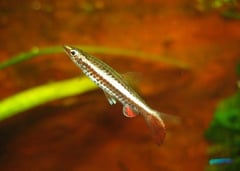
Nannostomus equesHockeystick Pencilfish
Lebiasinidae · Steindachner, 1876
The hockeystick pencilfish, Nannostomus eques, is a lebiasinid from the central and upper Amazon, the Orinoco drainage and rivers of Guyana. It swims at an oblique angle, a trait shared only with N. unifasciatus among congeners, and is also known as the 'rocket', 'diptail' or 'tubemouth' pencilfish. Genetic research on rio Negro populations raises the possibility that the species may be a complex of cryptic taxa.
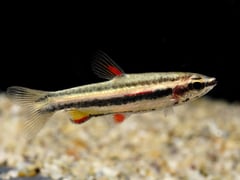
Nannostomus marginatusDwarf Pencilfish
Lebiasinidae · Eigenmann, 1909
The dwarf pencilfish, Nannostomus marginatus, is a lebiasinid of Guyana, Suriname and the middle-to-lower Amazon in Peru, Colombia and Brazil. Enduringly popular, it lacks the red body colour of males of the related N. mortenthaleri and N. rubrocaudatus, showing three dark lateral stripes with no red or purple between them. Colour varies between populations, and its small size and timid nature make it a poor community fish.

Paracheirodon axelrodiCardinal Tetra
Characidae · (Schultz, 1956)
The cardinal tetra, Paracheirodon axelrodi, is a small characid from the rio Negro and Orinoco drainages of Brazil, Colombia and Venezuela. Immensely popular in the hobby, it is now commercially bred on a large scale, but a significant proportion of trade fish are still wild caught or come from community-led projects such as Project Piaba. Rio Negro and Orinoco populations differ in colour pattern, and wild fish are less tolerant of deteriorating water conditions than commercially-produced ones.

Paracheirodon simulansGreen Neon Tetra
Characidae · (Géry, 1963)
The green neon tetra, Paracheirodon simulans, is a small characid from the rio Negro and Orinoco drainages of Brazil, Colombia and Venezuela. An exclusive inhabitant of blackwater, it lives only in the upper, terra firme reaches of tributaries and is sometimes traded as 'false neon tetra' or 'blue neon tetra'. A greener lateral stripe that extends to the caudal-fin base and duller red flanks separate it from P. innesi and P. axelrodi.
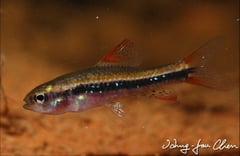
Poecilocharax weitzmaniBlack Darter Tetra
Crenuchidae · Géry, 1965
The black darter tetra, Poecilocharax weitzmani, is a crenuchid recorded from Brazil, Colombia, Peru and Venezuela. It has been collected from the upper Río Negro, Río Orinoco and Río Solimões drainages. Also traded as 'Black Morpho' tetra, it requires specialist care and is notoriously reluctant to accept dried foods. Unlike most small characids it does not form schools, and males are aggressively territorial towards one another. The Peruvian populations may apparently represent an undescribed species.
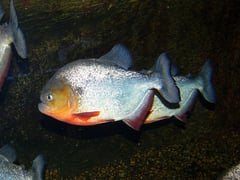
Pygocentrus caribaBlack Spot Piranha
Serrasalmidae · (Humboldt, 1821)
The black spot piranha, Pygocentrus cariba, is restricted to the Río Orinoco basin in Colombia and Venezuela. Many of its habitats lie within the llanos, and it has been recorded from river channels, tributaries and floodplain lakes, many of them acidic blackwater environments. Specimens over 100 mm SL have a large humeral spot and few spots on the body, which separates it from P. nattereri. It is best maintained alone.

Satanoperca daemonThreespot Eartheater
Cichlidae · (Heckel, 1840)
The threespot eartheater, Satanoperca daemon, is a cichlid from the rio Negro, Casiquiare and upper Orinoco systems in Brazil, Venezuela and Colombia. It is mostly observed in acidic, mineral-poor blackwater. Relatively common in the aquarium trade, it is by no means easy to maintain, needing particular attention to space, diet, water quality and chemistry. Two dark blotches on the flank separate it from the similar S. lilith, which has only one.