River
Meta
Only species with a profile on Seriously Fish are counted.
- Species
- 20
- Families
- 10
- Photographed
- 18 of 20
- Difficulty rated
- 20 of 20
Basin
Also in the Orinoco basinspecies recorded from both
Shares fishes with rivers elsewherespecies recorded from both
Runs through
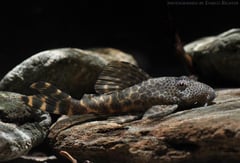
Ancistomus sp. L147L147
Loricariidae · authority not recorded
L147 is an undescribed Ancistomus species, a suckermouth catfish from tributaries of the middle Río Orinoco in Venezuela and the lower Río Meta in Colombia. Some reports suggest it occurs further up the Meta system, around Villavicencio, some 600 km upriver. It spawns in caves with the male responsible for brood care, and has been bred regularly in aquaria.

Apistogramma hongsloi
Cichlidae · Kullander, 1979
Apistogramma hongsloi is a dwarf cichlid from the Río Vichada and middle Río Meta basins in Colombia and the middle Orinoco in Venezuela. Coded A110 under the DATZ system, it has similar-looking, possibly conspecific populations referred to as A111 to A115 depending on locality. It lives in small tributaries and still waters, and males grow to 55 to 60 mm and females to 40 to 45 mm.

Apistogramma macmasteri
Cichlidae · Kullander, 1979
Apistogramma macmasteri is a dwarf cichlid known only from the Río Guaytiquía and Río Metica basins in the upper Río Meta system, Colombia. Coded A120 under the DATZ system, it has a similar-looking, possibly conspecific population referred to as A122, and A121 is the ornamental 'red' form. Captive-raised fish are the recommended choice for the community aquarium.

Axelrodia rieseiRuby Tetra
Characidae · Géry, 1966
The ruby tetra, Axelrodia riesei, is a tiny characid known only from the upper Río Meta basin in Colombia, part of the Orinoco system. It is less often seen in the hobby than A. stigmatias, presumably because of its remote, restricted range, and differs from it in its deeper body and red colour, which can fade after a period in aquaria. It is said to inhabit blackwater environments, and its small size and somewhat specialised requirements make it a poor community fish.
Chaetostoma formosaeStriped Bulldog Pleco
Loricariidae · Ballen, 2011
The striped bulldog pleco, Chaetostoma formosae, is a suckermouth catfish from piedmont streams of the upper Meta and Guaviare systems in Colombia. The commonest member of the genus in the hobby, it is still misidentified as C. thompsoni and sold under several names and L-numbers. An obligate inhabitant of fast-flowing headwater streams, it needs clean, well-oxygenated water with strong flow and does best in a dedicated species set-up.
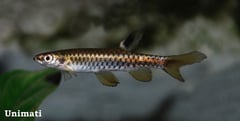
Copella eigenmanni
Lebiasinidae · Regan, 1912
Copella eigenmanni is a small lebiasinid from the Orinoco system in the llanos of Colombia and Venezuela, including the Meta, Caroní and Apure. It turns up in the trade from time to time among wild-caught fishes from the Orinoco basin. Colombian populations were formerly called C. metae until Zarske (2011) synonymised the two. A broad dark stripe runs from the snout to the eye, and the eggs are laid among vegetation and guarded by the male.
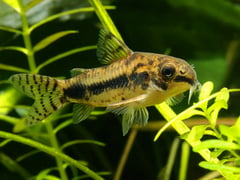
Hoplisoma habrosumSalt and Pepper Cory
Callichthyidae · (Weitzman, 1960)
The salt and pepper cory, Hoplisoma habrosum, long known as Corydoras habrosus, is a tiny armoured catfish from left bank tributaries of the upper Orinoco in Colombia and Venezuela. Most records come from the Río Apure watershed in the Llanos, where it apparently favours lagoons, streams, inundated forest and grassland with little flow. Also called 'dainty cory' and 'Venezuelan pygmy cory', it has 2-3 dark markings along the side of the body, against 4-5 in the similar H. cochui.
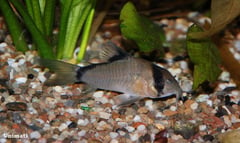
Hoplisoma metaeBandit Cory
Callichthyidae · (Eigenmann, 1914)
The bandit cory, Hoplisoma metae, long known as Corydoras metae, is an armoured catfish endemic to the upper Río Meta, an Orinoco tributary in eastern Colombia. It appears to be absent from the lower Meta and has not been recorded in Venezuela. Also called 'masked' or 'Meta' cory, it has an oblique dark bar on the rear of the body that ends at the caudal-fin base without splitting, and no other dark markings on the body.

Hyphessobrycon metaePurple Tetra
Characidae · Eigenmann & Henn, 1914
The purple tetra, Hyphessobrycon metae, is a characid endemic to the middle Río Orinoco watershed in Colombia and Venezuela. Also known as 'Río Meta tetra', it is often misidentified, and H. peruvianus has repeatedly appeared under its name. The dark band on the caudal peduncle, without a broad dark band along the lower body, separates it from H. peruvianus and H. loretoensis.
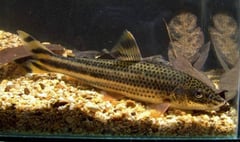
Leporellus vittatus
Anostomidae · Valenciennes, 1850
Leporellus vittatus is an anostomid with a huge natural range across the Amazon, Paraná-Paraguay, São Francisco and Orinoco river systems. Unlike most anostomids it is adapted to a benthic existence in flowing water and spends most of its time on or around the substrate. Occasionally exported, it requires quite specialised conditions, an aquarium of at least 210 by 60 cm and ideally a group of six or more.

Megalamphodus sweglesiRed Phantom Tetra
Characidae · Géry, 1961
The red phantom tetra, Megalamphodus sweglesi, is a small characid endemic to the upper and middle Río Orinoco watershed in Colombia and Venezuela. It apparently favours minor tributaries, oxbows and flooded forests, and in Venezuela is often found in morichals. Bred commercially in several countries, it has been traded in more than one colour form, and Zarske (2014) concluded that the particularly red form sold as 'red' or 'var. rubra' is conspecific.

Paracheirodon axelrodiCardinal Tetra
Characidae · Schultz, 1956
The cardinal tetra, Paracheirodon axelrodi, is a small characid from the rio Negro and Orinoco drainages of Brazil, Colombia and Venezuela. Immensely popular in the hobby, it is now commercially bred on a large scale, but a significant proportion of trade fish are still wild caught or come from community-led projects such as Project Piaba. Rio Negro and Orinoco populations differ in colour pattern, and wild fish are less tolerant of deteriorating water conditions than commercially-produced ones.

Paracheirodon simulansGreen Neon Tetra
Characidae · Géry, 1963
The green neon tetra, Paracheirodon simulans, is a small characid from the rio Negro and Orinoco drainages of Brazil, Colombia and Venezuela. An exclusive inhabitant of blackwater, it lives only in the upper, terra firme reaches of tributaries and is sometimes traded as 'false neon tetra' or 'blue neon tetra'. A greener lateral stripe that extends to the caudal-fin base and duller red flanks separate it from P. innesi and P. axelrodi.
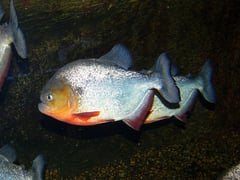
Pygocentrus caribaBlack Spot Piranha
Serrasalmidae · Humboldt, 1821
The black spot piranha, Pygocentrus cariba, is restricted to the Río Orinoco basin in Colombia and Venezuela. Many of its habitats lie within the llanos, and it has been recorded from river channels, tributaries and floodplain lakes, many of them acidic blackwater environments. Specimens over 100 mm SL have a large humeral spot and few spots on the body, which separates it from P. nattereri. It is best maintained alone.
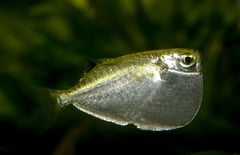
Thoracocharax stellatusSpotfin Hatchetfish
Gasteropelecidae · Kner, 1858
The spotfin hatchetfish, Thoracocharax stellatus, is the most widespread neotropical hatchetfish, recorded from much of South America. It is told from its only congener, T. securis, by a prominent dark spot in the dorsal fin, and is sometimes traded as 'platinum hatchetfish'. It feeds almost entirely on insects, and a tightly fitting cover is needed because it can clear several metres in one jump.

Aequidens tetramerusSaddle Cichlid
Cichlidae · Heckel, 1840
The saddle cichlid, Aequidens tetramerus, is a cichlid found across much of northern South America, from the Amazon and Orinoco basins to the Guianas. The type species of its genus, it occurs in several colour forms, and fish from Ecuador and Peru are sought after for the red or orange colouration on the lower head and belly. As currently recognised it is likely to represent a group of related fishes, some of which may be described as distinct species.
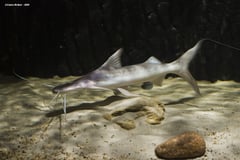
Brachyplatystoma platynemumSlobbering Catfish
Pimelodidae · Boulenger, 1898
The slobbering catfish, Brachyplatystoma platynemum, is a large migratory pimelodid catfish from the Amazon and Orinoco basins. The name refers to its relatively thick barbels, which give the impression that the fish is drooling. It travels considerable distances along deeper, flowing channels, and sexually mature adults have been observed in the upper rio Madeira basin, some 3000 km from the estuary. It grows to 1000 mm SL.
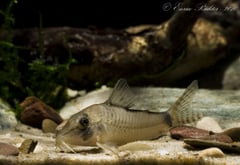
Corydoras simulatus
Callichthyidae · Weitzman & Nijssen, 1970
Corydoras simulatus is an armoured catfish known only from the upper Meta watershed in Colombia. It can be identified from most similar-looking congeners by its pair of small rictal barbels. The colour pattern varies considerably with collection locality and some forms have been misidentified as other species, while fish with a dark marking on the sides are sometimes referred to as Corydoras sp. 'olga'.
Tatia galaxias
Auchenipteridae · Mees, 1974
Tatia galaxias is a wood catfish from the Orinoco river basin in Venezuela and Colombia, dark with small, round white spots like stars. It is sometimes confused with Tatia intermedia, in which the spots are longer and oval.

Hyphessobrycon acaciae
Characidae · García-Alzate, Román-Valencia & Prada-Pedreros, 2010
Hyphessobrycon acaciae is a small tetra known only from streams in the middle and upper Río Guamal, part of the Río Meta system in Colombia. The dark lateral band separates it from most Hyphessobrycon in the Orinoco basin, and it is told from the remaining few by counts of fin rays, teeth and scales. The Guamal drains into the upper Meta, which flows into the Río Orinoco.