River
Sharavathi
Only species with a profile on Seriously Fish are counted.
- Species
- 4
- Families
- 2
- Photographed
- 4 of 4
- Difficulty rated
- 4 of 4
Shares fishes withspecies recorded from both

Barilius bakeri
Cyprinidae · Day, 1865
Barilius bakeri is a fast-swimming cyprinid endemic to the Western Ghats of southwestern India, with records from many rivers in Kerala and Karnataka. It is traded as 'royal danio', 'blue-spotted hill trout' and 'blue-dotted mirror fish', and has a single row of bluish-green spots that get smaller with age. Its well-oxygenated, fast-flowing rivers are being polluted and degraded by exotic species and sand mining.

Barilius gatensisMalabar Baril
Cyprinidae · Valenciennes, 1844
The Malabar baril, Barilius gatensis, is a cyprinid endemic to the Western Ghats of southern India, in Karnataka, Kerala and Tamil Nadu. Occasionally seen in the trade, it has 13 to 15 dark blue vertical bars that often almost break up in adults. It inhabits well-oxygenated, fast-flowing rivers and streams, apparently favouring slower runs and pools, and its speed and vigorous feeding make it unsuitable for the general community.
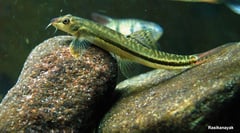
'Nemacheilus' anguilla
Nemacheilidae · Annandale, 1919
Nemacheilus anguilla is a loach endemic to the Western Ghats of southwestern India, recorded from rivers in Maharashtra, Karnataka and Kerala. Dark flank markings merged into a lateral stripe separate it from other Indian congeners, and its generic placement requires further study. It inhabits well-oxygenated, moderate to fast-flowing rivers over gravel and boulders, and is peaceful with its own kind, best kept in a group of four or more.

Puntius sahyadriensisMaharaja Barb
Cyprinidae · Silas, 1953
The maharaja barb, Puntius sahyadriensis, is a cyprinid endemic to the northern and central Western Ghats mountains of India. It lives in hill streams shaded by the forest canopy and dense marginal vegetation, over boulders, stones, sand or gravel. The angular body, colour pattern and enlarged male dorsal fin make it difficult to confuse with any other member of the genus, and it is occasionally traded as the 'Khavli' barb.