River
Bhadra
Only species with a profile on Seriously Fish are counted.
- Species
- 8
- Families
- 4
- Photographed
- 8 of 8
- Difficulty rated
- 8 of 8
Basin
Also in the Krishna basinspecies recorded from both
Shares fishes with rivers elsewherespecies recorded from both
Runs through

Dawkinsia filamentosaFilament Barb
Cyprinidae · (Valenciennes, 1844)
The filament barb, Dawkinsia filamentosa, is a cyprinid endemic to the Western Ghats region of southern India, in Kerala, Tamil Nadu and Karnataka. Adult males and some females develop filament-like extensions to the branched dorsal-fin rays. Most common in lowland coastal floodplains, it occurs in fresh and brackish water, and it also appears on trade lists as 'blackspot barb' or 'mahecola barb'.
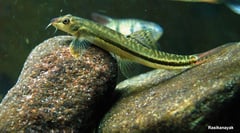
'Nemacheilus' anguilla
Nemacheilidae · Annandale, 1919
Nemacheilus anguilla is a loach endemic to the Western Ghats of southwestern India, recorded from rivers in Maharashtra, Karnataka and Kerala. Dark flank markings merged into a lateral stripe separate it from other Indian congeners, and its generic placement requires further study. It inhabits well-oxygenated, moderate to fast-flowing rivers over gravel and boulders, and is peaceful with its own kind, best kept in a group of four or more.
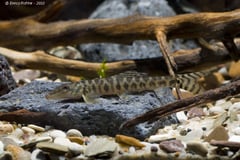
Nemachilichthys rueppelli
Nemacheilidae · (Sykes, 1839)
Nemachilichthys rueppelli is a nemacheilid loach from the upper Krishna River system in the Western Ghats, India. It inhabits moderate to fast-flowing streams and rivers, usually on the bed among aquatic vegetation and submerged roots. N. shimogensis was long treated as a separate species, but Keskar et al. (2015) examined topotypes of both and concluded they are conspecific.

Puntius sahyadriensisMaharaja Barb
Cyprinidae · Silas, 1953
The maharaja barb, Puntius sahyadriensis, is a cyprinid endemic to the northern and central Western Ghats mountains of India. It lives in hill streams shaded by the forest canopy and dense marginal vegetation, over boulders, stones, sand or gravel. The angular body, colour pattern and enlarged male dorsal fin make it difficult to confuse with any other member of the genus, and it is occasionally traded as the 'Khavli' barb.

Xenentodon cancilaFreshwater Needlefish
Belonidae · (Hamilton, 1822)
The freshwater needlefish, Xenentodon cancila, is a belonid from Pakistan east through India, Bangladesh, Nepal, Sri Lanka, Myanmar and Thailand. Often called 'freshwater garfish', it only superficially resembles the true gars, and most of its relatives in the Belonidae are marine or estuarine. A near-exclusive inhabitant of the upper water column, it is surprisingly peaceful with anything too large to swallow and is best kept in numbers of four or more, in a tank of 180 ∗ 60 cm or more.

Hemibagrus punctatusPorthole Bagrid
Bagridae · (Jerdon, 1849)
The porthole bagrid, Hemibagrus punctatus, is a catfish known only from the Cauvery (Kaveri) river system in southern India. The IUCN lists it as Critically Endangered (possibly extinct), and at its confirmed localities in the Kabini, Bhadra and Moyar systems it was last collected in 1998 or earlier. It has been available only very occasionally in the aquarium trade, and its flanks carry dark spots arranged in vertical columns.

Garra mullya
Cyprinidae · (Sykes, 1839)
Garra mullya is a cyprinid endemic to and widespread within peninsular India, in rivers including the Tapti, Narmada, Godavari, Krishna and Cauvery. It has been recorded from flowing headwater streams to low altitude main river channels, including polluted stretches, and at least some populations migrate upstream to breed. Wild fish feed on algae, diatoms and organic detritus.

Gymnostomus ariza
Cyprinidae · (Hamilton, 1807)
Gymnostomus ariza is a cyprinid widely distributed from the Indus basin in Pakistan through India, Bangladesh and Myanmar. Growing to around 300 mm SL, it inhabits flowing streams and tributaries with clear water. It has a confusing taxonomic history, having been placed in Bangana, Cirrhinus and Labeo in recent years. It breeds in temporarily-inundated zones in the wet season and is also produced commercially for food.