River
Tunga
Only species with a profile on Seriously Fish are counted.
- Species
- 10
- Families
- 4
- Photographed
- 10 of 10
- Difficulty rated
- 10 of 10
Basin
Also in the Krishna basinspecies recorded from both
Shares fishes with rivers elsewherespecies recorded from both
Runs through

Barilius bakeri
Cyprinidae · Day, 1865
Barilius bakeri is a fast-swimming cyprinid endemic to the Western Ghats of southwestern India, with records from many rivers in Kerala and Karnataka. It is traded as 'royal danio', 'blue-spotted hill trout' and 'blue-dotted mirror fish', and has a single row of bluish-green spots that get smaller with age. Its well-oxygenated, fast-flowing rivers are being polluted and degraded by exotic species and sand mining.
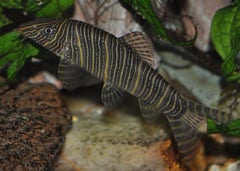
Botia striataZebra Loach
Botiidae · Narayan Rao, 1920
The zebra loach, Botia striata, is a botiid loach from the Krishna River system in southern India, described from the Tunga River in Karnataka. Its yellow to golden body with blue, green, grey or black bars and typically red mouthparts make it one of the most easily recognised in the genus, although the bars break up entirely in some specimens. Given its adult size and peaceable nature it is perhaps the best choice of Botia for the general community.

Dawkinsia arulius
Cyprinidae · Jerdon, 1849
Dawkinsia arulius is a cyprinid from Karnataka, southwestern India, apparently now restricted to the upper Cauvery and the Tungabhadra headwaters. Adults have three large, diffuse dark markings on the body. It appears extirpated at its type locality, most likely because of the Krishna Raja Sagara dam upstream, and the fish traded as 'arulius barb' is often the related D. tambraparniei, in which males have filamentous dorsal-fin rays.

Garra bicornutaRhino Garra
Cyprinidae · Narayan Rao, 1920
The rhino garra, Garra bicornuta, is a cyprinid from the Tunga River in the upper Krishna drainage, Karnataka, southern India. No other Garra is known to have a pair of rostral processes, which males develop and hold erect when sparring. A blue opercular spot ringed with gold blotches also identifies it. It is traded as 'Tunga garra' or 'lionhead garra', and can be territorial, especially at feeding time.

Haludaria fasciataMelon Barb
Cyprinidae · Jerdon, 1849
The melon barb, Haludaria fasciata, is a small cyprinid endemic to the Western Ghats of southern India, in Goa, Karnataka, Kerala and Tamil Nadu. It exists in a number of colour forms, and it is undecided whether they are geographical variants or a complex of closely-related species. Also traded as the 'ember barb', 'banded barb' and 'black spot barb', it is relatively peaceful and hardy, but a vigorous feeder that may outcompete slower or more timid fishes.
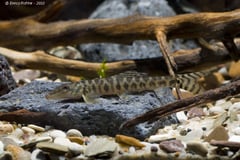
Nemachilichthys rueppelli
Nemacheilidae · Sykes, 1839
Nemachilichthys rueppelli is a nemacheilid loach from the upper Krishna River system in the Western Ghats, India. It inhabits moderate to fast-flowing streams and rivers, usually on the bed among aquatic vegetation and submerged roots. N. shimogensis was long treated as a separate species, but Keskar et al. (2015) examined topotypes of both and concluded they are conspecific.

Pethia setnaiNarayan Barb
Cyprinidae · Chhapgar & Sane, 1992
The Narayan barb, Pethia setnai, is a small cyprinid common in rivers draining the Western Ghats of India, described from Sanguem in Goa. It is widely traded as 'Puntius' narayani, though the trade fish all have the serrated dorsal-fin spine of P. setnai, a feature 'P.' narayani lacks. The central of its three dark flank markings, beneath the dorsal fin, is uniquely pale and diffuse. In hill streams and smaller rivers it gathers in backwater pools and deeper, slower areas.

Puntius sahyadriensisMaharaja Barb
Cyprinidae · Silas, 1953
The maharaja barb, Puntius sahyadriensis, is a cyprinid endemic to the northern and central Western Ghats mountains of India. It lives in hill streams shaded by the forest canopy and dense marginal vegetation, over boulders, stones, sand or gravel. The angular body, colour pattern and enlarged male dorsal fin make it difficult to confuse with any other member of the genus, and it is occasionally traded as the 'Khavli' barb.

Xenentodon cancilaFreshwater Needlefish
Belonidae · Hamilton, 1822
The freshwater needlefish, Xenentodon cancila, is a belonid from Pakistan east through India, Bangladesh, Nepal, Sri Lanka, Myanmar and Thailand. Often called 'freshwater garfish', it only superficially resembles the true gars, and most of its relatives in the Belonidae are marine or estuarine. A near-exclusive inhabitant of the upper water column, it is surprisingly peaceful with anything too large to swallow and is best kept in numbers of four or more, in a tank of 180 ∗ 60 cm or more.

Gymnostomus ariza
Cyprinidae · Hamilton, 1807
Gymnostomus ariza is a cyprinid widely distributed from the Indus basin in Pakistan through India, Bangladesh and Myanmar. Growing to around 300 mm SL, it inhabits flowing streams and tributaries with clear water. It has a confusing taxonomic history, having been placed in Bangana, Cirrhinus and Labeo in recent years. It breeds in temporarily-inundated zones in the wet season and is also produced commercially for food.