River
Tadi
Only species with a profile on Seriously Fish are counted.
- Species
- 3
- Families
- 3
- Photographed
- 3 of 3
- Difficulty rated
- 3 of 3
Shares fishes withspecies recorded from both

Garra cambodgiensisFalse SAE
Cyprinidae · Tirant, 1883
The false SAE, Garra cambodgiensis, is a cyprinid from the Mekong, Chao Phraya and Mae Klong basins and northern Peninsular Malaysia. It is still traded as Garra taeniata and is often confused with the Crossocheilus species sold as 'Siamese algae eater'. In this species the dark lateral stripe ends at the caudal peduncle, and a sucker formed by the lower lip is present. It inhabits swiftly-flowing headwaters and tributaries.
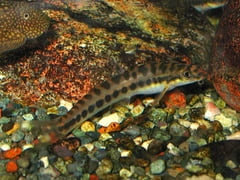
Nemacheilus masyaeArrow Loach
Nemacheilidae · Smith, 1933
Nemacheilus masyae is a nemacheilid loach from Thailand and Peninsular Malaysia. Its flanks carry 14-18 short dark bars and its back 12-17 saddles. It occurs in both small blackwater forest streams and turbid main river channels. It is very similar to N. pallidus but has a more slender body, and its dark bars and saddles are wider than the light interspaces between them.
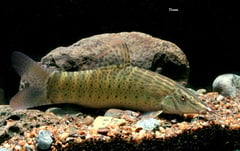
Syncrossus beaufortiChameleon Loach
Botiidae · Smith, 1931
The chameleon loach, Syncrossus beauforti, is a botiid loach from Thailand and southern Myanmar, including the Chao Phraya and the Ataran River. It has been widely mislabelled as S. berdmorei in older aquarium literature, but has 9-10 branched dorsal-fin rays and rows of small dark markings across the body and head even when young. Adults reach 160-180 mm, and wild populations appear to have declined by at least 20-29% since 1997.