River
Tigre
Only species with a profile on Seriously Fish are counted.
- Species
- 10
- Families
- 6
- Photographed
- 10 of 10
- Difficulty rated
- 10 of 10
Basin
Also in the Amazon basinspecies recorded from both
Shares fishes with rivers elsewherespecies recorded from both
Runs through
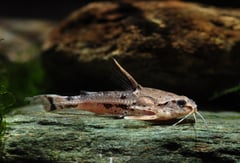
Amblydoras nauticusMarbled Talking Catfish
Doradidae · Cope, 1874
The marbled talking catfish, Amblydoras nauticus, is a small doradid catfish from Peru, described from Nauta in the Peruvian Amazon. It is often still sold as A. hancockii, a name now considered a synonym of Platydoras hancockii. Hardy and tolerant of a wide range of water conditions, it is secretive and rarely seen by day. It makes audible sounds by grinding its pectoral spines in their sockets and by resonating the swim bladder, and its spines tangle easily in nets.

Apistogramma agassiziiAgassiz's Dwarf Cichlid
Cichlidae · Steindachner, 1875
Apistogramma agassizii is a dwarf cichlid found through much of the Amazon/Solimões basin, from the Río Ucayali in Peru to the Capim River in Brazil. Colour and pattern vary considerably with locality, and numerous ornamental forms have been selectively bred for the trade. It inhabits slower-moving tributaries and creeks where leaf litter collects. Captive-raised fish suit the community aquarium, while wild fish are best kept alone or with small dither fishes.

Astyanax bimaculatusTwo Spot Astyanax
Characidae · Linnaeus, 1758
The two spot astyanax, Astyanax bimaculatus, is a characid ranging from Panama through most of the Amazon and Orinoco basins. It lives in a wide variety of biotopes, from swiftly-flowing rivers and streams to ponds, ditches and reservoirs. The name is currently applied to what is considered a species complex of at least four taxa, and aquarium fish most often arrive as contaminants among shipments of other species.

Colomesus asellusAmazon Puffer
Tetraodontidae · Müller & Troschel, 1849
The Amazon puffer, Colomesus asellus, is a freshwater puffer found throughout much of the Amazon basin, with records north to Guyana and Venezuela. Also traded as the South American puffer or 'SAP', it is told from congeners by a transverse row of dermal flaps across the chin. It lives mostly in well-oxygenated river habitats, is intolerant of organic waste, and forms loose aggregations, so a group of 6 or more is best, away from the general community.
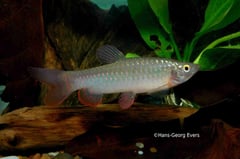
Copeina guttataRed-spotted Tetra
Lebiasinidae · Steindachner, 1876
The red-spotted tetra, Copeina guttata, is a lebiasinid from the middle and upper Amazon basin in Brazil, Peru, Ecuador and Colombia. Reaching 76 mm, it needs a tank of at least 120 x 30 cm. The eggs are apparently deposited in a shallow depression dug in the substrate and guarded by the male. Like many fishes from pristine environments it is intolerant of organic pollutants and requires spotless water.
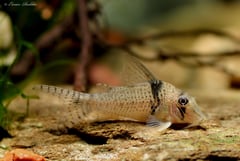
Corydoras pastazensisPastaza Cory
Callichthyidae · Weitzman, 1963
The Pastaza cory, Corydoras pastazensis, is an armoured catfish from the upper Río Pastaza basin in Ecuador and the ríos Ucayali and Puinahua in Peru. The Río Tigre form was raised to species status as C. orcesi, a decision not followed by all authorities. The two are relatively easy to tell apart: in C. pastazensis the dark vertical bar breaks up or tapers off low on the body, and the body is peppered with numerous small dark spots.

Hyphessobrycon peruvianusPeruvian Tetra
Characidae · Ladiges, 1938
The Peruvian tetra, Hyphessobrycon peruvianus, is a characid known only from the upper Amazon basin in Peru. Popular in the trade, it is sometimes confused with H. loretoensis and H. metae and has repeatedly appeared under the latter name in aquarium literature. A more elongate body, a dark band reaching the tips of the median caudal-fin rays and red markings at the base of both caudal lobes set it apart.
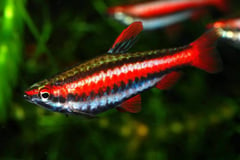
Nannostomus mortenthaleriCoral Red Pencilfish
Lebiasinidae · Paepke & Arendt, 2001
The coral red pencilfish, Nannostomus mortenthaleri, is a lebiasinid that appears endemic to the Nanay basin and Río Tigre system in Loreto, Peru. Originally described as a subspecies of N. marginatus, it is traded under names including 'red arc' and 'Peruvian red' pencilfish, and males carry bright red between the upper two dark lateral stripes. More aggressive than most congeners, it needs a spacious tank with plenty of broken lines of sight.
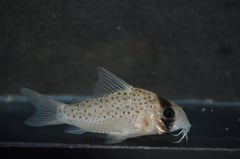
Hoplisoma atropersonatumFairy Cory
Callichthyidae · (Weitzman & Nijssen, 1970)
The fairy cory, Hoplisoma atropersonatum, long known as Corydoras atropersonatus, is an armoured catfish known only from the Tigre and Nanay drainages in Ecuador and Peru. It is sometimes confused with Brochis sychri, a more elongate fish with a longer snout, and more closely with C097, traded as C. sychri 'longnose'. C097 has a snout of intermediate length and better-defined, more widely spaced dark spots.

Laetacara thayeri
Cichlidae · Steindachner, 1875
Laetacara thayeri is a cichlid from the middle and upper Amazon basin in western Brazil and northern Peru. It is relatively rare in the aquarium trade. Ctenoid scales on the sides of the head and the lack of a dark spot at the caudal-fin base separate it from all congeners. Males grow larger than females and develop more-extended dorsal, anal and caudal fins.