Country · Asia
Taiwan
Only species with a profile on Seriously Fish are counted, whether native or introduced.
- Species
- 29
- Families
- 11
- Genera
- 19
- Found only here
- 6
- Photographed
- 28 of 29
Shares its fishes withspecies recorded in both
Found only here6
6 of the species on this page are recorded in Taiwan and in no other country. This is not the same as being endemic.
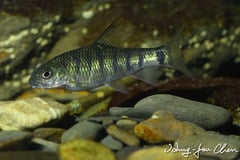
Acrossocheilus paradoxusTaiwan Banded Barb
Cyprinidae · (Günther, 1868)
The Taiwan banded barb, Acrossocheilus paradoxus, is a cyprinid native to Taiwan, where it occurs throughout western and northeastern river drainages. It inhabits subtropical streams and small to medium rivers at medium to relatively high altitudes, and in the aquarium needs spotless, well-oxygenated water with moderate flow. Growing to around 200 mm SL, it needs a tank of at least 180 x 45 cm.
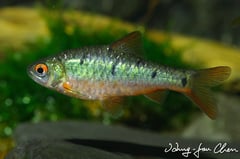
Barbodes semifasciolatusGolden Barb*
Cyprinidae · (Günther, 1868)
Barbodes semifasciolatus, the green or Chinese barb, is a cyprinid from Vietnam, Taiwan, southwestern China and northern Laos. The natural green form is an infrequent find in the trade, but the selectively-bred golden variant, first produced in the 1960s, is farmed in huge numbers. Commercial fish are largely inbred, with reduced fins and other deformities not uncommon. The name 'Puntius schuberti' often given to the golden form is not an official scientific name.

Butis butisCrazy Fish
Butidae · (Hamilton, 1822)
The crazy fish, Butis butis, is a flathead gudgeon of coastal and brackish waters across the Indo-Pacific, from eastern Africa to Fiji. The most commonly traded member of the genus, it has many other names, including crocodile fish, duckbill sleeper and upside-down sleeper. A nocturnal ambush predator, it often swims upside-down, and it is territorial and not sociable with conspecifics, so is best kept singly.
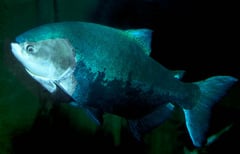
Colossoma macropomumBlack Pacu
Serrasalmidae · authority not recorded
The black pacu, Colossoma macropomum, is a very large serrasalmid from the Orinoco and Amazon basins in Colombia, Venezuela, Peru, Bolivia and Brazil. Known as the tambaqui in its native countries, it is the second largest scaled fish in the Amazon basin and easily capable of reaching 60 cm in captivity. It is regularly sold as a small juvenile, and releases of outgrown fish have led many wildlife authorities in the US to ban its sale. Wild stocks suffer from gross overfishing in many of its native waters.
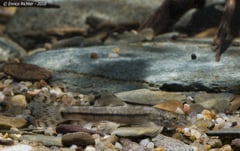
Formosania lacustrisTasseled-mouth Loach
Gastromyzontidae · (Steindachner, 1908)
The tasseled-mouth loach, Formosania lacustris, is a gastromyzontid from Taiwan and some coastal drainages of Fujian Province, mainland China. An obligate dweller of swiftly-flowing streams and headwaters, it clings to rocks in riffles and runs using its flattened head and body and horizontal paired fins. The genus was formerly Crossostoma, and colour and pattern vary with locality and age.
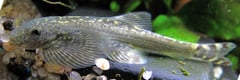
Hemimyzon formosanus
Balitoridae · (Boulenger, 1894)
Hemimyzon formosanus is a balitorid loach endemic to Taiwan, most abundant in rivers draining the western slopes of the Central Mountain Range. Current knowledge suggests it is the most widely distributed of the three Hemimyzon species endemic to the island. It lives in shallow, fast-flowing, highly oxygenated headwaters and needs clean, well-oxygenated water, a biologically mature tank with plenty of biofilm, and a tight cover since it can climb glass.

Macropodus opercularisParadise Fish
Osphronemidae · (Linnaeus, 1758)
The paradise fish, Macropodus opercularis, is a labyrinth fish from China south of the Yangtze, including Taiwan and Hainan, plus Vietnam and Laos. Imported to France in 1869, it was among the very first ornamental fish brought to Europe. Wild examples are uncommon in the hobby since it is farmed extensively, and xanthic, albino, red, blue and stripeless strains exist. Males are territorially aggressive, especially when breeding, and should not be housed together unless the aquarium is very large.
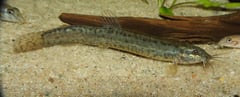
Misgurnus dabryanusLarge-scaled Loach
Cobitidae · (Guichenot, 1872)
The large-scaled loach, Misgurnus dabryanus, is a 'true' loach from the Yangtze and Pearl rivers in China, plus Taiwan and the Amur in Russia. It is sold regularly in the hobby but almost always labelled as or mixed in with M. anguillicaudatus, from which it differs in its high adipose crests on the caudal peduncle and the lack of a dark spot at the caudal-fin base. It spends some of its time completely buried, so it needs a soft, sandy substrate.
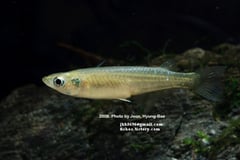
Oryzias latipesMedaka
Adrianichthyidae · (Temminck & Schlegel, 1846)
The medaka, Oryzias latipes, is a ricefish from Japan, Korea, Taiwan, eastern China, Laos and Vietnam. Long used as a model organism in genomic and experimental biology, it was the first vertebrate animal to mate in space, in the mid-1990s. The ornamental 'golden' variant is more often seen than the natural form, and a transgenic 'glowing' form is illegal to buy, sell or own within the European Union.

'Puntius' snyderi
Cyprinidae · Oshima, 1919
'Puntius' snyderi is a cyprinid from central and northern Taiwan, found in shallow margins of slow streams, irrigation canals and ponds. Almost identical to the wild form of 'P.' semifasciolatus, the 'golden barb' of the hobby, it is reliably told apart externally only by its tiny, indistinct barbels. It is also a deeper-bodied fish with 4-5 main dark markings on the flank, and the two differ genetically.
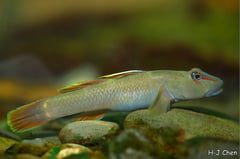
Rhinogobius candidianus
Gobiidae · (Regan, 1908)
Rhinogobius candidianus is a goby from northern and western Taiwan, where it lives in smaller tributaries and hill streams. It is normally imported alongside a smaller, near-identical congener identified as R. nantaiensis, and both are usually traded as R. candidianus. The two can be separated by snout length, noticeably longer in R. candidianus, and by adult size: R. nantaiensis reaches just 50 to 55 mm.
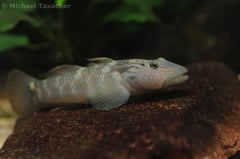
Rhinogobius formosanus
Gobiidae · Oshima, 1919
Rhinogobius formosanus is a goby endemic to river systems of northern and northeastern Taiwan. Previously considered a subspecies of R. nagoyae, it has generally been accepted as distinct since 2008. Irregular, worm-like, reddish-brown lines on the cheek and opercle separate it from other Taiwanese Rhinogobius. Like many fishes from running water it needs spotless water and does best in a tank set up to simulate a flowing stream.
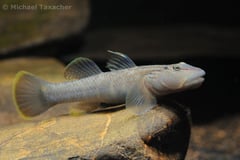
Rhinogobius gigas
Gobiidae · Aonuma & Chen, 1996
Rhinogobius gigas is a goby native to eastern Taiwan, found in the middle and lower sections of rivers in Yilan, Hualien and Taitung counties. The species is uncommon in the aquarium hobby, and its name is sometimes applied to similar-looking congeners. Well-defined dark cross bands on the body, a spotted cheek and rows of spots in the second dorsal and anal fins help tell it apart from other Taiwanese Rhinogobius.
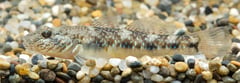
Rhinogobius giurinus
Gobiidae · (Rutter, 1897)
Rhinogobius giurinus is a goby found through much of China, plus Taiwan, the Korean Peninsula, Japan and the Red and Pha river basins in Vietnam. It appears to exist in a number of forms that differ in colour pattern, morphology or both, and it is unclear whether all of them are conspecific. Newly-imported wild fish tend to be aggressive towards conspecifics, so unlike most Rhinogobius it is best kept in sexed pairs.
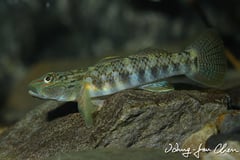
Rhinogobius lanyuensis
Gobiidae · Chen, Miller & Fang, 1998
Rhinogobius lanyuensis is a goby known only from Lanyu Island, better known as Orchid Island, off the southeastern coast of Taiwan. It has been available in Japan on occasion. The body carries 8 vertical blackish brown bars, and females have a discontinuous dark lateral stripe that males lack. Lanyu is a small volcanic island with no major rivers, and the species presumably inhabits small streams over gravel, rocks and bedrock.
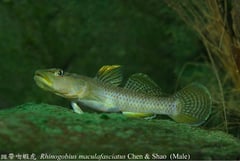
Rhinogobius maculafasciatus
Gobiidae · Chen & Shao, 1996
Rhinogobius maculafasciatus is a small goby known only from certain rivers in southern Taiwan, including the Tzengwen and Kaoping drainages. It has been collected by a few individuals. Fewer scale rows between the first dorsal-fin origin and upper pectoral-fin base than in related Taiwanese species give it a somewhat elongate appearance. Typical habitats are small brooks, tributaries and pools with slow flow over rocks and pebbles.
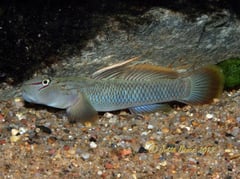
Rhinogobius nantaiensis
Gobiidae · Aonuma & Chen, 1996
Rhinogobius nantaiensis is a goby from Taiwan, officially known only from the Tzengwen and Kaoping river basins in the south of the island. It is normally imported in mixed batches with the near-identical R. candidianus, and is the commoner of the two in the aquarium trade. It does not grow as large, has a more rounded snout, and most specimens have spot-like markings on the sides of the head.
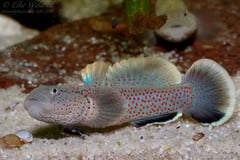
Rhinogobius rubromaculatusRed-spotted Goby
Gobiidae · Lee & Chang, 1996
The red-spotted goby, Rhinogobius rubromaculatus, is endemic to Taiwan and apparently quite common in central and western parts of the island. Fish from the Linbian river in the south are smaller, with larger and more intense red spots, and have been called R. rubromaculatus 'rot' or 'red' in the hobby, but they show only minor genetic differences. Among the less problematic members of the genus to breed, it can spawn year-round in aquaria.
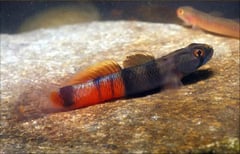
Sicyopus zosterophorus
Gobiidae · (Bleeker, 1856)
Sicyopus zosterophorus is a stream goby with a patchy but wide range from the Marquesas Islands westwards to Indonesia, Japan and southern China. It is occasionally available in the hobby as the 'flaming arrow goby', 'belted rockclimbing goby' or 'ornate goby', often under the invalid name Sicyopus zosterophorum. It inhabits short coastal streams on tropical islands, typically above waterfalls or cataracts.
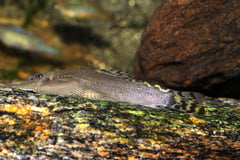
Sinogastromyzon puliensis
Balitoridae · Liang, 1974
Sinogastromyzon puliensis is a hillstream loach endemic to western river drainages of central and southern Taiwan. It is considered endangered across some of its range and has been protected by the Wildlife Conservation Act of Taiwan since 1989, and those in the trade appear to be collected and exported illegally. It lives in riffles and rapids with swift currents.
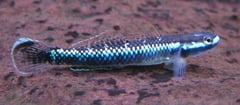
Stiphodon atropurpureusBlue Neon Goby
Gobiidae · (Herre, 1927)
The blue neon goby, Stiphodon atropurpureus, is a stream-dwelling goby from southern Japan, Taiwan, southern China, the Philippines and Malaysia. It is available occasionally but often under the wrong name, including S. elegans and 'Sumatran blue neon goby', though it is not found on Sumatra. In males the bright blue-green lateral stripe combined with a reddish outer edge to the first dorsal fin is unique within the genus.
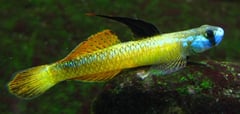
Stiphodon percnopterygionus
Gobiidae · Watson & Chen, 1998
Stiphodon percnopterygionus is a small stream-dwelling goby ranging from southern Taiwan through the Ryukyu and Bonin islands to Guam and Palau. Rare in the aquarium trade, it is among the most easily identified in the genus. Males have highly extended fourth and fifth spines in the first dorsal fin, and adults reach only 30-35 mm SL. Like other Stiphodon it is a specialised algal grazer with an amphidromous life cycle.
Xiphophorus helleriiGreen Swordtail
Poeciliidae · Heckel, 1848
The green swordtail, Xiphophorus hellerii, is a livebearer native to southeastern Mexico, Guatemala, Belize and Honduras. Among the world's most recognisable aquarium fishes, it is ubiquitous in the trade, where selective breeding and hybridisation with X. maculatus and X. variatus have produced a bewildering array of ornamental forms. The name is often misspelled X. helleri.

Ctenopharyngodon idellaGrass Carp
Cyprinidae · (Valenciennes, 1844)
The grass carp, Ctenopharyngodon idella, is a large cyprinid native to the Amur River system in eastern Russia and northeastern China. Adults typically reach 800 to 1200 mm, making it a wholly unsuitable aquarium subject, though an albino form is traded. Widely introduced for aquaculture and weed control, it has caused serious damage to natural waters, and unwanted fish should never be released.
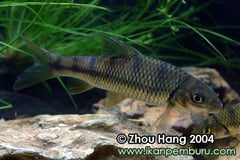
Acrossocheilus parallens
Cyprinidae · (Nichols, 1931)
Acrossocheilus parallens is a barred cyprinid from Guangdong and Hainan provinces in southern China, plus the island of Taiwan. It has five or six dark vertical bars on each flank, each two scales wide, a pattern it shares with A. paradoxus and several other congeners. Wild fish feed on small benthic invertebrates and graze biofilm from rocks and other solid surfaces.
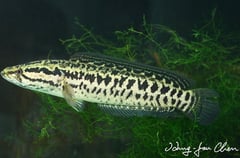
Channa maculataBlotched Snakehead
Channidae · (Lacepède, 1801)
The blotched snakehead, Channa maculata, is a snakehead from coastal drainages of southeastern China, including Hong Kong, and northern Vietnam. It is frequently confused with C. argus but has fewer fin rays and lateral line scales and carries 2-3 rounded blotches on the caudal peduncle. An important food fish, it has become established in Japan, Taiwan, the Philippines, Madagascar and Hawaii, and hybrids with C. argus appear to be quite common in aquaculture.
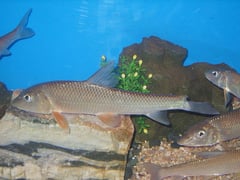
Hemibarbus labeoBarbel Steed
Cyprinidae · (Pallas, 1776)
The barbel steed, Hemibarbus labeo, is a cyprinid widespread in eastern Asia between the Yangtze and Amur river basins. A predominantly riverine fish of clear, well-oxygenated running water, it forms schools just above the substrate as an adult, and some populations make annual spawning migrations. Adults lack dark spots on the body and have a long snout and well-developed lips.
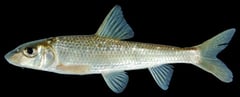
Hemibarbus maculatusSpotted Steed
Cyprinidae · Bleeker, 1871
The spotted steed, Hemibarbus maculatus, is a cyprinid widespread in eastern Asia between the Yangtze and Amur basins, including Taiwan and Hainan. It has 7–11 large blackish spots on each flank and a deep body with a clearly convex dorsal profile. A riverine fish of clear, well-oxygenated running water, it breeds in May and June, depositing its eggs among aquatic vegetation. It has probably been introduced to Vietnam and Laos, or records from there represent another species.
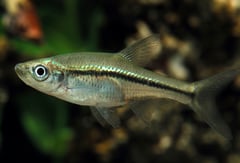
Metzia formosae
Cyprinidae · (Oshima, 1920)
Metzia formosae is a small cyprinid from northern Taiwan, Hainan, Hong Kong, southern China and northern Vietnam. It is identified by its upturned mouth and a black stripe along the flank from the gill opening to the caudal-fin base. It inhabits slow-moving to still, well-vegetated waters, including streams, rice paddies, ditches and canals. The genus remains unresolved in taxonomic terms.