Hobbyist group · Cypriniformes
Other cypriniforms
Other cypriniforms spans 2 families.
- Species
- 151
- Families
- 2
- Genera
- 42
- Photographed
- 151 of 151
- Difficulty rated
- 150 of 151
Families
Where they come fromnative records only

Cyclocheilichthys heteronema
Cyprinidae · Bleeker, 1854
Cyclocheilichthys heteronema is a cyprinid ranging from Myanmar east to Vietnam and south to Peninsular Malaysia, Borneo and Sumatra. Its fimbriated barbels, extended downwards while it browses, are unique in the genus. It doesn't appear to be common in nature, with most records from Peninsular Malaysia, and it reaches the trade only as occasional bycatch. Very peaceful but retiring, it is easily outcompeted by boisterous tankmates.

Oreichthys crenuchoidesDrape Fin Barb
Cyprinidae · Schäfer, 2009
The drape fin barb, Oreichthys crenuchoides, is a small cyprinid possibly endemic to Brahmaputra tributaries in West Bengal, eastern India. The species is sometimes traded as Oreichthys cosuatis, O. sp. 'high fin', Puntius 'arunavii' or 'neon highfin barb'. Males have a significantly enlarged dorsal-fin, and a large black marking at the caudal-fin base with no dark marking in the anal-fin separates it from congeners.
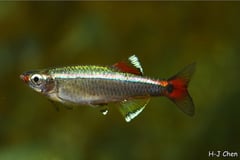
Tanichthys albonubesWhite Cloud Mountain Minnow
Cyprinidae · Lin, 1932
The White Cloud Mountain minnow, Tanichthys albonubes, is a small cyprinid from Guangdong and Hainan in southern China and from northeastern Vietnam. It appears to have been extirpated from White Cloud Mountain itself and is considered endangered in China, but all the fish on sale are commercially bred. Inbreeding among farm-bred stock has left many genetically weak and prone to disease or deformity, and permanent exposure to warmer conditions is likely to shorten its life.
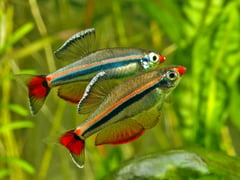
Tanichthys micagemmae
Cyprinidae · Freyhof & Herder, 2001
Tanichthys micagemmae is a small cyprinid from the Ben Hai river system in north central Vietnam. Sold under trade names such as 'Vietnamese minnow', 'cardinal minnow' and 'royal white cloud', it is smaller than T. albonubes, lacks that species' reddish-brown body colour and has reddish ventral and anal fins. At the type locality it was found only in the margins of a fast-flowing, shallow stream where the flow was much reduced.
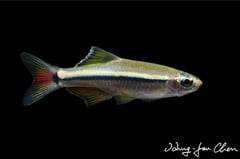
Tanichthys sp. 'Vietnam'
Cyprinidae · authority not recorded
Tanichthys sp. 'Vietnam' is a small cyprinid known only from Da Nang province in central Vietnam, first collected in 2009. Sold as T. sp. 'lemon' or 'yellow white cloud', it has also been misidentified as T. thacbaensis, a valid species from much further north in Vietnam. Its ventral and anal fins are bright yellow, and it is smaller than T. albonubes and lacks that species' reddish-brown body colour.
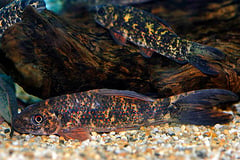
Labeo cyclorhynchusHarlequin Shark
Cyprinidae · authority not recorded
The harlequin shark, Labeo cyclorhynchus, is a cyprinid from the middle and lower Congo basin and the Ogooué drainage in Gabon. The patterning of young fish fades with age and adults are much darker. It becomes increasingly territorial as it grows, especially towards similar-looking species, so tankmates need choosing with care. It may still be seen as Labeo variegatus, an invalid name, in older literature and trade lists.

Garra dampaensis
Cyprinidae · Laironunga, Lainuntluanga & Lairamliana, 2013
Garra dampaensis is a cyprinid known only from the Seling River in the Dampa tiger reserve, Mizoram, northeastern India. The Seling belongs to the Karnaphuli drainage. It has been collected from clear, shallow, moderately fast-flowing streams with rocky substrates, and is recognised among Indian Garra partly by a W-shaped black band across the middle of the caudal fin.

Garra poecilura
Cyprinidae · Kullander & Fang, 2004
Garra poecilura is a small cyprinid known only from a minor Irrawaddy tributary draining the eastern Rakhine Yoma, western Myanmar. The largest specimen in the type series measured 44.5 mm. The type locality is a clear stream 1-2 metres wide in bamboo forest, flowing over rocks and gravel. It has a weakly-defined dark band or series of blotches on the flank and two vertical rows of black spots on the caudal fin.
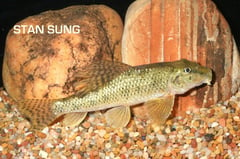
Abbottina rivularisChinese False Gudgeon
Cyprinidae · Basilewsky, 1855
The Chinese false gudgeon, Abbottina rivularis, is a small bottom-dwelling cyprinid native to China, the Korean peninsula and southern Japan. It has been widely introduced elsewhere, including the Mekong and Salween basins, Taiwan, Turkmenistan and Kyrgyzstan, and is considered invasive. It has started to appear in the aquarium trade and should never be released into natural waters outside its native range.
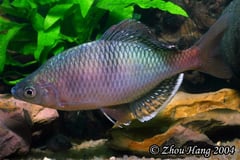
Acheilognathus macropterusGiant Chinese Bitterling
Cyprinidae · Bleeker, 1871
The giant Chinese bitterling, Acheilognathus macropterus, is a bitterling from China, the Korean peninsula, northern Vietnam and southeastern Russia. It has been introduced to Japan and is considered invasive there. Typical adults are 100 to 150 mm, and it appears in the trade only irregularly. Like all bitterlings it spawns in living unionid mussels, and its wide range suggests it may be a group of closely-related species.
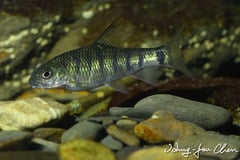
Acrossocheilus paradoxusTaiwan Banded Barb
Cyprinidae · Günther, 1868
The Taiwan banded barb, Acrossocheilus paradoxus, is a cyprinid native to Taiwan, where it occurs throughout western and northeastern river drainages. It inhabits subtropical streams and small to medium rivers at medium to relatively high altitudes, and in the aquarium needs spotless, well-oxygenated water with moderate flow. Growing to around 200 mm SL, it needs a tank of at least 180 x 45 cm.
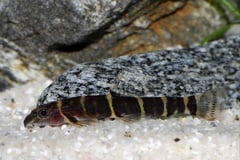
Barbucca diabolica
Barbuccidae · Roberts, 1989
Barbucca diabolica is a small 'scooter' loach from the upper-middle Kapuas basin in West Kalimantan, Indonesian Borneo, with one specimen from Johor. Barbucca spp. keep near-continuous belly contact with solid surfaces and often swim inverted or vertically. Most fish seen have red eyes and six dark body stripes, but several undescribed species exist and more than one may have been exported. Kottelat (2012) erected the family Barbuccidae for the genus.

Barilius ardens
Cyprinidae · Knight, Rai, d'Souza & Vijaykrishnan, 2015
Barilius ardens is a fast-swimming cyprinid from the Sita and Swarna river systems of the Western Ghats in Karnataka, southwestern India. Before its description it was usually identified in the trade as B. canarensis. A row of bluish-green vertical markings along the body and broad orange margins on the dorsal and anal fins distinguish it. It lives in well-oxygenated, moderate to fast-flowing rivers and streams.

Barilius bakeri
Cyprinidae · Day, 1865
Barilius bakeri is a fast-swimming cyprinid endemic to the Western Ghats of southwestern India, with records from many rivers in Kerala and Karnataka. It is traded as 'royal danio', 'blue-spotted hill trout' and 'blue-dotted mirror fish', and has a single row of bluish-green spots that get smaller with age. Its well-oxygenated, fast-flowing rivers are being polluted and degraded by exotic species and sand mining.

Barilius bendelisis
Cyprinidae · Hamilton, 1807
Barilius bendelisis is a large, fast-swimming cyprinid from India, Bangladesh, Nepal and probably Bhutan. Occasionally sold as 'Indian hill trout' or 'Hamilton's baril', it has 8 to 12 bluish vertical bars and, in adults, a blue-black spot on each scale. It grows to around 200 mm SL and inhabits well-oxygenated, fast-flowing rivers and streams, and its speed and vigorous feeding make it unsuitable for the general community.

Barilius canarensis
Cyprinidae · Jerdon, 1849
Barilius canarensis is a cyprinid from southwestern India, known with certainty only from the Netravathi and Tungabhadra river systems in Karnataka. Its name has historically been applied in the trade to B. ardens and B. malabaricus, and it was redescribed in 2015. Two rows of bluish-green spots and broad white margins on the dorsal and anal fins distinguish it. It inhabits well-oxygenated, fast-flowing rivers and streams.

Barilius gatensisMalabar Baril
Cyprinidae · Valenciennes, 1844
The Malabar baril, Barilius gatensis, is a cyprinid endemic to the Western Ghats of southern India, in Karnataka, Kerala and Tamil Nadu. Occasionally seen in the trade, it has 13 to 15 dark blue vertical bars that often almost break up in adults. It inhabits well-oxygenated, fast-flowing rivers and streams, apparently favouring slower runs and pools, and its speed and vigorous feeding make it unsuitable for the general community.

Barilius malabaricus
Cyprinidae · Jerdon, 1849
Barilius malabaricus is a cyprinid from southwestern India, known with certainty only from the Payaswini and Valapattanam river systems in Kerala. Before its revalidation in 2015 it was usually traded as B. canarensis or B. bakeri 'orange fin'. Bluish-green spots along the body and broad orange margins on the dorsal and anal fins distinguish it. It probably inhabits well-oxygenated, fast-flowing rivers and streams.

Barilius shacra
Cyprinidae · Hamilton, 1822
Barilius shacra is a cyprinid from the Himalayan foothills of Nepal and northern India, in the Ganges and Brahmaputra systems, and from Bangladesh. Poorly known in the hobby but exported on occasion, it has around 12 vertical bars on each flank and a black band in the upper third of the dorsal fin. It inhabits well-oxygenated, fast-flowing rivers with gravel, cobble and boulder substrates, and is too fast and vigorous a feeder for the general community.

Barilius vagra
Cyprinidae · Hamilton, 1822
Barilius vagra is a cyprinid widely distributed in the Ganges and Brahmaputra river systems of northern India, Nepal and Bangladesh. Poorly known in the hobby but exported on occasion, it has 10 to 14 vertical bars on each flank that do not extend below the lateral line. It inhabits well-oxygenated, fast-flowing rivers and tributaries with gravel, cobble and boulder substrates, and its speed and vigorous feeding make it unsuitable for the general community.

Chagunius baileyi
Cyprinidae · Rainboth, 1986
Chagunius baileyi is a large cyprinid endemic to the Salween and Sittaung river basins in Myanmar and western Thailand. Rarely kept, it turns up occasionally as bycatch among shipments of wild fish from Thailand and Myanmar. It looks almost identical to C. chagunio and C. nicholsi, and the three are most easily separated by collection details since their ranges do not overlap. At up to 200 mm it needs a very large tank with plenty of open swimming space.

Crossocheilus atrilimesSiamese Algae Eater
Cyprinidae · Kottelat, 2000
Crossocheilus atrilimes is one of several near-identical cyprinids traded as the Siamese algae eater, native to the Mekong and Chao Phraya drainages. Telling it apart from C. langei and the undescribed C. sp. 'citripinnis' takes a combination of characters, including a black stripe running to the tip of the caudal fin that broadens and pales when the fish spar. A shoaling fish of flowing streams, it needs spotless, well-oxygenated water and a group of six or more.
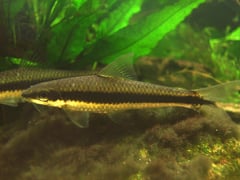
Crossocheilus langeiSiamese Algae Eater
Cyprinidae · Bleeker, 1860
Crossocheilus langei is a cyprinid from Borneo, Peninsular Malaysia and Thailand, one of several near-identical fish sold as the Siamese algae eater. The trade name 'Crossocheilus siamensis' used for these fish is not valid. C. langei can be told apart by a dark blotch in front of the anal fin and a lateral line running straight through the dark body stripe.

Crossocheilus latius
Cyprinidae · Hamilton, 1822
Crossocheilus latius is a cyprinid widespread in India, described from the Tista River on the border with Bangladesh. It lives everywhere from boulder-strewn Himalayan hill streams to silt-laden tributaries and pools. Not often available in the trade, it sometimes turns up in shipments of Indian Garra, and its relatively plain pattern makes it unlikely to be confused with congeners. Juveniles are gregarious and active, but adults tend to become sedentary and solitary.
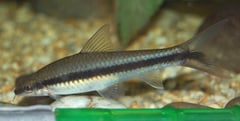
Crossocheilus nigriloba
Cyprinidae · Popta, 1904
Crossocheilus nigriloba is a cyprinid endemic to Borneo, known from the Kapuas, Belayan and Mahakam rivers in Indonesian Kalimantan. Rarely seen, it is among the near-identical congeners traded as 'Siamese algae-eater' or 'SAE' but is simple to identify: the lower caudal-fin lobe carries dark pigment suffused with red, which gave rise to the trade name 'penguin flying fox'. The lateral stripe breaks into blotches when the fish are sparring, stressed or sleeping.

Crossocheilus reticulatus
Cyprinidae · Fowler, 1934
Usually offered as the reticulated or fishnet flying fox, Crossocheilus reticulatus is a cyprinid from the Chao Phraya and Mekong basins. A silvery body, dark-edged scales and a dark caudal peduncle blotch set it apart from similar congeners. Patterning varies with collection locality, which led to several names now treated as synonyms. A fish of flowing streams, it is best kept in a group of six or more, since weaker individuals can be bullied in smaller numbers.

Cyclocheilichthys apogonBeardless Barb
Cyprinidae · Valenciennes, 1842
The beardless barb, Cyclocheilichthys apogon, is a cyprinid ranging from Myanmar to Vietnam and south via Peninsular Malaysia to Borneo and Sumatra. Also sold as 'skinhead barb', it lacks barbels and has a black blotch at the caudal-fin base plus rows of dark spots along the scale rows. It favours slower-moving or still water and grazes the biofilm on submerged roots and branches. Rarely imported in numbers, it most often arrives as bycatch.

Cyclocheilichthys armatus
Cyprinidae · Valenciennes, 1842
Cyclocheilichthys armatus is a cyprinid ranging from the Mekong region through Thailand and Peninsular Malaysia to Borneo, Sumatra and Java. It forages from mid-water to the bottom of rivers in the dry season and is thought to migrate into flooded forest to breed. Rarely imported in numbers and most often arriving as bycatch, it makes a peaceful, unusual addition to larger aquaria in a group of at least six.
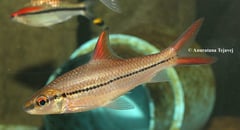
Cyclocheilichthys janthochir
Cyprinidae · Bleeker, 1854
Cyclocheilichthys janthochir is a cyprinid endemic to Borneo, known from West and Central Kalimantan in Indonesia. It inhabits black water streams and rivers associated with ancient forest peat swamps, where the water is very soft and acidic. Red markings in the dorsal and caudal fins plus a dark lateral stripe make it easy to identify. Specialised shops stock it from time to time, and it also turns up as bycatch among wild fish from Kalimantan.

Cyclocheilichthys lagleri
Cyprinidae · Sontirat, 1985
Cyclocheilichthys lagleri is a cyprinid from the Chao Phraya river system in central Thailand and the lower Mekong basin in Thailand and Cambodia. It is observed mostly on low-altitude floodplains and may migrate into inundated areas to spawn. Lacking barbels entirely and with 20 circumpeduncular scales, it makes a peaceful, unusual addition to larger aquaria in a group of at least six.

Cyclocheilichthys repasson
Cyprinidae · Bleeker, 1853
Cyclocheilichthys repasson is a cyprinid with an enormous range, from the Mekong region and Myanmar through Peninsular Malaysia to Borneo and Sumatra. It grows to around 280 mm SL and favours slower-moving or still water, grazing the biofilm on submerged roots and branches. It is not often seen in the hobby. Most populations have a dark caudal peduncle spot, stripes formed by dark markings on the scales, and two pairs of barbels.

Discherodontus ashmeadi
Cyprinidae · Fowler, 1937
Discherodontus ashmeadi is a cyprinid apparently native to the Mae Klong and Mekong river basins in Thailand, Laos and Cambodia. The type species of its genus, it inhabits clear, fast-flowing minor rivers and forest streams. Like its congeners it is notoriously delicate and difficult to ship: it goes into shock and loses scales very easily when removed from the water, and damaged areas tend to become infected.
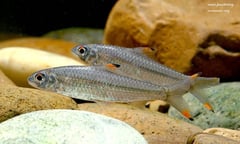
Discherodontus halei
Cyprinidae · Duncker, 1904
Discherodontus halei is a cyprinid with an apparently disjunct range: Pahang in Peninsular Malaysia, and the Mae Klong and Chao Phraya in Thailand. It inhabits clear, fast-flowing minor rivers and forest streams, and orange pigmentation in the dorsal and caudal fins helps separate it from congeners. Like others in the genus it is notoriously delicate and difficult to ship, losing scales very easily when removed from the water.
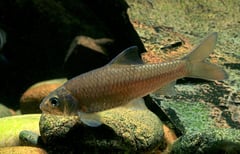
Discherodontus schroederi
Cyprinidae · Smith, 1945
Discherodontus schroederi is a cyprinid native to the Mae Klong and Chao Phraya river basins in Thailand. Said to be the hardiest member of the genus, it is rarely collected for the aquatic trade, presumably because it is the least colourful of the Thai species. Juveniles can be confused with D. ashmeadi, but its dark dorsal blotch fades to a thin distal band with age, and its barbels are noticeably longer than in other members of the genus.
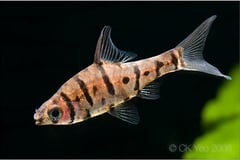
Eirmotus insignis
Cyprinidae · Tan & Kottelat, 2008
Eirmotus insignis is a small cyprinid known only from the Kapuas basin in West Kalimantan, Borneo, and Belitung Island off Sumatra. It inhabits shady, slow-moving rainforest streams and swamps with dense vegetation. One of four similar species in the genus, it is traded alongside E. octozona as the 'false eight-banded barb' and is told apart mainly by the black markings on its dorsal fin.
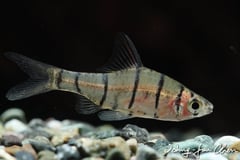
Eirmotus octozona
Cyprinidae · Schultz, 1959
Eirmotus octozona is a small cyprinid with eight dark body bars, known from Johor state in Peninsular Malaysia. The type series came from aquarium fish said to originate at Bueng Boraphet in Thailand, where it has never been recorded since, and if it occurs in Thailand it is probably restricted to the peninsula. It is sold, along with E. insignis, as the 'false eight-banded barb'.
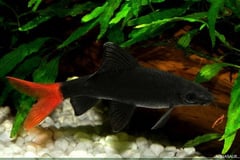
Epalzeorhynchos bicolorRed-Tailed Black Shark
Cyprinidae · Smith, 1931
The red-tailed black shark, Epalzeorhynchos bicolor, is a cyprinid native to central and western Thailand, in the Mae Klong and Chao Phraya basins. Declared extinct in 1996, it was found again in 2011 and 2014 and is considered critically endangered, while all fish in the trade are commercially produced. It becomes increasingly territorial as it grows, especially towards similar-looking species, and can live for over 15 years.

Epalzeorhynchos frenatumRainbow Shark
Cyprinidae · Fowler, 1934
The rainbow shark, Epalzeorhynchos frenatum, is a cyprinid reportedly native to Thailand, Laos and Cambodia. Recorded from the Mae Klong, Chao Phraya and Mekong basins, many of its wild populations have dwindled or vanished, and large numbers are farmed for the trade, including an albino and an anerythristic form sometimes misidentified as E. munense. It becomes increasingly territorial as it grows and can live for over 15 years.
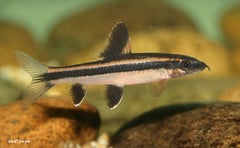
Epalzeorhynchos kalopterumFlying Fox
Cyprinidae · Bleeker, 1850
The flying fox, Epalzeorhynchos kalopterum, is a cyprinid from southern Thailand, Peninsular Malaysia and the Greater Sunda Islands. Fishes sold as 'false flying fox' or 'Siamese flying fox', such as Garra cambodgiensis and Gyrinocheilus aymonieri, are often confused with it, but it has white-edged red and black fins and two pairs of barbels. It grows increasingly territorial with age and can live for over 15 years.

Epalzeorhynchos munense
Cyprinidae · Smith, 1934
Epalzeorhynchos munense is a cyprinid from the Mun river and other tributaries of the middle Mekong in Thailand and Laos. It resembles E. bicolor and E. frenatum but has a black head, body and anal fin, red caudal and dorsal fins, and black margins on the pelvic and pectoral fins. A record from the Tonlé Sap system may refer to E. frenatum.

Esomus danricaFlying Barb
Cyprinidae · Hamilton, 1822
The flying barb, Esomus danrica, is a cyprinid with an enormous range across Pakistan, Nepal, Bangladesh, most of India, Myanmar and Sri Lanka. It shows a marked preference for shallow, slow-moving and standing waters such as rice paddies with dense vegetation, and is generally absent from major river channels. Reports on its suitability for community aquaria are mixed, with some keepers seeing a pronounced tendency to nip fins.

Esomus longimanusMekong Flying Barb
Cyprinidae · Lunel, 1881
The Mekong flying barb, Esomus longimanus, is a cyprinid from the Mekong basin in Thailand, Laos, Cambodia and Vietnam, and the Tonlé Sap system. It favours shallow, slow-moving and standing waters with dense aquatic vegetation, such as ditches, marshes and rice paddies. Like other Esomus it has greatly enlarged pectoral fins and very long maxillary barbels, and it jumps well enough to escape through the tiniest gaps.

Esomus metallicusStriped Flying Barb
Cyprinidae · Ahl, 1923
The striped flying barb, Esomus metallicus, is a cyprinid found from the Salween basin in Myanmar east across Thailand to Laos and Cambodia. It is abundant over most of this range and moves into rice paddies and other flooded ground at the onset of the wet season, returning to permanent water when the flooding recedes. Its lateral stripe grows more intense towards the tail and ends at the caudal-fin base.

Garra bicornutaRhino Garra
Cyprinidae · Narayan Rao, 1920
The rhino garra, Garra bicornuta, is a cyprinid from the Tunga River in the upper Krishna drainage, Karnataka, southern India. No other Garra is known to have a pair of rostral processes, which males develop and hold erect when sparring. A blue opercular spot ringed with gold blotches also identifies it. It is traded as 'Tunga garra' or 'lionhead garra', and can be territorial, especially at feeding time.

Garra cambodgiensisFalse SAE
Cyprinidae · Tirant, 1883
The false SAE, Garra cambodgiensis, is a cyprinid from the Mekong, Chao Phraya and Mae Klong basins and northern Peninsular Malaysia. It is still traded as Garra taeniata and is often confused with the Crossocheilus species sold as 'Siamese algae eater'. In this species the dark lateral stripe ends at the caudal peduncle, and a sucker formed by the lower lip is present. It inhabits swiftly-flowing headwaters and tributaries.

Garra fasciacauda
Cyprinidae · Fowler, 1937
Garra fasciacauda is a cyprinid native to the Mekong river system in Thailand, Laos, Vietnam and Cambodia, including the Tonlé Sap basin. It has a black submarginal stripe on both caudal lobes and a plain dorsal fin. It inhabits swiftly-flowing water and migrates seasonally, with many fish moving from the Tonlé Sap system to the Khone Falls in the dry season.

Garra flavatraPanda Garra
Cyprinidae · Kullander & Fang, 2004
The panda garra (Garra flavatra) is a stream-dwelling cyprinid endemic to the Rakhine Yoma, or Arakan, mountain range in western Myanmar. It reached the hobby in 2005 and is traded as the 'panda', 'clown', 'banded butterfly' or 'rainbow' garra, sometimes incorrectly as a loach. Colour pattern varies considerably between individuals. It has been bred commercially in Myanmar since 2008.
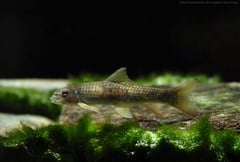
Garra rufaDoctor Fish
Cyprinidae · Heckel, 1843
The doctor fish (Garra rufa) is a cyprinid from the eastern Mediterranean and Middle East, from Turkey and Israel to the Tigris-Euphrates in Iran. Fish sold as G. rufa are marketed worldwide for their questionable ability to remove dead skin, but the species likely represents a complex of closely-related taxa and it is unclear which the traded fish are. Strictly not a tropical species, it is kept at 14-20 °C.

Garra sp. 'redtail'Burmese Red-tailed Garra
Cyprinidae · authority not recorded
The Burmese red-tailed garra, Garra sp. 'redtail', is a cyprinid from headwaters of the Salween basin around the border between Myanmar and Thailand. A putatively undescribed species, it is often sold as G. sp. 'burmanicus' and first appeared in the trade in 2005. A flexible, proboscis-like rostral process between the eyes becomes erect during territorial conflicts or courtship. It inhabits shady, fast-flowing stretches and riffles.

Garra spilota
Cyprinidae · Kullander & Fang, 2004
Garra spilota is a small cyprinid probably endemic to the Rakhine Yoma, or Arakan, mountains in western Myanmar, and occasionally seen in the trade. It has reddish fins, a series of dark blotches on the flanks and an unusual upper lip lined with unculi, and differs from the similar G. flavatra in some meristic counts. It is less territorial with conspecifics than some Garra, and a group of 3-4 is the minimum.
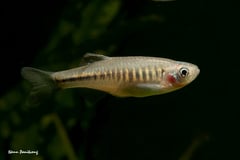
'Inlecypris' maetaengensisFire Bar 'Danio'
Cyprinidae · Fang, 1997
The fire bar 'danio', Inlecypris maetaengensis, is a small cyprinid endemic to the Mae Nam Ping drainage in northern Thailand. Also traded as 'tiger danio', it is most easily confused with 'I.' shanensis and Devario interruptus, and has a complete lateral line with 31 to 35 pored scales and a P stripe of contiguous blotches. It inhabits small, clear, moderate-to-swiftly-flowing streams with no aquatic vegetation.
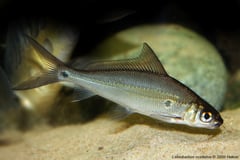
Labiobarbus ocellatus
Cyprinidae · Heckel, 1843
Labiobarbus ocellatus is a cyprinid from Peninsular Malaysia, Sumatra and Borneo, with a black spot on the shoulder and one on the caudal peduncle. It is occasionally available in the ornamental trade, typically under a name such as 'Bornean eye-spot silver shark' or the invalid scientific name Cirrhinus chinensis. A pelagic species of rivers and some lakes, it moves into seasonally inundated floodplains and forest during the wet season, and grows to 180 mm SL.

Laubuka fasciataMalabar Hatchet Chela
Cyprinidae · Silas, 1958
The Malabar hatchet chela, Laubuka fasciata, is a cyprinid endemic to the state of Kerala in southwestern India. A dark stripe runs from the eye to the caudal peduncle, and it favours slow-moving, shallow margins of rivers and streams over rock and gravel. It is occasionally available in the aquarium trade, apparently collected only in small numbers, and is an accomplished jumper.

Lobocheilos melanotaenia
Cyprinidae · Fowler, 1935
Lobocheilos melanotaenia is a grazing cyprinid from the Mekong in Laos, Thailand, Cambodia and Vietnam, plus the Dong Nai, Chao Phraya and Mae Klong. One of the most abundant species in the seasonal cyprinid migrations of the mainstream Mekong, it is available on a sporadic basis. It is told from L. rhabdoura by its deeper body, narrower mouth and a dark area in the dorsal-fin. It can be aggressive at feeding times and is not particularly tolerant of conspecifics.

Lobocheilos rhabdoura
Cyprinidae · Fowler, 1934
Lobocheilos rhabdoura is a grazing cyprinid from Indochina, found in the Mekong, Chao Phraya and Mae Klong systems and south to Peninsular Malaysia. One of the most abundant species in the seasonal cyprinid migrations of the mainstream Mekong, it is available on a sporadic basis. It differs from L. melanotaenia in its shallower body, wider mouth and larger snout tubercules. It can be aggressive at feeding times and is not particularly tolerant of conspecifics.

Mystacoleucus argenteus
Cyprinidae · Day, 1888
Mystacoleucus argenteus is a cyprinid from the Salween and middle Irrawaddy basins in Myanmar and western Thailand. It is occasionally marketed as 'Burmese rainbow barb' and differs from the similar M. obtusirostris in lacking black-edged scales on the body. Little has been published since Day's original description of 1888. Vigorous when feeding, it can upset slow-moving or timid tankmates.

Mystacoleucus greenwayi
Cyprinidae · Pellegrin & Fang, 1940
Mystacoleucus greenwayi is a riverine cyprinid from the middle Mekong basin in Thailand and Laos and the Chao Phraya watershed. It favours clear, well-oxygenated running water over sand or gravel, often in rock and boulder-filled headwater streams. A schooling fish, it should be kept in a group of six or more alongside similarly-sized cyprinids, loaches and other riverine fishes, and like all Mystacoleucus it has a forward-pointing predorsal spine that can snag in a net.

Mystacoleucus obtusirostris
Cyprinidae · Valenciennes, 1842
Mystacoleucus obtusirostris is a riverine cyprinid found from Myanmar and southwestern China to Vietnam, Borneo, Sumatra and Java. Referred to as M. marginatus for decades, it is the most widely distributed member of the genus, and populations vary somewhat in colour pattern. It is occasionally marketed as 'Burmese rainbow barb'. A group of six or more is the smallest to consider, and like all Mystacoleucus it has a forward-pointing predorsal spine that can snag in a net.

Opsarius barna
Cyprinidae · Hamilton, 1822
Traded as 'striped hill trout' or 'banded hill trout', Opsarius barna is a cyprinid from the Ganges and Brahmaputra basins in northern India. It is thought to also occur in the Mahanadi and in river systems in Nepal, Bhutan, Bangladesh and Rakhine State, Myanmar, in well-oxygenated, fast-flowing rivers over gravel, cobbles and boulders. An extremely fast swimmer and vigorous feeder, it is unsuitable for the general community.

Opsarius bernatziki
Cyprinidae · Koumans, 1937
Sold as 'blue hillstream trout', Opsarius bernatziki is a cyprinid from peninsular Thailand and Tanintharyi, Myanmar, south of the Isthmus of Kra. It inhabits well-oxygenated, moderate to fast-flowing rivers and streams, usually 10-20 km or more from the sea. Six or seven bluish vertical bars on each flank and a large blotch at the caudal-fin base help identify it. Like its congeners it is too fast and vigorous a feeder for the general community.

Opsarius caudiocellatus
Cyprinidae · Chu, 1984
Opsarius caudiocellatus is a cyprinid known only from the Salween in southern China, Myanmar and western Thailand, and the upper Mekong in Yunnan. It is named for the black round spot at the caudal-fin base, which with its black dorsal-fin rays separates it from similar congeners. It may have appeared in the aquarium trade, though probably not under the correct name, and inhabits well-oxygenated, moderate to fast-flowing rivers and streams.

Opsarius dogarsinghiManipur Baril
Cyprinidae · Hora, 1921
The Manipur baril, Opsarius dogarsinghi, is a cyprinid from the Chindwin river system in Manipur and Nagaland, northeastern India, and Myanmar. It occasionally appears in the trade as 'Burmese hill trout' or 'striped hill trout'. A large dark blotch at the caudal-fin base and 8-9 dark blue vertical bars help separate it from congeners, and it has been bred in aquaria.

Opsarius infrafasciatus
Cyprinidae · Fowler, 1934
Opsarius infrafasciatus is a cyprinid from the Ping river in Thailand, the Ataran and Salween in Myanmar and China, and Mekong tributaries in China. Once considered synonymous with both O. ornatus and O. pulchellus, it has been treated as distinct since Tejavej (2012). It typically inhabits headwaters and minor rivers and streams with moderate to fast flow, and a small caudal spot is among the characters separating it from congeners.

Opsarius koratensis
Cyprinidae · Smith, 1931
Opsarius koratensis is a cyprinid of the middle and lower Mekong in Thailand, Laos and Cambodia, and the Chao Phraya, Mae Klong and Dong Nai systems. It apparently inhabits larger, deeper and more turbid rivers than many congeners. Genetic evidence from Tang et al. (2010) suggests it may represent a distinct genus, and it occasionally appears in the ornamental trade.
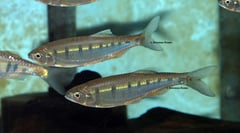
Opsarius ornatus
Cyprinidae · Sauvage, 1883
Opsarius ornatus is a cyprinid from Thailand, possibly restricted to a few small systems in Chumphon Province, mostly in the Tha Sae basin. Kottelat (2013) disputed that view, and the species may have been described from the Chao Phraya system. Populations in the Salween, Ataran, Ping and Mekong drainages formerly considered O. ornatus are O. infrafasciatus. It may have been exported for aquaria, though probably not under the correct name.

Opsarius pulchellus
Cyprinidae · Smith, 1931
Traded as 'butterfly barb' or 'mackerel barb', Opsarius pulchellus is a cyprinid from the Chao Phraya and mid-to-lower Mekong basins. It occurs in Thailand, Laos, Cambodia and Vietnam, typically in submontane headwaters and fast-flowing minor rivers and streams. Also sold as 'royal opsarius', it carries 7-10 elongate vertical bars on each flank, and like its congeners is too fast and vigorous a feeder for the general community.
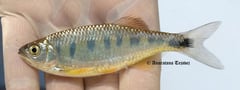
Opsarius signicaudus
Cyprinidae · Tejavej, 2012
Opsarius signicaudus is a cyprinid known only from headwater tributaries of the Mae Klong River in western Thailand. It inhabits well-oxygenated, moderate to fast-moving rivers and streams over gravel, cobbles and boulders, and is intolerant of organic wastes. A large, elongated blotch at the caudal-fin base helps separate it from congeners. It may have been exported for aquaria, though probably not under the correct name.

Oreichthys cosuatis
Cyprinidae · Hamilton, 1822
Oreichthys cosuatis is a small cyprinid probably restricted to the Ganges and Brahmaputra River basins in Nepal, India and Bangladesh. Several undescribed Oreichthys spp. from India, Myanmar and Thailand continue to be traded under its name, and apparent records from those places likely represent other species. It lacks a black blotch on the caudal peduncle, and adults have a dark triangular blotch in the anal-fin.

Oreichthys sp. 'Myanmar Redfin'
Cyprinidae · authority not recorded
Oreichthys sp. 'Myanmar Redfin' is a small cyprinid apparently native to parts of the Irrawaddy River basin in northern Myanmar. It appears to be an undescribed species, and is one of several fish sometimes imported and sold as O. cosuatis or O. parvus. Adult males lack a dark marking in the dorsal-fin, and a large, well-defined black blotch on the caudal peduncle is the easiest way to tell it from both.
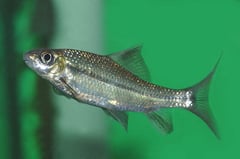
Osteochilus nashii
Cyprinidae · authority not recorded
Osteochilus nashii is a cyprinid endemic to India, where it appears restricted to Karnataka and Kerala in the southwest. Predominantly a riverine fish, it lives in clear, well-oxygenated running water and hill streams over boulders, bedrock and smaller stones. Reaching around 18 cm, it is very scarce in the trade and most likely to turn up as a contaminant among imports of other Indian species.
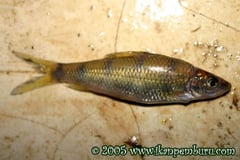
Acrossocheilus iridescens
Cyprinidae · Nichols & Pope, 1927
Acrossocheilus iridescens is a barred cyprinid known from Laos, northern Vietnam, Yunnan province in southwestern China and Hainan Island. Adults carry wide black vertical bars on the flanks, each six to eight scales across, and lack the filament on the dorsal fin seen in its closest relative, A. longipinnis. Some populations are of questionable taxonomic status, and the species sensu stricto may be restricted to Hainan, where the type locality lies.

Crossocheilus burmanicus
Cyprinidae · Hora, 1936
Crossocheilus burmanicus is a cyprinid from Myanmar plus northeastern India and western Thailand, in rivers draining to the Irrawaddy and Salween. It lives in clear, flowing streams over boulders, pebbles, gravel and sand, browsing the biofilm on submerged surfaces. Its dark lateral stripe does not extend into the caudal fin, which separates it from the fish traded as 'Siamese algae eater' or 'SAE'.

Crossocheilus cobitis
Cyprinidae · Bleeker, 1854
Crossocheilus cobitis is a cyprinid ranging from the Mekong drainage in Laos, Vietnam and Thailand south to Sumatra, Borneo and Java. Primarily a lowland species, it lives in the turbid lower reaches of rivers over mud, close to submerged logs and similar objects. Given its wide range it has probably reached the trade as the invalid 'Crossocheilus siamensis', and it is likely to represent a group of similar-looking, closely related species.
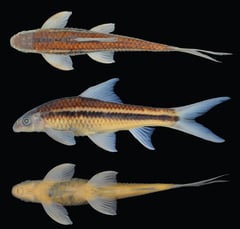
Crossocheilus elegans
Cyprinidae · Kottelat & Tan, 2011
Crossocheilus elegans is a cyprinid known only from the Segama and Kinabatangan river systems in Sabah, northern Borneo. It is mostly collected in or near the riffles of fast-flowing, rocky headwater hill streams. A pale yellowish brown stripe between the dark brown back and the blackish midlateral stripe separates it from other black-striped Crossocheilus, and before its description it was referred to as Epalzeorhynchos kalliurus and C. cobitis.

Esomus caudiocellatus
Cyprinidae · Ahl, 1924
Esomus caudiocellatus is a cyprinid from Myanmar, collected from the Salween river system in the east of the country and in northwestern Thailand. It lacks the dark lateral stripe of its congeners and has a prominent dark marking on the caudal peduncle. Like other Esomus it has greatly enlarged pectoral fins and very long maxillary barbels. Some hobbyists have recorded a wasting disease in Esomus spp. that usually kills within a couple of weeks.

Garra fuliginosa
Cyprinidae · Fowler, 1934
Garra fuliginosa is a cyprinid from the Mekong basin in Thailand, Laos, Vietnam and Cambodia, and the Chao Phraya and Mae Klong in Thailand. It tends to inhabit swiftly-flowing headwaters and tributaries with clear, oxygen-saturated water. Like other Garra it has a lower lip modified to form a mental adhesive disc for clinging to surfaces. The body is dark with random lighter scales.

Mekongina erythrospila
Cyprinidae · Fowler, 1937
Mekongina erythrospila is a large cyprinid endemic to the middle and lower Mekong River system in Laos, Thailand, Cambodia and Vietnam. It tends to inhabit medium to large river channels with fast-flowing water and rocky beds. Occasionally in the ornamental trade, it grows to 400 to 450 mm and is unsuitable for most private aquaria. It can be aggressively territorial towards conspecifics and similarly-shaped fishes.
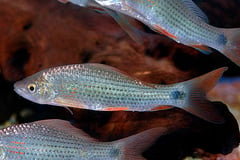
Osteochilus hasseltiiHard-lipped Barb
Cyprinidae · authority not recorded
The hard-lipped barb, Osteochilus hasseltii, is a cyprinid with an enormous range from Myanmar to Vietnam and south to Borneo, Sumatra and Java. Reaching 32 cm, it inhabits slow-moving tributaries and large streams with soft substrates, and migrates into inundated forest to feed and spawn at the onset of the rainy season. A caudal spot, 15-18 dorsal-fin rays and orange flecking on the flanks help identify it.
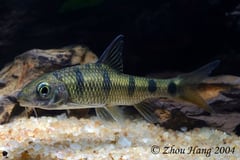
Acrossocheilus beijiangensis
Cyprinidae · Wu & Lin, 1977
Acrossocheilus beijiangensis is a barred cyprinid from Fujian, Guangdong and Guangxi in southern China, plus the islands of Hainan and Hong Kong. With A. clivosius it is one of only two species in the genus always to have five dark vertical bars on each flank. Wild fish feed on small benthic invertebrates and graze biofilm from rocks and other solid surfaces.
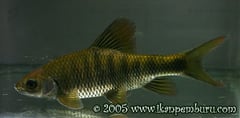
Acrossocheilus monticola
Cyprinidae · Günther, 1888
Acrossocheilus monticola is a barred cyprinid that is apparently endemic to the upper Yangtze River basin in China. It alone in the genus has seven or eight dark vertical bars on each flank, each one to three scales wide. The type locality is a mountain stream flowing into the Ichang gorge, and wild fish feed on small benthic invertebrates and graze biofilm from rocks and other solid surfaces.
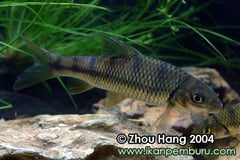
Acrossocheilus parallens
Cyprinidae · Nichols, 1931
Acrossocheilus parallens is a barred cyprinid from Guangdong and Hainan provinces in southern China, plus the island of Taiwan. It has five or six dark vertical bars on each flank, each two scales wide, a pattern it shares with A. paradoxus and several other congeners. Wild fish feed on small benthic invertebrates and graze biofilm from rocks and other solid surfaces.

Amblyrhynchichthys micracanthus
Cyprinidae · Ng & Kottelat, 2004
Amblyrhynchichthys micracanthus is a riverine cyprinid from the Mekong catchment in Laos, Thailand, Cambodia and Vietnam, and the Chao Phraya system. It moves into inundated forest during the wet season, and wild fish feed on periphyton, plankton and benthic algae. Older records of A. truncatus from mainland Indochina all refer to this species, which has a straighter snout profile, a shorter dorsal-fin spine and fewer gill rakers.

Bangana devdevi
Cyprinidae · Hora, 1936
Bangana devdevi is a cyprinid known with certainty from the Irrawaddy system in Manipur, India, and Myanmar, and the Salween in Myanmar and Thailand. Records from the Red River basin in Vietnam appear questionable. It presumably inhabits flowing river channels and larger tributaries and migrates seasonally, as related species do.

Garra arupi
Cyprinidae · Nebeshwar, Vishwanath & Das, 2009
Garra arupi is a cyprinid from the upper Brahmaputra River basin in Arunachal Pradesh, northern India. It is sympatric with the congeners G. kempi and G. lissorynchus, and is told apart from them by scale and fin-ray counts, a transverse band of tubercles on the snout tip, and other characters. It grows to around 75 mm SL.

Garra bispinosa
Cyprinidae · Zhang, 2005
Garra bispinosa is a cyprinid known only from its type locality, the Daying Jiang in the Irrawaddy basin, Yunnan Province, China. It is distinguished from other Garra in Southeast Asia and China by a quadrate proboscis on the snout, each lobe tipped with a single large tubercle. Nothing specific is recorded of its habitat.
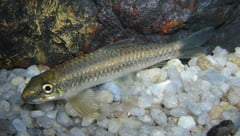
Garra borneensis
Cyprinidae · Vaillant, 1902
Garra borneensis is a cyprinid endemic to northern and western Borneo, in Kalimantan, Brunei, Sabah and Sarawak. No other member of the genus is known from the island. An obligate dweller of swiftly-flowing streams and headwaters, it lives in clear, oxygen-saturated water over gravel, rocks and bedrock carpeted with biofilm.

Garra hughiCardamom Garra
Cyprinidae · Silas, 1955
The Cardamom garra (Garra hughi) is a cyprinid from the Anamalai, Cardamom, Palani and Ashambu Hills of the Western Ghats, southern India. It appears occasionally in the ornamental trade, where it may be labelled 'chocolate algae eater'. The flanks are grey and the belly yellowish-white, with a conspicuous dark lateral band running to the caudal-fin base. It inhabits swiftly-flowing headwaters and tributaries.

Garra imberba
Cyprinidae · Garman, 1912
Garra imberba is a cyprinid without barbels from the upper Yangtze, Mekong and Red River basins in southern China, and the upper Red in Vietnam. Records from the Salween system result from confusion with the similarly-named G. imberbis. With G. micropulvinus it is placed in the Semilabeoina, for which the name Ageneiogarra has been suggested. It tends to inhabit swiftly-flowing headwaters and tributaries.

Garra kalpangi
Cyprinidae · Nebeshwar, Bagra & Das, 2012
Garra kalpangi is a small cyprinid known only from the Kalpangi River, a Brahmaputra tributary in the Himalayan foothills of Arunachal Pradesh, India. It grows to around 75 mm SL and has two pairs of barbels and a weakly developed proboscis on the snout, a feature it shares with G. gravelyi, G. rotundinasus and G. elongata. Like other Garra it has a lower lip modified to form an adhesive disc.

Garra mirofrontis
Cyprinidae · Chu & Cui, 1987
Garra mirofrontis is a cyprinid native to the upper Mekong (Lancangjiang) basin in Yunnan province, China. It is characterised by a transverse groove on the snout directly in front of the eyes, and a bifurcate proboscis with a conical keratinised tubercle at each tip. A typical habitat is a strongly-flowing river about 25 m across with a predominantly rocky substrate.

Garra mullya
Cyprinidae · Sykes, 1839
Garra mullya is a cyprinid endemic to and widespread within peninsular India, in rivers including the Tapti, Narmada, Godavari, Krishna and Cauvery. It has been recorded from flowing headwater streams to low altitude main river channels, including polluted stretches, and at least some populations migrate upstream to breed. Wild fish feed on algae, diatoms and organic detritus.

Garra nambulica
Cyprinidae · Vishwanath & Joyshree, 2005
Garra nambulica is a small cyprinid known only from tributary streams of the Nambul River, in the Chindwin basin of Manipur state, northeastern India. It has a squarish head, no proboscis or transverse groove on the snout, and a W-shaped blue-black band on the caudal fin. It grows to around 65 mm SL.

Garra notata
Cyprinidae · Blyth, 1860
Garra notata is a cyprinid known with certainty from the Salween basin in Myanmar, China and Thailand, and the Tenasserim drainage. Records from the Western Ghats of southern India are unlikely to be accurate, and a report from the upper Irrawaddy needs confirmation. It lacks both a transverse groove and a proboscis on the snout, and has dark spots at the base of the dorsal-fin rays.
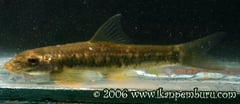
Garra qiaojiensis
Cyprinidae · Wu & Yao, 1977
Garra qiaojiensis is a cyprinid known only from a handful of localities in the upper Irrawaddy (Yiluowadi Jiang) basin in Yunnan province, China. It may also occur in northern Myanmar, and was collected from clear, flowing mountain streams over rock and gravel. It is similar to G. rotundinasus but has a quadrate, heavily tuberculated proboscis, a longer head and a deeper body. It grows to around 175 mm SL.

Garra rakhinica
Cyprinidae · Kullander & Fang, 2004
Garra rakhinica is a small cyprinid known only from its type locality, a minor stream on the western slope of the Rakhine Yoma, western Myanmar. In March 1998 that stream was reduced to a series of interconnected pools of clear water over gravel and rocks, with no aquatic vegetation. The body is almost uniform greyish, with a dark spot behind the upper edge of the opercle and white tips to the caudal-fin lobes.
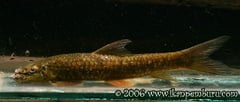
Garra rotundinasus
Cyprinidae · Zhang, 2006
Garra rotundinasus is a cyprinid native to the Yiluowadi Jiang, the upper Irrawaddy river system, in Yunnan province, southern China. Before its description it was confused with a congener now accepted to occur only in the Salween and Manipur basins. Both have a weakly-developed proboscis, but G. rotundinasus has a broadly rounded snout and more lateral line scales. It grows to around 185 mm SL.

Garra salweenica
Cyprinidae · Hora & Mukerji, 1934
Garra salweenica is a cyprinid found throughout the Salween River system in Yunnan province, China, Myanmar and western Thailand. It has a brownish body with longitudinal stripes on the rear half, a trilobed proboscis on the blunt snout, and a dark marking at the tip of the upper caudal-fin lobe. It tends to inhabit swiftly-flowing headwaters and tributaries, and grows to around 175 mm SL.

Garra surendranathanii
Cyprinidae · Shaji, Arun & Easa, 1996
Garra surendranathanii is a cyprinid known only from the Chalakkudy, Periyar and Pamba river basins in Kerala, southwestern India. It has appeared in the aquarium trade on a handful of occasions, marketed as 'green algae-eater'. The body is elongate and shallow, with black-edged scales and a black spot at the upper extremity of the opercle. It grows to around 150 mm SL.

Garra theunensis
Cyprinidae · Kottelat, 1998
Garra theunensis is a large cyprinid from the Nam Theun and Nam Gnouang systems of the Mekong watershed in Laos, and the Nan River in Thailand. It grows to 300 mm SL and has a plain brown body and fins, sometimes with 6-8 faint longitudinal stripes. It tends to inhabit swiftly-flowing headwaters and tributaries with clear, oxygen-saturated water.

Gymnostomus ariza
Cyprinidae · Hamilton, 1807
Gymnostomus ariza is a cyprinid widely distributed from the Indus basin in Pakistan through India, Bangladesh and Myanmar. Growing to around 300 mm SL, it inhabits flowing streams and tributaries with clear water. It has a confusing taxonomic history, having been placed in Bangana, Cirrhinus and Labeo in recent years. It breeds in temporarily-inundated zones in the wet season and is also produced commercially for food.

Gymnostomus lineatus
Cyprinidae · Smith, 1945
Gymnostomus lineatus is a riverine cyprinid from the middle to lower Mekong basin and the Chao Phraya, in China, Laos, Thailand and Cambodia. It is most often collected in mid-to-large channels, although in the Mekong basin it also enters smaller tributaries and inundated fields. It has a pair of small maxillary barbels and 5-6 faint, thin stripes along each flank, and has been placed in Henicorhynchus, Cirrhinus, Bangana and Labeo in the last few decades.

Gymnostomus lobatus
Cyprinidae · Smith, 1945
Gymnostomus lobatus is a cyprinid from the middle to lower Mekong basin in Laos, Thailand and Cambodia, and the Chao Phraya and Mae Klong in Thailand. It is considered one of the most abundant species in the massive seasonal migrations of cyprinids in the mainstream Mekong, and enters inundated forests in the wet season. The body is relatively slender and plain silver, with no dark marking on the caudal peduncle, and the snout often projects strongly.

Gymnostomus ornatapinnis
Cyprinidae · Roberts, 1997
Gymnostomus ornatapinnis is a small cyprinid known only from the Mekong River system in Laos, Thailand and Cambodia. It appears to favour still or slow-moving, often temporarily-inundated, marginal habitats away from the major river channels. Barbels are completely absent, the caudal peduncle is very deep, and the pectoral, pelvic and anal fins are usually reddish-orange or rose-tinted.

Gymnostomus siamensisSiamese Mud Carp
Cyprinidae · Sauvage, 1881
The Siamese mud carp, Gymnostomus siamensis, is a cyprinid from the Mekong, Chao Phraya and Mae Klong basins in Laos, Thailand, Cambodia and Vietnam. Common in the Mekong main channel and larger tributaries, it moves into inundated zones to spawn in the wet season and is abundant in the massive seasonal migrations of cyprinids. It has a relatively deep, plain silver body and a large, broad head.
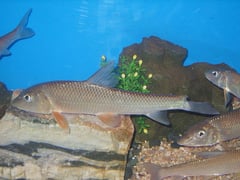
Hemibarbus labeoBarbel Steed
Cyprinidae · Pallas, 1776
The barbel steed, Hemibarbus labeo, is a cyprinid widespread in eastern Asia between the Yangtze and Amur river basins. A predominantly riverine fish of clear, well-oxygenated running water, it forms schools just above the substrate as an adult, and some populations make annual spawning migrations. Adults lack dark spots on the body and have a long snout and well-developed lips.
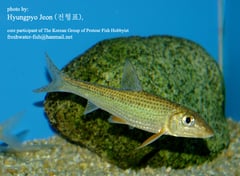
Hemibarbus longirostris
Cyprinidae · Regan, 1908
Hemibarbus longirostris is a cyprinid native to far eastern Asia, including northeastern China, southeastern Russia, the Korean peninsula and Japan. A predominantly riverine fish, it lives in clear, well-oxygenated running water over sand, gravel, rock or mud, and adults tend to form schools just above the substrate in slower-moving sections.
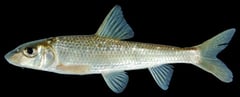
Hemibarbus maculatusSpotted Steed
Cyprinidae · Bleeker, 1871
The spotted steed, Hemibarbus maculatus, is a cyprinid widespread in eastern Asia between the Yangtze and Amur basins, including Taiwan and Hainan. It has 7–11 large blackish spots on each flank and a deep body with a clearly convex dorsal profile. A riverine fish of clear, well-oxygenated running water, it breeds in May and June, depositing its eggs among aquatic vegetation. It has probably been introduced to Vietnam and Laos, or records from there represent another species.
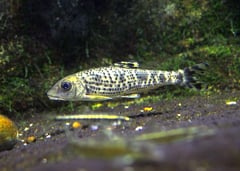
Hemibarbus mylodon
Cyprinidae · Berg, 1907
Hemibarbus mylodon is a cyprinid endemic to the Korean peninsula, where it occurs throughout North Korea and South Korea. A predominantly riverine fish, it lives in clear, well-oxygenated running water over sand, gravel, rock or mud, and adults tend to form schools just above the substrate in faster-flowing sections.

Hypsibarbus pierreiYellow Eyed Silver Barb
Cyprinidae · Sauvage, 1880
The yellow eyed silver barb, Hypsibarbus pierrei, is a large cyprinid from the middle and lower Mekong basin in Laos, Thailand, Cambodia and Vietnam. It also occurs in the Dong Nai drainage, and migrates seasonally from larger river channels in the dry season to spawning grounds that remain unknown. Reaching at least 300 mm, it is a valued food fish, and most Hypsibarbus species are thought to be in decline because of the damming of rivers and agriculture.

Hypsibarbus salweenensis
Cyprinidae · Rainboth, 1996
Hypsibarbus salweenensis is a large cyprinid endemic to the Salween river system in Yunnan province, China, eastern Myanmar and northwestern Thailand. It has been collected from submontane headwater streams, larger tributaries and main river channels, and appears to be abundant on a seasonal basis in the lower Salween, suggesting a migratory lifestyle. Growing to at least 300 mm, it belongs to a genus of valued food fishes.

Labeo angra
Cyprinidae · Hamilton, 1822
Labeo angra is a benthic cyprinid from Pakistan, Nepal, northern India, Bangladesh and Myanmar, described from the Brahmaputra. It can be identified by a brownish back, yellowish flanks and belly, and a black to bluish stripe from the eye to the caudal-fin base. It undertakes annual spawning migrations within its native river systems.
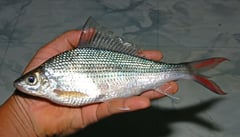
Labiobarbus fasciatus
Cyprinidae · Bleeker, 1853
Labiobarbus fasciatus is a labeonin cyprinid from the Pahang River system in Peninsular Malaysia and the islands of Sumatra and Borneo. It has a red caudal fin with a thin dark stripe along each lobe, and longitudinal stripes formed by spots on the scales. Like other Labiobarbus it has two pairs of well-developed barbels and an extremely long dorsal fin, and the genus was known as Dangila for over 100 years.

Labiobarbus siamensis
Cyprinidae · Sauvage, 1881
Labiobarbus siamensis is a cyprinid from the Mekong in Laos, Thailand and Cambodia, and the Chao Phraya and Bang Pakong in central Thailand. It inhabits rivers and streams of all sizes and moves into inundated floodplains and forests during the wet season. Wild fish feed on small items including phytoplankton, zooplankton, periphyton and benthic algae. Relatively long maxillary barbels, reaching well beyond the eye, help separate it from congeners.
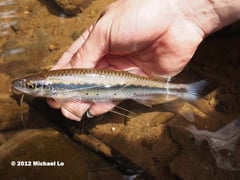
Luciosoma pellegrinii
Cyprinidae · Popta, 1905
Luciosoma pellegrinii is a slender, pike-like cyprinid endemic to Borneo, ranging from the Kapuas in West Kalimantan to Sabah. It is scarcely known in the aquarium trade because it comes from an area where very few commercial collections take place, but its name is misapplied on a regular basis. It has 4 to 8 distinct dark spots on the lateral line and appears to develop longer pelvic-fin filaments than any other member of the genus.
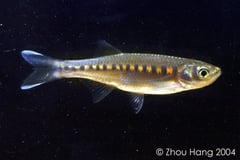
Luciosoma spilopleura
Cyprinidae · Bleeker, 1855
Luciosoma spilopleura is a small cyprinid known only from Sumatra and the Indonesian part of Borneo, where it prefers fast-flowing headwater streams. The species is poorly known and is not present in the ornamental trade, although its name has been widely misapplied to other Luciosoma species for decades. The largest known specimen measured 81.9 mm, so it appears to grow much smaller than its congeners.

Metzia bounthobi
Cyprinidae · Shibukawa, Phousavanh, Phongsa & Iwata, 2012
Metzia bounthobi is a cyprinid known only from the Nam Ou River basin, a Mekong tributary in northern Laos. It has been collected from hill streams with clear, slow to moderately fast-flowing water. It differs from all its congeners in having more branched anal-fin rays and more lateral line scales, and the genus itself remains unresolved in taxonomic terms.
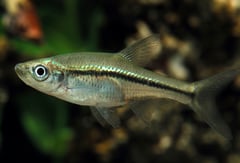
Metzia formosae
Cyprinidae · Oshima, 1920
Metzia formosae is a small cyprinid from northern Taiwan, Hainan, Hong Kong, southern China and northern Vietnam. It is identified by its upturned mouth and a black stripe along the flank from the gill opening to the caudal-fin base. It inhabits slow-moving to still, well-vegetated waters, including streams, rice paddies, ditches and canals. The genus remains unresolved in taxonomic terms.
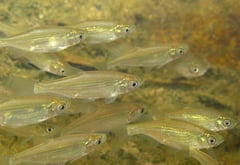
Metzia lineata
Cyprinidae · Pellegrin, 1907
Metzia lineata is a cyprinid from southern China, Hainan, Hong Kong and the Red River basin of northern Vietnam. Populations from the upper Pearl River and from Vietnam differ from those elsewhere, which suggests several species may be included under the name. It lives in slow-moving to still, well-vegetated waters. It has been introduced to other river systems in China and to northern Laos.

Mystacoleucus atridorsalis
Cyprinidae · Fowler, 1937
Mystacoleucus atridorsalis is a pelagic cyprinid considered endemic to the lower Mekong basin in Laos, Thailand and Cambodia. It favours flowing lowland river channels and moves into flooded forest during the wet season. A triangular blotch at the tip of the dorsal fin helps separate it from congeners, and like all Mystacoleucus it has a forward-pointing predorsal spine that can become entangled in an aquarium net.

Mystacoleucus chilopterus
Cyprinidae · Fowler, 1935
Mystacoleucus chilopterus is a pelagic cyprinid from the middle Mekong, Chao Phraya and Mae Klong basins in Laos and Thailand. It favours flowing lowland rivers and swiftly-flowing forest streams with rock and gravel. The anal fin has a concave margin and the dorsal and caudal fins black margins, and like all Mystacoleucus it has a forward-pointing predorsal spine that can become entangled in an aquarium net.

Mystacoleucus ectypus
Cyprinidae · Kottelat, 2000
Mystacoleucus ectypus is a pelagic cyprinid from the middle Mekong basin in Laos and Thailand, and may be endemic to the Khorat Plateau. It inhabits flowing lowland rivers and swift tributary streams with rock and gravel. It has a triangular blotch at the tip of the dorsal fin but no black fin margins or crescent-shaped scale markings, and like all Mystacoleucus it has a forward-pointing predorsal spine that can snag in a net.

Mystacoleucus lepturus
Cyprinidae · Huang, 1979
Mystacoleucus lepturus is a riverine cyprinid known only from the upper Mekong basin in southern China, Laos and Thailand. It favours clear, well-oxygenated running water over sand or gravel. The body is relatively slender, with a black margin on the dorsal fin and many crescent-marked scales. Records from Vietnam and Hainan Island refer to other species. Like all Mystacoleucus it has a forward-pointing predorsal spine that can snag in a net.
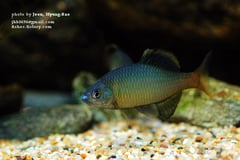
Tanakia signiferKorean Bitterling
Cyprinidae · Berg, 1907
The Korean bitterling, Tanakia signifer, is endemic to the Korean peninsula, where it occurs in southern North Korea and northern South Korea. It is considered endangered in South Korea, where it lives only in the Han river system and many populations have been extirpated. It inhabits cool, clean, shallow water over coarse sand or gravel, and like all bitterlings it spawns in living unionid mussels.
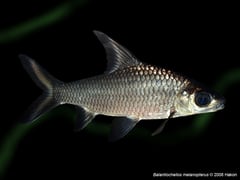
Balantiocheilos melanopterusSilver Shark
Cyprinidae · Bleeker, 1850
The silver shark, Balantiocheilos melanopterus, is a large cyprinid from Borneo, Sumatra and possibly Peninsular Malaysia. Also sold as the 'Bala shark', it is among the most commonly encountered ornamental fishes, yet it reaches 300 to 350 mm SL and long-term care is beyond most hobbyists. Wild populations have dwindled or vanished, it has been listed as Endangered by the IUCN since 1996, and fish on sale are almost certainly all commercially bred. It does not occur in Indochina.

Chagunius chagunio
Cyprinidae · Hamilton, 1822
Chagunius chagunio is a large cyprinid endemic to the Ganges and Brahmaputra river basins in northern India, Nepal and Bangladesh. Growing to 400-450 mm, it can only be considered suitable for public aquaria and a very small minority of private aquarists. Rarely seen in the trade, it looks almost identical to C. baileyi and C. nicholsi but has more circumferential and circumpeduncular scales.

Folifer brevifilis
Cyprinidae · Peters, 1881
Folifer brevifilis is a large cyprinid from the Mekong, Salween and Ayeyarwady systems of southern China, Myanmar, Thailand, Laos and Vietnam. It has also been recorded from Hainan and Hong Kong. Growing to 300 mm SL, it is unsuitable for the majority of home aquaria and extremely rare in the ornamental trade. It inhabits flowing middle and lower sections of major rivers and may migrate seasonally to spawn.

Hampala disparSpotted Hampala Barb
Cyprinidae · Smith, 1934
The spotted hampala barb, Hampala dispar, is a cyprinid endemic to the Mekong basin in northern Laos, Thailand and Cambodia. It needs plenty of space but, at up to 350 mm SL, makes a more suitable aquarium fish than the larger and more commonly traded H. macrolepidota. It has a single dark blotch on the body and less well-defined marginal stripes on the caudal lobes, although juveniles of the two can appear very similar.

Hampala salweenensis
Cyprinidae · Doi & Taki, 1994
Hampala salweenensis is a riverine cyprinid endemic to the Salween basin in northwestern Thailand and Myanmar. It has two roundish dark blotches on each flank, one beneath the dorsal-fin origin and one on the caudal peduncle, and a black marginal band on both caudal-fin lobes. It is poorly known in the aquarium hobby, and the full extent of its distribution within the watershed is unclear.
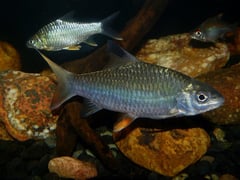
Hypselobarbus jerdoniJerdon's Carp
Cyprinidae · authority not recorded
Jerdon's carp, Hypselobarbus jerdoni, is a large cyprinid endemic to India, recorded from Maharashtra, Karnataka, Kerala and Tamil Nadu. A riverine fish of clear, well-oxygenated, running water, it can reach 46 cm and is very rarely encountered in the trade. Very active and a vigorous feeder, it needs a tank of 240 ∗ 120 ∗ 120 cm or more for a group of adults, and many Indian authors consider it endangered.

Hypsibarbus lagleri
Cyprinidae · Rainboth, 1996
Hypsibarbus lagleri is a large cyprinid endemic to the middle Mekong basin in Laos, eastern Thailand and Cambodia. It migrates seasonally, living in larger river channels in the dry season and moving into smaller tributaries and flooded forests in the wetter months. Growing to 350 mm, it is a valued food fish, and like most of its congeners is thought to be in decline because of the damming of rivers and agriculture.

Hypsibarbus vernayi
Cyprinidae · Norman, 1925
Hypsibarbus vernayi is a cyprinid widespread in mainland Southeast Asia, from the Mekong basin in southern China to northern Peninsular Malaysia. Very similar to H. wetmorei, it has yellow pectoral, pelvic and anal fins (orange to red in H. wetmorei), so yellow-finned fish sold as H. wetmorei or 'lemon fin barb' appear likely to be this species. It prefers flowing water with abundant riparian vegetation and migrates seasonally.

Hypsibarbus wetmorei
Cyprinidae · Smith, 1931
Hypsibarbus wetmorei is a cyprinid widespread in mainland Southeast Asia, from the lower Mekong basin south to the Pahang River in Malaysia. Its orange to red pectoral, pelvic and anal fins separate it from the very similar H. vernayi (yellow), and yellow-finned fish traded as H. wetmorei or 'lemon fin barb' appear likely to be that species. It prefers flowing water with abundant riparian vegetation and grows to 250 mm.

Labeo bogaViolet Shark
Cyprinidae · Hamilton, 1822
The violet shark, Labeo boga, is a cyprinid from most major river systems in India, Pakistan, Nepal, Bangladesh and Myanmar. It inhabits major river channels and larger tributaries and grows to 250 mm, needing a tank of at least 240 x 60 cm. It is unsuitable for most home aquaria but turns up in the trade irregularly, also as the 'violet-gilled shark' or 'blushing violet shark'. L. boga as currently recognised probably represents a complex of closely-related species.

Labiobarbus leptocheilus
Cyprinidae · Valenciennes, 1842
Labiobarbus leptocheilus is a large cyprinid widespread in Southeast Asia, from the Mekong and Salween to the Greater Sunda Islands. Different populations vary somewhat in appearance, and it may turn out to represent a group of closely-related species. The Cambodian Mekong population has been considered a distinct species, Labiobarbus lineatus, and that name is widely used in the ornamental trade although it is currently a synonym. It grows to 260 mm SL and needs spotless, well-oxygenated water.

Luciosoma bleekeri
Cyprinidae · Steindachner, 1878
Luciosoma bleekeri is a slender, pike-like cyprinid from the Mekong in Laos, Thailand, Cambodia and Vietnam, and from central and western Thailand. Subadults are traded regularly as 'apollo shark' or 'shark minnow' and it is frequently confused with L. setigerum, which has a series of black spots on the lateral line scales that this species lacks. It needs the largest private aquaria, and feeds mainly on terrestrial insects taken at the surface.

Luciosoma setigerumApollo Shark
Cyprinidae · Valenciennes, 1842
The apollo shark, Luciosoma setigerum, is a slender cyprinid found across much of Southeast Asia, from the Mekong basin to Borneo, Sumatra and Java. Subadults are traded regularly and are frequently confused with L. bleekeri, which lacks the series of black spots on the lateral line scales. A similar fish of unknown origin with no stripe on the front of the body is also common in the trade, listed as L. cf. setigerum. It needs the largest private aquaria.

Ctenopharyngodon idellaGrass Carp
Cyprinidae · Valenciennes, 1844
The grass carp, Ctenopharyngodon idella, is a large cyprinid native to the Amur River system in eastern Russia and northeastern China. Adults typically reach 800 to 1200 mm, making it a wholly unsuitable aquarium subject, though an albino form is traded. Widely introduced for aquaculture and weed control, it has caused serious damage to natural waters, and unwanted fish should never be released.

Cyclocheilos enoplos
Cyprinidae · Bleeker, 1849
Cyclocheilos enoplos is a large cyprinid from the Mekong region and Thailand south through Peninsular Malaysia to Borneo, Sumatra and Java. Growing to around 750 mm SL, it is clearly unsuitable for aquaria and scarce to non-existent in the ornamental trade. In the Mekong it makes long seasonal migrations, and adults move upstream above Khone Falls in what appear to be spawning migrations.

Hampala macrolepidotaHampala Barb
Cyprinidae · Kuhl & van Hasselt, 1823
The hampala barb, Hampala macrolepidota, is a cyprinid ranging from Myanmar through Thailand to the Mekong, and south to Borneo, Sumatra and Java. Also known as 'jungle perch' or 'sidebar barb', it can grow to over 2 feet and 5 kg and is a powerful, pelagic predator and not an aquarium subject in all but the most extreme circumstances. Prized as a food and sport fish, it has been introduced to numerous water bodies.

Hypsibarbus malcolmiGoldfin Tinfoil Barb
Cyprinidae · Smith, 1945
The goldfin tinfoil barb, Hypsibarbus malcolmi, is a large cyprinid from Thailand, Laos, Cambodia and Peninsular Malaysia. It occurs throughout the Mekong system and in the Chao Phraya and Maeklong drainages, and in the Mekong migrates seasonally between larger river channels and flooded forests. Reaching 400 to 500 mm, it is suitable only for public aquaria or the very largest private set-ups.

Incisilabeo behri
Cyprinidae · Fowler, 1937
Incisilabeo behri is a large cyprinid native to the Mekong river system in southern China, Laos, Thailand, Vietnam and Cambodia. Growing to 450 to 550 mm, it is patently unsuitable for the home aquarium, though juveniles are available on a relatively regular basis. The only member of its genus, it is separated from Bangana by a conspicuous transverse notch across the top of the head, and migrates seasonally up the Sekong, Sesan and Srepok rivers.

Labeo chrysophekadionBlack Shark
Cyprinidae · Bleeker, 1849
The black shark, Labeo chrysophekadion, is a large cyprinid from Southeast Asia, including the Mekong, Chao Phraya and the Greater Sunda Islands. Also known as the black sharkminnow, it reaches 600 mm and is aggressively territorial towards conspecifics and similarly-shaped fishes. It continues to be sold despite its patent unsuitability for the home aquarium, and an albino form has been selectively bred for the trade.
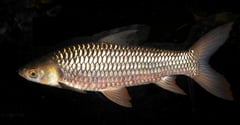
Leptobarbus hoeveniiMad Barb
Cyprinidae · Bleeker, 1851
The mad barb, Leptobarbus hoevenii, is a large pelagic cyprinid apparently native to Peninsular Malaysia, Borneo, Sumatra and Java. A popular sport fish growing to 800 to 1000 mm, it is wholly unsuitable for private aquaria but is readily available at 100 to 150 mm. The congener L. rubripinna was referred to as L. hoevenii for decades and both are traded under the same name. L. hoevenii lacks the broad dark midlateral stripe and has dark grey pelvic and anal fins.

Leptobarbus rubripinnaRed-finned Cigar Shark
Cyprinidae · Fowler, 1937
The red-finned cigar shark, Leptobarbus rubripinna, is a large pelagic cyprinid from the Mekong, Chao Phraya and Mae Klong river systems of Indochina. For decades it was referred to as its congener L. hoevenii, and both are still traded under the same name. A popular sport fish growing to 800 to 1000 mm, it is wholly unsuitable for private aquaria despite being readily available at 100 to 150 mm. It has a broad dark midlateral stripe and orange to red pelvic and anal fins.

Macrochirichthys macrochirusGiant Sword Minnow
Cyprinidae · Valenciennes, 1844
The giant sword minnow, Macrochirichthys macrochirus, is a large pelagic cyprinid widespread in Southeast Asia, from the Mekong to Borneo and Sumatra. Growing to 600 to 800 mm and becoming increasingly piscivorous as it grows, it is unsuitable for the majority of private aquaria, although juveniles are traded on occasion. It is thought to have been extirpated from the Chao Phraya, Mae Klong, Lake Songkhla and Java, and the Mekong populations have been drastically reduced.
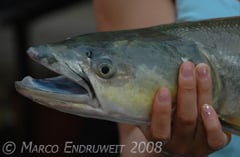
Elopichthys bambusa
Cyprinidae · Richardson, 1845
Elopichthys bambusa is a large predatory cyprinid of eastern Asia, from the Amur River in Russia to the Lam drainage in northern Vietnam. Growing to 2 m and 40 kg, it is entirely unsuitable for the home aquarium, though young individuals appear in the ornamental trade on an irregular basis. The only species in its genus, it is an important food fish over much of its range.
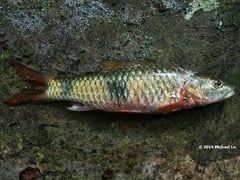
Hampala bimaculata
Cyprinidae · Popta, 1905
Hampala bimaculata is a large riverine cyprinid endemic to Borneo, recorded from Sarawak, Sabah, East Kalimantan and Brunei. Its adult size of up to 500 mm SL more-or-less precludes it as an aquarium fish, and it is poorly known in the ornamental trade. Of the Hampala species with two body blotches, it has saddle-shaped markings, with the anterior blotch beneath the posterior half of the dorsal-fin.
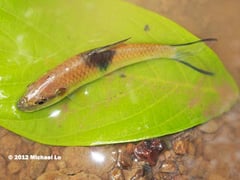
Hampala sabana
Cyprinidae · Inger & Chin, 1962
Hampala sabana is a large riverine cyprinid endemic to the Malaysian state of Sabah in northern Borneo. It inhabits clear, well-oxygenated running water and apparently favours deeper, slower-moving stretches. It has a single body marking and a higher count of circumpeduncular scales than its congeners. Growing to 410 mm SL, it is poorly known in the ornamental trade, and its size more-or-less precludes it as an aquarium fish.

Labeo calbasuOrangefin Labeo
Cyprinidae · Hamilton, 1822
The orangefin labeo, Labeo calbasu, is a large cyprinid from Pakistan, Nepal, India, Bangladesh, Myanmar and southern China. Growing to 800 mm, it is an important food and game fish across its native range and is not a suitable subject for the home aquarium. It is known as 'black rohu' in parts of India and Bangladesh, and inhabits the lower reaches of major rivers, lakes and reservoirs.

Labeo pierrei
Cyprinidae · Sauvage, 1880
Labeo pierrei is a large cyprinid from the Mekong river system in southern China, Laos, Thailand, Cambodia and Vietnam, and the Dong Nai in Vietnam. It grows to 800 mm and inhabits main river channels and large, deep tributaries. It migrates seasonally, moving upstream into the Sekong, Sesan and Srepok rivers at the onset of the wet season and returning downstream in the dry months.
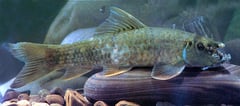
Garra orientalis
Cyprinidae · Nichols, 1925
Garra orientalis is a cyprinid widely distributed in southern China, with records from the Pearl River (Zhu Jiang) and Min Jiang watersheds. Earlier records from the Salween and upper Irrawaddy are now known to represent other species. It shares a forward-projecting, trilobed proboscis with G. salweenica and G. fuliginosa but lacks their dark blotch on the caudal peduncle. It tends to inhabit rocky, swiftly-flowing headwaters.