Hobbyist group · Siluriformes
Other siluriforms
Other siluriforms spans 13 families.
- Species
- 85
- Families
- 13
- Genera
- 40
- Photographed
- 84 of 85
- Difficulty rated
- 84 of 85
Families
Where they come fromnative records only
Hara jerdoniAsian Stone Catfish
Sisoridae · authority not recorded
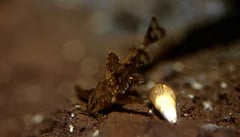
The Asian stone catfish, Hara jerdoni, is a tiny sisorid catfish from India and Bangladesh, found in slow-moving streams and small rivers. It grows to around 30 mm SL and is told apart from others in the genus by its elongated pectoral spines. It and its congeners also go by the name moth catfish, after their patterning and shape when viewed from above. Very peaceful, it prefers soft substrates and is outcompeted by active bottom-dwelling species.
Auchenipterichthys coracoideusMidnight Catfish
Auchenipteridae · (Eigenmann & Allen, 1942)
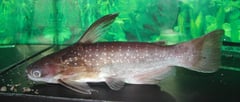
The midnight catfish, Auchenipterichthys coracoideus, is an auchenipterid catfish from the Peruvian and Brazilian Amazon and the Essequibo drainage. Also known as the 'Zamora woodcat', it has often been misidentified as A. thoracatus, and the two differ principally in anal-fin ray count. By day it shelters among submerged roots, tree stumps or vegetation in turbid rivers and flooded areas, emerging to feed in open water at night.
Balroglanis macracanthus
Auchenipteridae · (Soares-Porto, 2000)
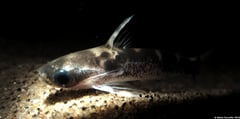
Balroglanis macracanthus is a small driftwood catfish endemic to the upper rio Negro system in Brazil. Poorly known but occasionally available in the aquarium hobby, it shelters among submerged wood by day and forages at night. Like other auchenipterids it practises internal insemination, and females can carry eggs and sperm packets until conditions trigger fertilisation.
Centromochlus reticulatusReticulated Driftwood Catfish
Auchenipteridae · (Mees, 1974)
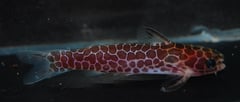
The reticulated driftwood catfish, Centromochlus reticulatus, is a small auchenipterid first known from the upper Rupununi River basin in Guyana. Its secretive, mostly nocturnal habits mean it may have been overlooked elsewhere, and it has been recorded from the rio Preto da Eva near Manaus, Brazil. Sometimes traded as 'purple oil catfish', it is highly gregarious and ideally kept in groups of at least eight.
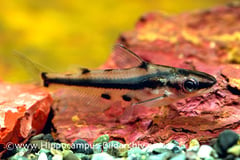
Hyalobagrus flavusShadow Catfish
Bagridae · authority not recorded
The shadow catfish, Hyalobagrus flavus, is a small bagrid catfish from the Batang Hari drainage in Sumatra and the Mentaya basin in Borneo. For many years it has been imported as Pelteobagrus ornatus. Unlike most catfish it is diurnal and spends much of its time swimming in shoals in midwater, and it suits a peaceful community with soft, acidic water.
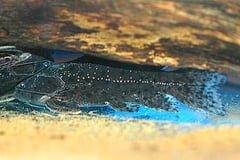
Liosomadoras morrowiFalse Jaguar Catfish
Auchenipteridae · authority not recorded
The false jaguar catfish, Liosomadoras morrowi, is an auchenipterid catfish from the Río Ucayali basin in Peru. It is often confused with its congener L. oncinus, from which it differs in its duller patterning. Nocturnal, peaceful and shy, it will eat small fish during the hours of darkness, and fertilisation is internal, with the male's extended anal fin used in a similar way to a livebearer's gonopodium.
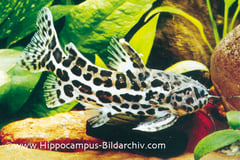
Liosomadoras oncinusJaguar Catfish
Auchenipteridae · authority not recorded
The jaguar catfish, Liosomadoras oncinus, is an auchenipterid catfish from the Ucayali, Amazonas and Negro river basins in South America. Often confused with L. morrowi, it has brighter patterning and grows larger, to around 250 mm SL. Formerly placed in the Doradidae because of its opercular spines, it is nocturnal and generally peaceful but eats small fish after dark. Its water requirements depend on where it was collected.
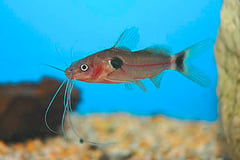
Mystus bimaculatusTwo Spot Mystus
Bagridae · authority not recorded
The two spot mystus, Mystus bimaculatus, is a small catfish found only on the island of Sumatra in Indonesia. It inhabits peat swamps, and its natural habitat is in danger of destruction by human activity. Very peaceful with even the smallest fish, it is more outgoing in a small group of its own kind. Commercial breeders have bred it only by hormone injection.
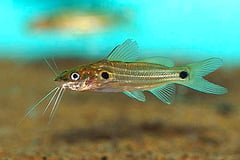
Mystus bleekeriDay's Mystus
Bagridae · authority not recorded
Day's mystus, Mystus bleekeri, is a bagrid catfish from India, Pakistan, Nepal, Bangladesh, Bhutan, Myanmar and Indonesia. It superficially resembles the more common M. vittatus but grows larger, to around 155 mm, and has a much longer adipose fin. Peaceful and gregarious, it suits communities of larger fish, though adults will probably eat small fish, and it is more outgoing in a small group.
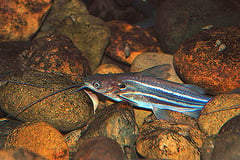
Mystus mysticetus
Bagridae · authority not recorded
Mystus mysticetus is a peaceful bagrid catfish from rivers of Laos, Thailand and Cambodia. It migrates into flooded forest in the wet season and is apparently often seen living and feeding in large shoals with its congener M. multiradiatus. The only Mystus with laterally positioned eyes, it makes a good bottom dweller for communities of larger peaceful fish, though it will probably eat small fish when adult.
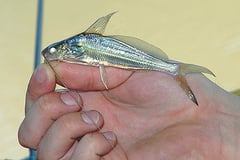
Mystus singaringan
Bagridae · authority not recorded
Mystus singaringan is a large bagrid catfish from Cambodia, Thailand, Vietnam, Laos, Malaysia and Indonesia. Not often seen in the hobby, it grows to around 300 mm and is used as a food fish in many of its native countries. It can be territorial and aggressive, eats smaller fish and is usually intolerant of its own kind, so it suits a tank of bigger fish such as larger barbs and large cichlids.
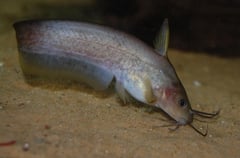
Neosilurus brevidorsalisShortfin Tandan
Plotosidae · (Günther, 1867)
The shortfin tandan, Neosilurus brevidorsalis, is a plotosid catfish restricted to the tips of northern Australia and southern Papua New Guinea. In Australia it is recorded only from the Jardine and Jackson river systems on the Cape York Peninsula, and in Papua New Guinea from the Fly River and some other drainages.
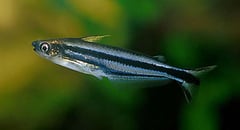
Pareutropius buffeiThree Striped African Glass Catfish
Schilbeidae · authority not recorded
The three striped African glass catfish, Pareutropius buffei, is a midwater, diurnal catfish from Nigeria, Niger, Benin, Mali and Guinea. It is very often sold as 'Debauwi catfish', but the closely related P. debauwi is seldom imported. P. buffei has three lateral stripes to that species' one, black spots in the caudal fin and a clear leading edge to the adipose fin, though young fish of the two are hard to tell apart.
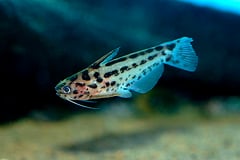
Trachelyichthys decaradiatus
Auchenipteridae · authority not recorded
Trachelyichthys decaradiatus is a small auchenipterid catfish known only from the Rupununi River in Guyana. It is very similar to T. exilis but has the eye set further back and a broader, shorter humeral process, and neither is seen very often in the hobby. Unlike most auchenipterids it usually feeds by day, and it is peaceful and does best in a group.
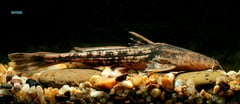
Acrochordonichthys gyrinusFalcate Chameleon Catfish
Akysidae · Vidthayanon & Ng, 2003
The falcate chameleon catfish, Acrochordonichthys gyrinus, is an akysid catfish known only from the Yom River, Chao Phraya basin, northern Thailand. A concave rear margin to the pectoral fins separates it from the rest of the A. ischnosoma group. When stressed it can secrete a milky substance from the axillary pore that quickly kills other fishes in an aquarium, and smaller tankmates will be eaten.
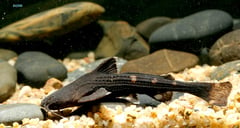
Acrochordonichthys rugosusAsian Banjo Catfish
Akysidae · (Bleeker, 1846)
The Asian banjo catfish, Acrochordonichthys rugosus, is an akysid catfish from Java, Sumatra, Borneo, Peninsular Malaysia and southern Thailand. The most commonly encountered member of the genus in the trade, it is still by no means common, and body colouration varies widely even among fish from a single locality. Like its congeners it can secrete a milky substance from the axillary pore when stressed, and this can quickly kill other fishes in the confines of an aquarium.
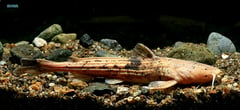
Acrochordonichthys septentrionalisMae Klong Chameleon Catfish
Akysidae · Ng & Ng, 2001
The Mae Klong chameleon catfish, Acrochordonichthys septentrionalis, is an akysid from western Thailand, possibly endemic to the Mae Klong drainage. It differs from other members of the A. ischnosoma group in its almost uniformly cream body with a few small brown spots, though colouration in the genus is variable. Like its congeners it can secrete a milky substance from the axillary pore when stressed, and this can quickly kill other fishes in an aquarium.
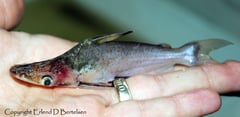
Ageneiosus ucayalensisDuck Catfish
Auchenipteridae · Castelnau, 1855
The duck catfish, Ageneiosus ucayalensis, is an auchenipterid catfish described from Peru and recorded across the Amazon, Orinoco and Guianas. Body patterning apparently varies with locality, and fish from black water habitats, particularly on the Guiana Shield, tend to be darker. Growing to around 290 mm SL and capable of taking large prey, it is safe only with similarly sized catfishes or large pelagic characins, mostly a combination for public aquaria.
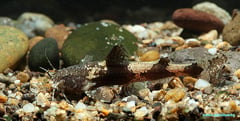
Akysis hendricksoniHendrickson's Stream Catfish
Akysidae · Alfred, 1966
Hendrickson's stream catfish, Akysis hendricksoni, is a small akysid catfish from much of Peninsular Malaysia and the extreme south of Thailand. One of the few members of the family exported for the hobby, it grows to around 50 mm SL and spends some of its time buried in sand with only the eyes showing. Colour pattern varies with locality, and like many fishes from running water it is intolerant of organic pollutants and needs spotless water.

Akysis longifilisSittaung Stream Catfish
Akysidae · Ng, 2006
The Sittaung stream catfish, Akysis longifilis, is a small akysid catfish known from the Sittaung River system in southern Myanmar. One of the few members of the family exported for the hobby, it has noticeably long nasal and maxillary barbels and two saddle-shaped light markings between the dorsal and caudal fins. The sympatric A. portellus is very similar, and differs mainly in its shorter adipose fin base and smaller mouth.
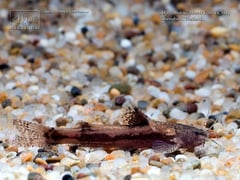
Akysis maculipinnisSpotfin Stream Catfish
Akysidae · Fowler, 1934
The spotfin stream catfish, Akysis maculipinnis, is a small akysid catfish from Chanthaburi Province in eastern Thailand. Its range apparently extends into Cambodia. Among the smaller members of the family at around 35 mm SL, it has been exported for the hobby. It spawns above the substrate in flowing water with no parental care, and the adults are avid egg-eaters, so the eggs must be protected if fry are to be raised.

Akysis portellusSmallmouth Stream Catfish
Akysidae · Ng, 2009
The smallmouth stream catfish, Akysis portellus, is a small akysid catfish from the Sittaung River system in southern Myanmar. One of the few members of the family exported for the hobby, it grows to around 43 mm SL. It closely resembles the sympatric A. longifilis, and differs in its shorter adipose fin base, smaller mouth and more rounded head when viewed from above.

Akysis prashadiIndawgyi Stream Catfish
Akysidae · Hora, 1936
The Indawgyi stream catfish, Akysis prashadi, is an akysid catfish from Lake Indawgyi and the upper Ayeyarwady drainage in northern Myanmar. It has also been recorded from the Lokchao river in Manipur, India. At up to 62 mm SL it ranks among the largest in the genus, and though it has been exported for the hobby it is by no means common.
Akysis pulvinatusKra Stream Catfish
Akysidae · Ng, 2007
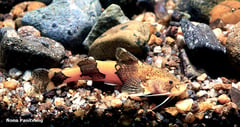
The Kra stream catfish, Akysis pulvinatus, is a small akysid catfish from southern Thailand. Known from streams on the western side of the Kra Isthmus and the upper Tapi basin, it grows to around 30 mm SL and has been exported for the hobby on an extremely limited basis. It most resembles A. vespa, and differs in its longer adipose fin base, deeper caudal peduncle and a caudal fin with the lower lobe longer than the upper.

Akysis variusVariable Stream Catfish
Akysidae · Ng & Kottelat, 1998
The variable stream catfish, Akysis varius, is a small akysid catfish from the Mekong drainage in Laos, Thailand and Cambodia. The number of serrations on its pectoral spine varies, and in contrast to other Akysis with serrated spines, the larger specimens examined had fewer or none. Members of the genus live almost exclusively in swiftly flowing streams and rivers over sand, gravel and rocks.

Akysis vespaOrange-Banded Stream Catfish
Akysidae · Ng & Kottelat, 2004
The orange-banded stream catfish, Akysis vespa, appears endemic to headwaters of the Salween basin on the border between Myanmar and Thailand. One of the few members of the family exported for the hobby, it is also sold as 'wasp catfish' or 'orange micro bumblebee catfish'. Its yellow markings normally form wide bands, a pattern rarely seen in congeners, and the yellow on the snout extends to the base of the nasal barbels.

Akysis vespertinusWestern Stream Catfish
Akysidae · Ng, 2008
The western stream catfish, Akysis vespertinus, is an akysid catfish known only from the Ann Chaung river system in Rakhine State, western Myanmar. Exceptionally rare in the aquarium trade, it has a narrow snout that makes the head look triangular, and two light, saddle-shaped markings between the dorsal and caudal fins. The region holds several other locally endemic fishes, including Danio aesculapii, and the species seems likely to occur more widely there.
Asterophysus batrachusGulper Catfish
Auchenipteridae · Kner, 1858
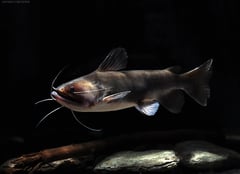
The gulper catfish, Asterophysus batrachus, is a predatory auchenipterid catfish from the rio Negro in Brazil and the Orinoco in Venezuela. Also called the 'ogre catfish', it hunts in shallow blackwater tributaries, mostly at night. It can consume fishes almost twice its own size and is not recommended for the community aquarium.
Bagrichthys macracanthusBlack Lancer
Bagridae · (Bleeker, 1854)
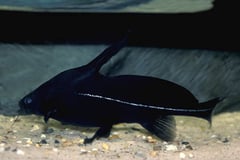
The black lancer, Bagrichthys macracanthus, is a bagrid catfish described from Sumatra, Indonesia, and possibly endemic to that island. The name 'lancer' comes from the extended dorsal spine of several members of the genus. Fish from the Chao Phraya and Mekong once included in it were described as B. majusculus in 2002. A shy, nocturnal catfish of large, turbid rivers, it needs a dimly lit tank with plenty of hiding places and is territorial towards other bottom-dwellers.

Bagrichthys majusculusWhite-Whisker Lancer
Bagridae · Ng, 2002
The white-whisker lancer, Bagrichthys majusculus, is a bagrid catfish from the Mekong and Chao Phraya river systems in Thailand and Laos. Described from the Mun River in eastern Thailand, it is most similar to B. macracanthus and B. vaillantii and differs from both in its longer pectoral-fin spines. It inhabits large, turbid, slow rivers and moves into flooded riparian zones to spawn in the wet season. A shy, nocturnal fish, it is territorial towards other bottom-dwellers, especially its own kind.

Bagrichthys obscurus
Bagridae · Ng, 1999
Bagrichthys obscurus is a bagrid catfish from the Chao Phraya, Bang Pakong and Mekong watersheds in Thailand, Cambodia and Vietnam. One of the lancers, named for the extended dorsal spine in several members of the genus, it has a uniformly brown body with no pale stripe or blotches, a small mouth and a relatively short dorsal spine. It inhabits large, turbid rivers with slow flow, and is shy, nocturnal and territorial towards other bottom-dwellers.

Batasio feruminatus
Bagridae · Ng & Kottelat, 2008
Batasio feruminatus is a small bagrid catfish from the Ataran River system in southern Myanmar, to which it is possibly endemic. Some Ataran tributaries extend across the border into Thailand. Like its congeners it is an obligate inhabitant of shallow, fast-flowing, highly-oxygenated headwater streams. B. feruminatus alone in the genus has both an oblique dark bar in front of the dorsal fin and a thin black midlateral stripe.
Batasio fluviatilis
Bagridae · (Day, 1888)
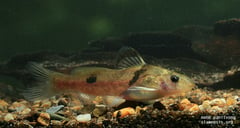
Batasio fluviatilis is a small bagrid catfish from southern Thailand and Peninsular Malaysia, below the Isthmus of Kra. Like its congeners it is an obligate inhabitant of shallow, fast-flowing, highly-oxygenated headwater streams, and it is largely unsuitable for the 'general' community aquarium. Batasio havmolleri is considered a junior synonym, and this is one of the Batasio species that has been spawned in captivity.
Batasio tigrinus
Bagridae · Ng & Kottelat, 2001
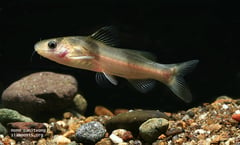
Batasio tigrinus is a small bagrid catfish that appears endemic to the Khwae Noi basin, often called the River Kwai, in western Thailand. The Khwae Noi is part of the larger Mae Klong watershed. Like its congeners it is an obligate inhabitant of shallow, fast-flowing, highly-oxygenated headwater streams, and it is largely unsuitable for the 'general' community aquarium.

Batasio travancoriaMalabar Batasio
Bagridae · Hora & Law, 1941
The Malabar batasio, Batasio travancoria, is a bagrid catfish endemic to southern Kerala, India, in the Pamba, Chittar and Kallada drainages. Its darkish midlateral stripe and poorly-defined post-opercular spot separate it from B. sharavtiensis, the only other described member of the genus in southwestern India. Like its congeners it is an obligate inhabitant of shallow, fast-flowing, highly-oxygenated headwater streams.
Belodontichthys dinema
Siluridae · (Bleeker, 1851)
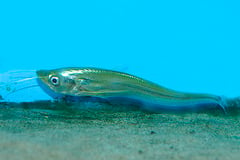
Belodontichthys dinema is a large, open-water predatory catfish from the Malay Peninsula, Sumatra and Borneo that reaches 100 cm TL in the wild. It eats only fish and needs a very large aquarium without tankmates small enough to swallow. Fish exported from Thailand or elsewhere in Indochina under this name are likely to be B. truncatus, the species found in the Mekong and Chao Phraya basins.
Centromochlus perugiaeOil Catfish
Auchenipteridae · authority not recorded
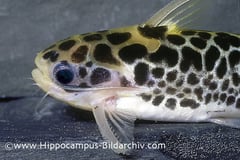
The oil catfish, Centromochlus perugiae, is a small auchenipterid catfish from Peru and Ecuador. It lives around the shorelines of swift-flowing rivers with sandy substrates and no aquatic plants. By day it squeezes into spaces little bigger than itself, emerging in the evening to feed close to the surface in the flow. It breeds quite easily given strong flow and plenty of small crevices.
Cetopsis coecutiensBlue Whale Catfish
Cetopsidae · authority not recorded
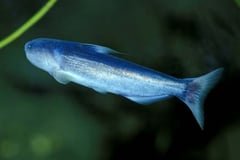
The blue whale catfish, Cetopsis coecutiens, is a cetopsid catfish from the Amazon, Tocantins and Orinoco river basins. In the wild it swims in voracious feeding groups, homing in on weakened fish by smell and burrowing into prey. It will bite chunks out of tankmates much bigger than itself, so it is best kept alone, and at up to 26.5 cm it needs a large tank with strong water flow and dim lighting.
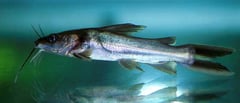
Clarotes laticepsWidehead Catfish
Bagridae · authority not recorded
The widehead catfish, Clarotes laticeps, is a large predatory catfish recorded across much of Africa, from Senegal and Guinea east to Egypt and Kenya. It inhabits large lakes and rivers and grows to 80 cm, though it is unlikely to reach this in captivity. Uncommon in the trade, it is capable of swallowing surprisingly large prey and is unsuitable for all but the biggest aquaria.
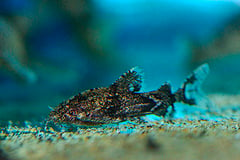
Erethistes maesotensis
Erethistidae · authority not recorded
Erethistes maesotensis is a small erethistid catfish known only from a single tributary of the Salween River on the border of Myanmar and Thailand. It lives in shallow, fast-flowing water over rocks and spends much of its time buried in the substrate or hiding in caves. Its outwardly pointing pectoral-fin denticles lead many experts to place it in Hara, though it is still officially included in Erethistes.
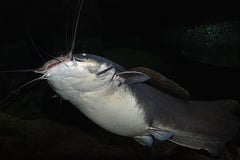
Heterobranchus longifilisVundu
Clariidae · authority not recorded
The vundu, Heterobranchus longifilis, is a clariid catfish widespread throughout Africa and one of the largest freshwater fishes on the continent. Growing to 150 cm, it is highly predatory, must be kept alone, and suits only public aquaria or a hobbyist able to house it properly. Its very long adipose fin separates it from similar members of the genus.
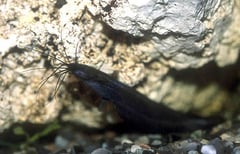
Heteropneustes fossilisLiver Catfish
Clariidae · authority not recorded
The liver catfish, Heteropneustes fossilis, is a catfish from Iran, Pakistan, India, Nepal, Sri Lanka, Bangladesh, Myanmar and the Andaman Islands. Also known as the stinging or fossil catfish, it carries venom sacs at the base of the pectoral spines and its sting is very painful, so it is not recommended for the inexperienced. Exceptionally hardy and long-lived, it can breathe atmospheric air to a certain extent and survives in sluggish, oxygen-deficient swamps and ditches.
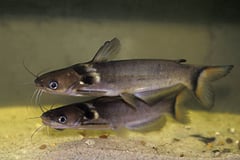
Horabagrus nigricollarisBlack Collared Catfish
Bagridae · authority not recorded
The black collared catfish, Horabagrus nigricollaris, is a bagrid catfish endemic to the Chalakudy River in Kerala, south-western India. The rarer of the two species in the genus in the hobby, it resembles the much larger H. brachysoma. Both are usually sold as juveniles, and in this species the black shoulder marking extends up and over the top of the body, giving the collar that names it.

Kryptopterus bicirrhis
Siluridae · (Valenciennes, 1840)
Kryptopterus bicirrhis is a silurid catfish from much of Southeast Asia, including the Mekong and Chao Phraya and the Greater Sunda Islands. Uncommon in the aquarium trade, its name was widely misapplied to K. vitreolus in older literature, but the two are easily told apart because K. bicirrhis does not have a transparent body in life. It tends to form schools, so four or more should be kept.
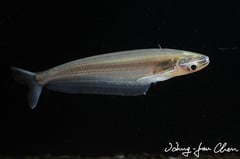
Kryptopterus cryptopterusBlue Sheatfish
Siluridae · (Bleeker, 1851)
The blue sheatfish, Kryptopterus cryptopterus, is a silurid catfish from the Malay Peninsula, Singapore, Sumatra, Borneo and Java. It inhabits flowing rivers and larger streams with turbid water, and is sometimes traded as 'smokey glass catfish'. Populations from Thailand, Cambodia, Laos and Vietnam once considered conspecific are now referred to K. geminus, its closest relative, from which it differs in having a wider head and a shorter snout and anal fin.

Kryptopterus geminus
Siluridae · Ng, 2003
Kryptopterus geminus is a silurid catfish from the lower and middle Mekong in Thailand, Laos, Cambodia and Vietnam, and the lower Chao Phraya. Wild populations were formerly considered K. cryptopterus, and it is likely to be traded as that very similar species. It differs in having a narrower head, a longer snout and anal fin and more laterally-placed eyes, and inhabits flowing rivers and larger streams with turbid water.
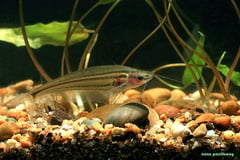
Kryptopterus macrocephalusStriped Glass Catfish
Siluridae · (Bleeker, 1858)
The striped glass catfish, Kryptopterus macrocephalus, is a silurid catfish from Thailand, Malaysia, Singapore and the Greater Sunda Islands. A stenotypic inhabitant of peat swamp forests and associated blackwater streams, it is also known as the false, mottled or tawny glass catfish. Striped and mottled colour forms exist that may or may not be conspecific, and the similar K. piperatus has a pale brown body with scattered dark spots.
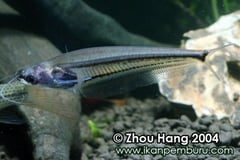
Kryptopterus palembangensis
Siluridae · (Bleeker, 1852)
Kryptopterus palembangensis is a silurid catfish known only from central and southern Sumatra, in the provinces of Jambi and South Sumatra. It is closely related to K. bicirrhis but is told apart by a prominent, dark lateral stripe on each flank. Almost unheard of in the aquarium trade, it may occasionally be exported among shipments of wild fishes from Sumatra.
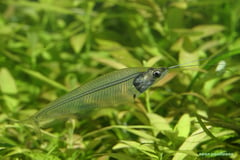
Kryptopterus vitreolusGlass Catfish
Siluridae · Ng & Kottelat, 2013
The glass catfish, Kryptopterus vitreolus, is a transparent silurid catfish from coastal river basins of peninsular and southeastern Thailand. Available in the trade for decades, it was widely misidentified as K. bicirrhis or K. minor until its description in 2013, so older literature uses those names. It is also sold as the 'Asian glass catfish', 'ghost catfish' or 'phantom catfish'. Its status in the wild requires investigation since it is collected intensively and has a restricted range.
Lophiobagrus cyclurusAfrican Bullhead
Claroteidae · authority not recorded
The African bullhead, Lophiobagrus cyclurus, is a small claroteid catfish endemic to Lake Tanganyika. It hides among rocks by day and forages after dark, and it lives in most communities of Tanganyikan catfish and cichlids, though very small fish will be eaten. It is rumoured to secrete a poisonous mucus when stressed that can kill other fish in the aquarium, which is one reason to house it in as large a tank as possible.
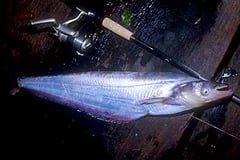
Micronema bleekeriBleeker's Sheatfish
Siluridae · authority not recorded
Bleeker's sheatfish (Micronema bleekeri) is a large silurid catfish from Thailand, Cambodia, Laos and Vietnam. An irregular import, it is often confused with some of its congeners. At up to 60 cm it needs a lot of open swimming space, powerful filtration and a heavy, tightly fitting cover, and it will eat any smaller fish it can fit in its mouth.
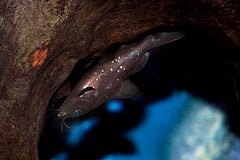
Mystus leucophasisAsian Upside Down Catfish
Bagridae · authority not recorded
The Asian upside down catfish, Mystus leucophasis, is a bagrid catfish from rivers in Myanmar that spends most of its time swimming inverted. Often sold at only a couple of inches, it is confused with the much smaller Synodontis nigriventris but is a uniform black without countershading. It grows to around 300 mm, will eat smaller fish, is usually intolerant of its own kind and is unsuitable for the general community tank.
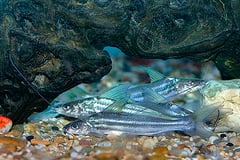
Mystus rhegma
Bagridae · authority not recorded
Mystus rhegma is a peaceful bagrid catfish from Laos, Thailand and Cambodia, where it inhabits rivers and flooded areas including fields. An irregular import, little is known about its natural behaviour. Gregarious, it makes a good bottom dweller for communities of larger peaceful fish, though it will probably eat small fish when adult.
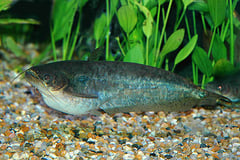
Ompok bimaculatusButter Catfish
Siluridae · authority not recorded
The butter catfish, Ompok bimaculatus, is a widespread silurid catfish recorded from Afghanistan and Pakistan east to China and Indonesia. Also known as the two spot glass catfish, it very likely contains a number of separate species, given the clear morphological differences between populations. It grows to 45 cm, needs a very large tank and will eat any smaller fish it can fit in its mouth.
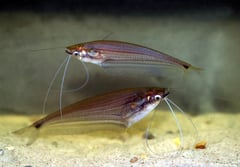
Ompok eugeneiatusBorneo Glass Catfish
Siluridae · authority not recorded
The Borneo glass catfish, Ompok eugeneiatus, is a silurid catfish from flowing waters in Brunei, Thailand, Cambodia, Malaysia and Indonesia. Not often encountered in the hobby, it is a schooling catfish for a community of medium to large peaceful fish, though it will eat any smaller fish it can fit in its mouth. It needs open swimming space, some current and clean, well-oxygenated water.
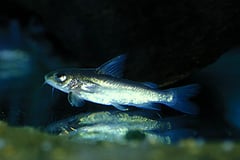
Rita kuturneeDeccan Rita
Bagridae · authority not recorded
The Deccan rita, Rita kuturnee, is a bagrid catfish from large river systems in India, growing to around 260 mm SL. Rita species are not often seen in the hobby. Relatively peaceful, it suits communities of larger species such as the bigger barbs, sturdy cichlids and loricariids, although smaller fish will be eaten.
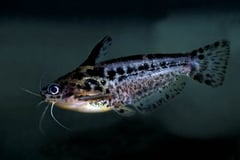
Trachelyichthys exilisPygmy Driftwood Catfish
Auchenipteridae · authority not recorded
The pygmy driftwood catfish, Trachelyichthys exilis, is a small auchenipterid catfish from the Nanay river basin in Peru. It is very similar to T. decaradiatus but has the eye set further forward and a longer, thinner humeral process. Unlike most auchenipterids it usually feeds by day. It is totally unaggressive towards conspecifics and does best in a group.
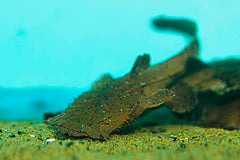
Chaca bankanensisChocolate Frogmouth Catfish
Chacidae · authority not recorded
The chocolate frogmouth catfish, Chaca bankanensis, is an ambush predator from rainforest waters in Malaysia, Indonesia and Brunei. It lies hidden among leaf litter and mulm, using its barbels as a lure to draw prey within reach of its capacious mouth. Very similar to C. chaca, it is darker and redder and lacks the hooklets on the lips and body. Chaca species appear to lower the pH in confined conditions, so water quality needs close attention.
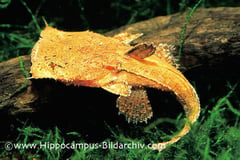
Chaca chacaFrogmouth Catfish
Chacidae · authority not recorded
The frogmouth catfish, Chaca chaca, is an ambush predator from still and slow-moving waters in India, Nepal, Bangladesh and Indonesia. Also known as the angler catfish, it lies hidden among leaf litter and mulm and moves its barbels like a worm to lure prey, which can be almost as big as itself. It is usually lighter than C. bankanensis and has small hooklets on the lower lip and body that its relative lacks.

Hemibagrus punctatusPorthole Bagrid
Bagridae · (Jerdon, 1849)
The porthole bagrid, Hemibagrus punctatus, is a catfish known only from the Cauvery (Kaveri) river system in southern India. The IUCN lists it as Critically Endangered (possibly extinct), and at its confirmed localities in the Kabini, Bhadra and Moyar systems it was last collected in 1998 or earlier. It has been available only very occasionally in the aquarium trade, and its flanks carry dark spots arranged in vertical columns.
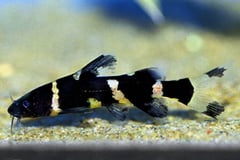
Pseudomystus siamensisAsian Bumblebee Catfish
Bagridae · authority not recorded
The Asian bumblebee catfish, Pseudomystus siamensis, is a bagrid from the lower Mekong and the Chao Phraya river in Thailand. It was formerly placed in Leiocassis, a name still used in much of the literature, and similarly patterned congeners may be sold under its name. Shy and nocturnal, it hides among submerged roots by day, will eat any tankmate small enough, and is territorial towards other bottom-dwellers.
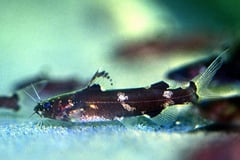
Pseudomystus sp. cf stenomusFalse Asian Bumblebee Catfish
Bagridae · authority not recorded
The false Asian bumblebee catfish, Pseudomystus sp. cf stenomus, is a bagrid from southeastern Thailand and peninsular Malaysia. Usually imported as P. stenomus, which is endemic to Java, it seems to be an undescribed species, and it lacks the striped bumblebee pattern of P. siamensis. Shy and nocturnal, it lurks among roots and rocks in fast-flowing, sandy-bottomed streams by day, and will eat any tankmate small enough.

Hemibagrus filamentus
Bagridae · (Fang & Chaux, 1949)
Hemibagrus filamentus is a bagrid catfish from the middle and lower Mekong river system in Laos, Cambodia and Thailand. It appears to be unknown in the aquarium trade but is a valued food fish within its native range, growing to 420 mm SL. It inhabits slowly-flowing or standing waters, including main river channels and lakes, and riverine populations typically migrate into flooded forest during the wet season.
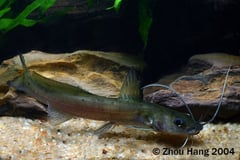
Hemibagrus macropterus
Bagridae · Bleeker, 1870
Hemibagrus macropterus is a bagrid catfish from the Zhujiang (Pearl River), Changjiang (Yangtze) and Qiantang Jiang in central and southern China. It inhabits swiftly-flowing rivers and tributaries with rocky substrates and grows to 408 mm SL. Virtually unknown in the aquarium trade, it is fished for food, and dam construction and pollution have affected it in parts of its range, where it may be locally extirpated.

Hemibagrus peguensis
Bagridae · (Boulenger, 1894)
Hemibagrus peguensis is a bagrid catfish from the Irrawaddy, Bago and Sittaung drainages of Myanmar and the Chindwin basin in northeastern India. Sometimes referred to as 'Sittang mystus', it has been widely confused with H. menoda in the past and seems virtually unknown in the aquarium hobby. It grows to 286 mm SL and can be told from H. menoda by its almost truncate snout.
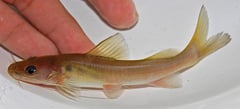
Hemibagrus planiceps
Bagridae · (Valenciennes, 1840)
Hemibagrus planiceps is a bagrid catfish endemic to western Java, known only from seven river systems including the Citarum and Ciliwung. It occurs in the upper parts of river basins, in clear, fast-flowing water over rock or sand. It has been confused in the past with H. gracilis, H. velox and H. bongan, and the population once thought to inhabit northwestern Peninsular Malaysia has been described as H. divaricatus.

Bagarius bagarius
Sisoridae · (Hamilton, 1822)
Bagarius bagarius, the goonch, is a very large sisorid catfish from the Indian subcontinent, in the Indus, Ganges and Brahmaputra drainages and the rivers of peninsular India. Also known as the giant devil catfish and sand shark, it reaches about 2 metres and is fished for food. It lives among boulders in the fast, turbulent rapids of larger rivers, is best kept alone and is too big for a home aquarium. Bagarius yarrelli is a synonym, and the large Southeast Asian fish sold under that name is B. lica.
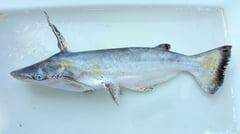
Ageneiosus inermisManduba
Auchenipteridae · (Linnaeus, 1766)
The manduba, Ageneiosus inermis, is a large auchenipterid catfish found throughout much of South America east of the Andes. At around 470 mm SL it would need an aquarium in excess of 400 x 120 cm as an adult and is largely unsuitable for private aquaria. An obligate carnivore, it can take surprisingly large prey, and the larger Ageneiosus species are often used as food fishes in their native countries.
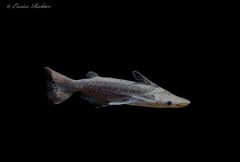
Ageneiosus marmoratusBottlenose Catfish
Auchenipteridae · Eigenmann, 1912
The bottlenose catfish, Ageneiosus marmoratus, is a predatory auchenipterid catfish from Guyana, Suriname and the upper Amazon in Peru and Ecuador. Also sold as 'Guyana slopehead', 'dolphin' or 'hammerhead' catfish, it loses much of its black-blotched juvenile patterning as it grows. Surprisingly peaceful with anything too large to swallow, it is active and sometimes skittish, and needs a tank of at least 150 x 60 cm.
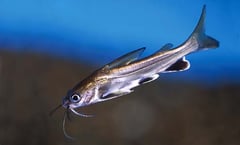
Ariopsis seemanniColombian Shark Catfish
Ariidae · (Günther, 1864)
The Colombian shark catfish, Ariopsis seemanni, is an ariid catfish from river mouths along the Pacific coast of the Americas, from Mexico to Peru. Usually sold as a silvery 2 to 3 inch juvenile, it grows to 350 mm SL and lives mostly in brackish water, so it is not recommended to those lacking the facilities to house it for life. Venom glands at the base of the first dorsal spine can cause a painful swelling.
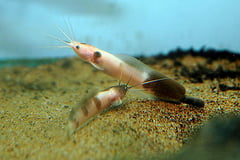
Clarias batrachusWalking Catfish
Clariidae · (Linnaeus, 1758)
The walking catfish, Clarias batrachus, is a large air-breathing catfish. In the strict sense it is known only from Java, and the walking catfishes of mainland Asia belong to other species. It can move across land on its stiff pectoral spines provided it stays damp, so a tightly fitting cover is essential. Walking catfishes are highly predatory and tolerate a very wide range of conditions, and they have become pests in several countries where they were introduced for farming, most notably the southern US. Most fish in the trade are albino or leucistic aquarium variants.

Kryptopterus limpok
Siluridae · (Bleeker, 1852)
Kryptopterus limpok is a silurid catfish widely distributed through Southeast Asia, including the Mekong and the Greater Sunda Islands. It can be told from its congeners by an extremely long mental barbel extending beyond the tip of the pectoral fin. It inhabits flowing rivers and larger streams with turbid water, grows to 260 mm and is almost unheard of in the ornamental trade.
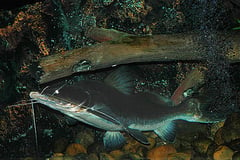
Sperata aorIndian Shovelnose Catfish
Bagridae · authority not recorded
The Indian shovelnose catfish, Sperata aor, is a large bagrid catfish from India, Pakistan, Nepal, Bangladesh and Myanmar. Named for its flattened, extended head, it is sometimes seen in dealers' tanks, but its enormous adult size makes it totally unsuited to aquarium life. It will eat any fish it can fit in its mouth and is territorial with its own kind.
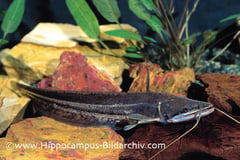
Wallago attuHelicopter Catfish
Siluridae · authority not recorded
The helicopter catfish, Wallago attu, is a giant predatory catfish found through much of Asia, from Afghanistan and Pakistan to Indonesia. It can reach 240 cm, and its mouth is filled with needle-sharp, backward-pointing teeth. It will bite aggressively when fed or handled, and the profile treats it as a genuinely dangerous fish that is clearly not an aquarium species.
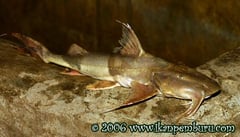
Bagarius rutilus
Sisoridae · Ng & Kottelat, 2000
Bagarius rutilus is a sisorid catfish from the Red River and other drainages of northern Vietnam and Yunnan in southern China, possibly also Laos. Reaching 700 to 1000 mm SL, it is clearly unsuitable for the home aquarium, and small numbers are only occasionally exported. It has orange fins in life. Adults live in fast, turbulent rapids in large river channels and perform spawning migrations when rivers swell between March and June.

Bagarius suchusCrocodile Catfish
Sisoridae · Roberts, 1983
The crocodile catfish, Bagarius suchus, is a sisorid catfish from the Mekong system in Thailand, Laos and Cambodia and the Chao Phraya in Thailand. Reaching 650 to 700 mm SL, it is clearly unsuitable for the home aquarium. An exposed, rugose cranium, sharp ridges on the predorsal plate and a row of prominent humps along the back separate it from congeners. It is mostly collected from turbulent rapids in larger rivers, where it shelters among boulders and large rocks.

Hemibagrus spilopterus
Bagridae · Ng & Rainboth, 1999
Hemibagrus spilopterus is a bagrid catfish from the Mekong and several other river systems in Laos, Vietnam, Cambodia and Thailand. Relatively common in the ornamental trade, it has been widely misidentified as H. nemurus, a Javan species that may never have been exported for aquaria. Given its size of up to 500 mm SL, its aggressive nature and a lifespan of several decades, it shouldn't be considered a home aquarium subject in all but the most exceptional circumstances.

Hemibagrus wyckiiCrystal-eyed Catfish
Bagridae · (Bleeker, 1858)
The crystal-eyed catfish, Hemibagrus wyckii, is a bagrid with an enormous distribution across central Indochina and western Indonesia. Juveniles are sometimes available in the aquarium trade, but buying them is strongly discouraged: it reaches 710 mm SL, is aggressively territorial and can live for several decades. Despite the common name, the blue eye is not given as a distinguishing character in any diagnosis we've seen.

Hemibagrus wyckioidesAsian Red Tailed Catfish
Bagridae · (Fang & Chaux, 1949)
The Asian red tailed catfish, Hemibagrus wyckioides, is a bagrid from the Mekong system in China, Laos, Vietnam, Cambodia and Thailand. It also occurs in the Chao Phraya drainage. The largest bagrid in central Indochina, it reaches at least 900–1000 mm and 70–80 kg, and the largest specimen known measured 1300 mm. Juveniles are sometimes sold, but buying them is strongly discouraged given its size, aggression and a lifespan of several decades.
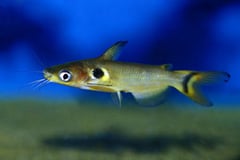
Horabagrus brachysomaSun Catfish
Bagridae · authority not recorded
The sun catfish, Horabagrus brachysoma, is a large bagrid catfish endemic to the state of Kerala in south-western India. Also sold as the bullseye, solar, eclipse or golden red-tailed catfish, it is often marketed as a general community fish, but at 45 cm it suits only communities of other large fish. The smaller H. nigricollaris is similar, and the two can be told apart by the black shoulder marking, a vaguely circular blotch in this species.

Phalacronotus apogon
Siluridae · (Bleeker, 1851)
Phalacronotus apogon is a large silurid catfish from much of Southeast Asia, including Thailand, the Mekong basin and the Greater Sunda Islands. It reaches 700 mm and arguably should not be considered a home aquarium subject at all, but juveniles are sometimes sold as 'blue neon sheatfish' or 'metallic cheatfish' without adequate information on long-term care. It is an important food fish across much of its native range.
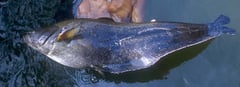
Wallagonia leeriiStriped Wallago Catfish
Siluridae · (Bleeker, 1851)
The striped wallago catfish, Wallago leerii, is a large predatory catfish from southeast Asia, including the Mekong basin, that can reach 2 metres. Like all Wallago it has an enormous mouth full of backward pointing teeth, and smaller fish are simply swallowed whole. This is NOT an aquarium fish, though it is imported quite regularly at a small size. In nature it is migratory and moves into inundated forest during the rainy season.
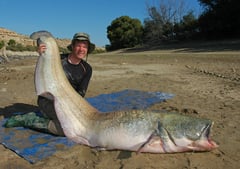
Silurus glanisWels catfish
Siluridae · authority not recorded
The wels catfish, Silurus glanis, is a sheatfish native to rivers draining into the North, Baltic, Black, Caspian and Aral seas. It has been introduced across western and southern Europe, where populations in Italy and Spain grow very large. Juveniles are occasionally available in the aquarium trade, but this species is clearly not a viable subject for the vast majority of private aquarists.

Hemibagrus microphthalmus
Bagridae · (Day, 1877)
Hemibagrus microphthalmus is a very large bagrid catfish from the Salween, Irrawaddy and Sittaung systems of Myanmar and western Thailand. It also occurs in the Manipur River drainage in northeastern India. Known to reach 1500 mm SL and to live for several decades, it cannot be considered a suitable home aquarium subject, and it is likely to prove aggressively territorial.

Caelatoglanis zonatus
Erethistidae · Ng & Kottelat, 2005
Caelatoglanis zonatus is an erethistid catfish known only from the Ataran River system in Kayin state, Myanmar, part of the Salween drainage. Images of the Ataran show flowing, forest-shaded headwaters with clear water, a mixed sand and rock substrate and plenty of submerged driftwood and leaf litter. The name zonatus refers to its barred colour pattern.