Cichla ocellaris
Peacock Bass
On this page11 sections
Quick facts
Difficulty5 of 8 measures
More bars, more demanding. Hardiness is not averaged with the rest.
- Space
- very large tank
- Water
- mild adjustment
- Temp
- steady heat
- Diet
- unknown
- Temperament
- territorial
- Social
- unknown
- Compatibility
- unknown
Hardiness on its own can raise the rating, whatever the measures above say.
- Hardiness
- survives most mistakes
Due to their large size, Peacock Bass are only really recommended for the experienced fishkeeper that can house them adequately. That said, they are a hardy and robust species that will adapt to a variety of conditions. Peacock Bass are becoming much more available in the hobby and are often seen for sale as cute 2" babies, often tempting people into buying a fish they will not be able to care for in the long term. Peacock Bass are also fished as a sport fish....
Distribution
Native to northern South America in Colombia, Venezuela, Guyana, Suriname, French Guiana and Brazil. Introduced populations exist in various countries, including Singapore and the USA.
Habitat
Native to northern South America in Colombia, Venezuela, Guyana, Suriname, French Guiana and Brazil. Introduced populations exist in various countries, including Singapore and the USA.
Aquarium size
More suited to public aquaria, otherwise a very large tank required. Ultimately, this fish will require a tank of at least 10'x3'x4' (l x h x w) for an adult fish. Smaller aquaria can be used for younger specimens but realistically you should not acquire this fish if you cannot house it long term.
Maintenance
Water conditions
Temperature: 24 – 27 °C75 – 81 °F
pH: 6.5 - 7.0
Hardness: Up to 15°H
Diet
Piscivorous in nature. The diet should consist of meaty foods such as prawn, mussel, lancefish, whitebait and other white fish.
Behaviour and compatibility
Territorial and moderately aggressive. Can be kept in species groups or with other large species such as arowana, stingrays, large cats and other large cichlids. An extremely large tank is required to achieve this with any degree of success.
Will eat tankmates small enough to be considered food.
Sexual dimorphism
The male is larger and develops a nuchal hump as he matures.
Reproduction
Limited reports of breeding in the hobby.
Notes
Due to their large size, Peacock Bass are only really recommended for the experienced fishkeeper that can house them adequately. That said, they are a hardy and robust species that will adapt to a variety of conditions.
Peacock Bass are becoming much more available in the hobby and are often seen for sale as cute 2" babies, often tempting people into buying a fish they will not be able to care for in the long term.
Peacock Bass are also fished as a sport fish.
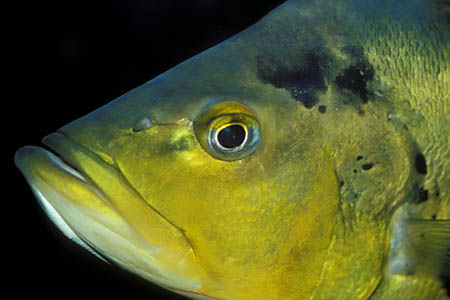
Species images · 1
Used with the photographer’s permission. Not licensed for reuse.
Profile completeness17 of 24
71% complete
Also missing: aquarium size, a recorded distribution, taxonomic authority, etymology.
Community
Questions about Cichla ocellaris?
Ask on Discord