Country · North & Central America
United States
Only species with a profile on Seriously Fish are counted, whether native or introduced.
- Species
- 16
- Families
- 10
- Genera
- 15
- Found only here
- 3
- Photographed
- 15 of 16
Regions here
Shares its fishes withspecies recorded in both
Found only here3
3 of the species on this page are recorded in United States and in no other country. This is not the same as being endemic.
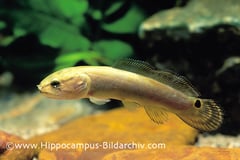
Amia calvaBowfin
Amiidae · Linnaeus, 1766
The bowfin, Amia calva, is the sole remaining member of the family Amiidae, from south-eastern Canada and the north-eastern USA. It breathes atmospheric air through a highly vascularised organ and can aestivate in wet ground during drought. A temperate predator growing to around 900 mm, it needs a very large tank of its own, and its sharp teeth and readiness to bite make it a dangerous species to own. Captive specimens over 30 years old are known.

Astyanax mexicanusBlind Cave Tetra
Characidae · De Filippi, 1853
The blind cave tetra, Astyanax mexicanus, is a characid found from Texas and New Mexico in the southern United States through Mexico into Guatemala. The eyeless, troglomorphic form lives only in underground caves in Mexico and is produced in huge numbers on Far Eastern farms, while the surface form is rarely seen in the hobby. The two may have diverged within the last 10,000 years, and the blind form finds its way with its lateral line.

Cichlasoma urophthalmusMayan Cichlid
Cichlidae · authority not recorded
The Mayan cichlid, Cichlasoma urophthalmus, is a large cichlid native to eastern parts of Mexico, Belize, Guatemala, Honduras and Nicaragua. Also known as the Mexican mojarra, it lives in swamps, marshes and coastal lagoons, can tolerate and even breed in full marine conditions, and is often seen spawning around mangroves. Territorial and fairly aggressive, it is regarded as a potential pest fish in the USA, where introduced populations exist.
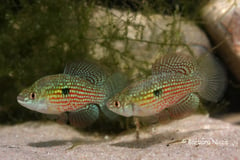
Jordanella floridaeFlorida Flagfish
Cyprinodontidae · Goode & Bean, 1879
The Florida flagfish, Jordanella floridae, is a cyprinodontid endemic to peninsular Florida in the United States. It lives in shallow, weedy backwaters, marshes, canals and ditches. A long-standing aquarium favourite, it is produced commercially and wild fish are very rare outside the U.S.A. Contrary to many reports it does not dig pits or exhibit extended parental care, and breeds as a fractional spawner like other cyprinodontids.

Thorichthys meekiFiremouth Cichlid
Cichlidae · Brind, 1918
The firemouth cichlid, Thorichthys meeki, is a Central American cichlid from Mexico's Atlantic slope and the Yucatán south into Belize and Guatemala. A popular aquarium fish for a long time, it is almost always commercially raised. It is easily identified by the bright red or orange underside of the head, which is more pronounced in adults. It is not especially aggressive but becomes territorial when breeding.

Xenentodon cancilaFreshwater Needlefish
Belonidae · Hamilton, 1822
The freshwater needlefish, Xenentodon cancila, is a belonid from Pakistan east through India, Bangladesh, Nepal, Sri Lanka, Myanmar and Thailand. Often called 'freshwater garfish', it only superficially resembles the true gars, and most of its relatives in the Belonidae are marine or estuarine. A near-exclusive inhabitant of the upper water column, it is surprisingly peaceful with anything too large to swallow and is best kept in numbers of four or more, in a tank of 180 ∗ 60 cm or more.
Xiphophorus helleriiGreen Swordtail
Poeciliidae · Heckel, 1848
The green swordtail, Xiphophorus hellerii, is a livebearer native to southeastern Mexico, Guatemala, Belize and Honduras. Among the world's most recognisable aquarium fishes, it is ubiquitous in the trade, where selective breeding and hybridisation with X. maculatus and X. variatus have produced a bewildering array of ornamental forms. The name is often misspelled X. helleri.
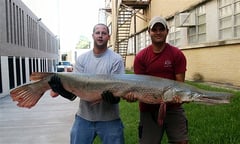
Atractosteus spatulaAlligator Gar
Lepisosteidae · Lacepède, 1803
The alligator gar, Atractosteus spatula, is a gar from the lower Mississippi basin and Gulf Coast states of the south-eastern USA and Mexico. One of the largest freshwater fishes in the world, it reaches a recorded 3050 mm and can live well over 50 years, so it should not be considered a home aquarium subject. Juveniles are seen for sale quite regularly, and a hybrid with Lepisosteus platostomus is known as the 'crocodile gar'.
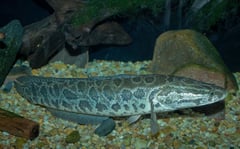
Channa argusNorthern Snakehead
Channidae · Cantor, 1842
The northern snakehead, Channa argus, is a large snakehead native to eastern China, southeastern Russia and the Korean peninsula. Growing to 850 mm, it is largely unsuitable for the home aquarium given its size and natural behaviour. Introduced populations, first intended for aquaculture, are now established in Japan, the United States, central Asia and parts of eastern Europe.

Cichla ocellarisPeacock Bass
Cichlidae · authority not recorded
The peacock bass, Cichla ocellaris, is a large predatory cichlid native to Colombia, Venezuela, Guyana, Suriname, French Guiana and Brazil. Introduced populations exist in several countries, including Singapore and the USA. Often sold as small juveniles, it grows to around 75 cm and needs a tank of at least 10 x 3 x 4 feet as an adult, and it will eat any tankmate small enough to be considered food.

Ctenopharyngodon idellaGrass Carp
Cyprinidae · Valenciennes, 1844
The grass carp, Ctenopharyngodon idella, is a large cyprinid native to the Amur River system in eastern Russia and northeastern China. Adults typically reach 800 to 1200 mm, making it a wholly unsuitable aquarium subject, though an albino form is traded. Widely introduced for aquaculture and weed control, it has caused serious damage to natural waters, and unwanted fish should never be released.

Fundulus xenicusDiamond Killifish
Fundulidae · Jordan & Gilbert, 1882
The diamond killifish, Fundulus xenicus, is a killifish native to the coastal waters of the northern Gulf of Mexico, from southern Florida to Texas. It lives in shallow lagoons, salt marshes and pools, usually in brackish water, and fares poorly with prolonged exposure to fresh water, so marine salt at 3-10 g/L is considered essential in the aquarium. Uncommon in the hobby, it is best kept on its own in a group of two or three females to each male.

Heterandria formosaLeast Killifish
Poeciliidae · Girard, 1859
The least killifish, Heterandria formosa, is a tiny livebearer from the United States, found in heavily vegetated margins of still or sluggish water. The smallest known livebearing fish, it is peaceful but not a community fish in the general sense, as the males reach only 2 cm and many commonly kept species will eat them. It is sometimes confused with the much more aggressive mosquito fish of the genus Gambusia.
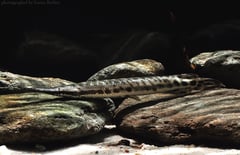
Lepisosteus oculatusSpotted Gar
Lepisosteidae · Winchell, 1864
The spotted gar, Lepisosteus oculatus, ranges from Lakes Erie and Michigan south through the Mississippi basin to the Gulf of Mexico drainages. Given its size and a lifespan of several decades it should not be considered a home aquarium subject, and only some public aquaria can maintain it long-term. A modified, vascularised swim bladder allows it to breathe atmospheric air to a certain extent.
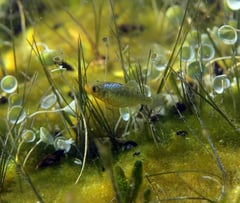
Cyprinodon variegatusSheepshead 'Minnow'
Cyprinodontidae · Lacepède, 1803
The sheepshead 'minnow', Cyprinodon variegatus, is a pupfish ranging from the northeastern U.S.A. to northeastern Mexico, the Bahamas and Antilles. It tends to be most common in brackish to hypersaline environments such as coastal salt marshes, lagoons and estuaries. On San Salvador Island in the Bahamas it appears to be the parent of a group of species living in sympatry and exploiting diverse but specific resources.
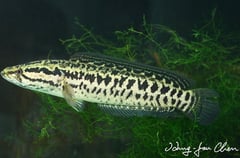
Channa maculataBlotched Snakehead
Channidae · Lacepède, 1801
The blotched snakehead, Channa maculata, is a snakehead from coastal drainages of southeastern China, including Hong Kong, and northern Vietnam. It is frequently confused with C. argus but has fewer fin rays and lateral line scales and carries 2-3 rounded blotches on the caudal peduncle. An important food fish, it has become established in Japan, Taiwan, the Philippines, Madagascar and Hawaii, and hybrids with C. argus appear to be quite common in aquaculture.