Hemiodus gracilis
Slender Hemiodus
On this page11 sections
Quick facts
Difficulty5 of 8 measures
More bars, more demanding.
- Space
- large tank
- Water
- tap water
- Temp
- steady heat
- Diet
- unknown
- Temperament
- peaceful
- Social
- shoal
- Compatibility
- unknown
Other demands
Each of these can raise the rating on its own, whatever the measures above say.
- Hardiness
- unknown
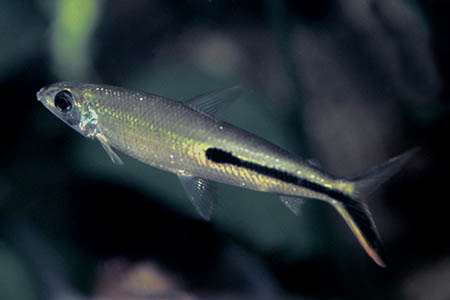
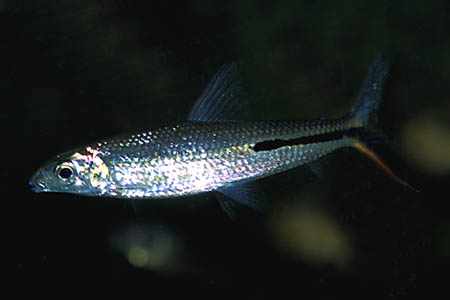
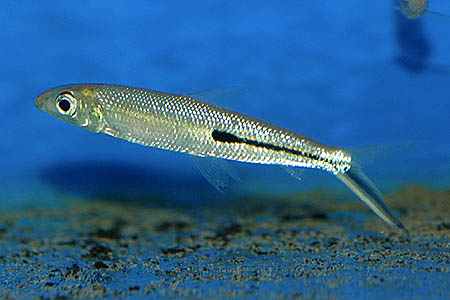
The slender hemiodus, Hemiodus gracilis, is a shoaling characin from Venezuela and Brazil, found in floodplain rivers and lakes. Probably the most often seen member of the genus in the hobby, it is sometimes sold as the red or red-tailed hemiodus. Very active and nervous when first introduced, it settles best in a large group in a spacious tank with a well-fitting cover.
Distribution
Habitat
Inhabits floodplain rivers and lakes.
Aquarium size
Very active and needs a tank measuring at least 120 ∗ 45 ∗ 45 cm48 ∗ 18 ∗ 18 in - ~243 litres~64 US gal.
Maintenance
A biotope setup would consist, very simply, of a layer of a couple of inches of inert sand as substrate, with perhaps some driftwood branches and twisted roots scattered around. Some floating vegetation will help to make this flighty species less skittish. It's also equally at home in a fully planted setup. In either case, the water should be very well-oxygenated and make sure the tank has a well-fitting cover as it can leap surprising distances. The species is sensitive to poor water conditions, so tank maintenance must be stringent.
Water conditions
Temperature: 23 – 27 °C73 – 81 °F
pH: 5.8-7.2
Hardness: 4-15°H
These recommendations come from this profile’s own figures. They contain affiliate links, so we may earn a commission.
Diet
Unfussy, and will accept most live, frozen and dried foods. Try to make sure it receives some greenstuffs in its diet, as it is reported to feed quite heavily on plant matter in nature.
Behaviour and compatibility
Very peaceful but it can intimidate much smaller or more quiet species with its activity and size. It makes an ideal shoaling species for the larger Amazon biotope setup, where it can be combined with similarly-sized characins, cichlids such as Geophagus, Satanoperca and Heros, catfish and Loricariids. It is a shoaling species by nature and should always be kept in a group.
Sexual dimorphism
Unknown. Mature females are likely to be rounder-bellied than males.
Reproduction
Not thought to have been bred in the hobby. It's probably an egg-scatterer.
Notes
Hemiodus species can be very nervous when first introduced to the aquarium but usually settle down over time, especially if a large number are being kept together. All of them look superficially similar, but can be distinguished by differences in patterning. None are particularly common in the hobby, but H. gracilis is probably the most often seen. It is sometimes sold as the red or red-tailed hemiodus and was previously considered a member of the now defunct genus Hemiodopsis.
Species images · 3
Used with the photographer’s permission. Not licensed for reuse.
Profile completeness19 of 24
79% complete
Also missing: a recorded distribution, taxonomic authority, etymology.
Community
Questions about Hemiodus gracilis?
Ask on Discord