Henicorhynchus ornatipinnis
Formerly Cirrhinus ornatipinnis Roberts, 1997 · Cirrhinus soi Roberts, 1997 · Gymnostomus ornatipinnis
Last revised 2026Edit this page
On this page6 sections
Quick factsEdit
Difficulty3 of 8 measures
- Space
- medium tank
- Water
- unknown
- Temp
- unknown
- Diet
- unknown
- Temperament
- unknown
- Social
- needs to be in a group
- Compatibility
- fine with others
Other demands
Each of these can raise the rating on its own, whatever the measures above say.
- Hardiness
- unknown
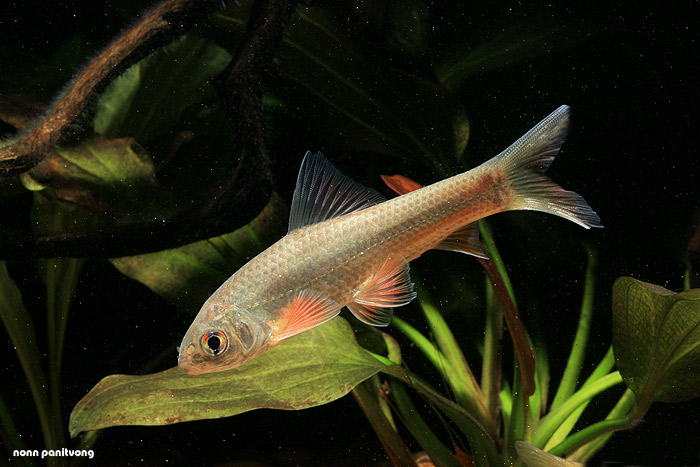
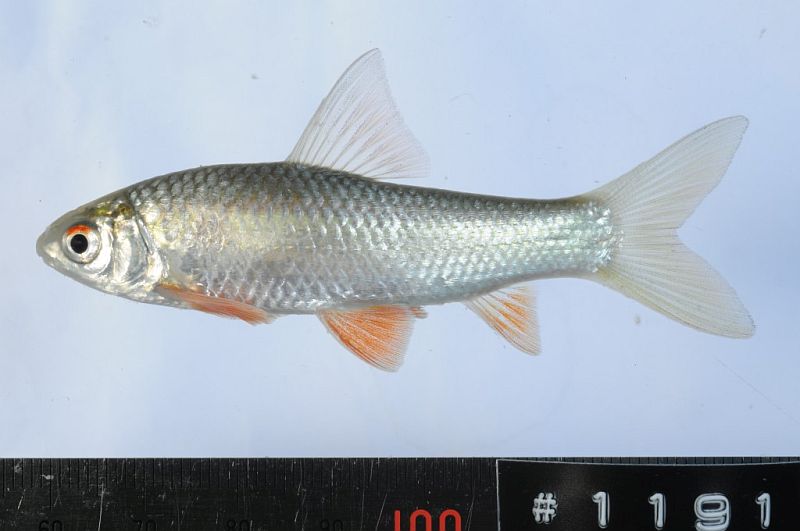
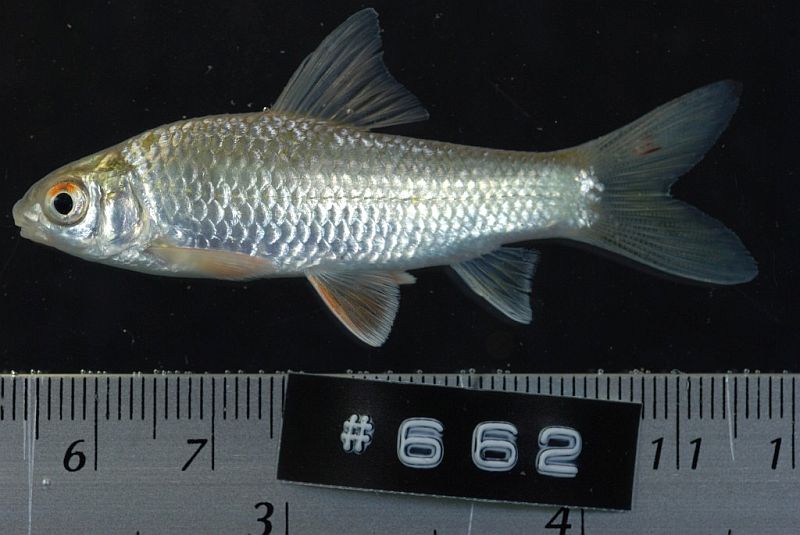
Henicorhynchus ornatipinnis is a small cyprinid known only from the Mekong River system in Laos, Thailand and Cambodia. It appears to favour still or slow-moving, often temporarily-inundated, marginal habitats away from the major river channels. Barbels are completely absent, the caudal peduncle is very deep, and the pectoral, pelvic and anal fins are usually reddish-orange or rose-tinted.
Etymology
Editornatipinnis: from the Latin ornatus, meaning 'decorated, adorned', and pinna, meaning 'fin', in reference to the colourful fins in this species compared with other members of the genus.
Distribution
EditHabitat
Write a noteEditThis species has not been collected from major river channels to date, and appears to display a preference for still or slow-moving, often temporarily-inundated, marginal habitats.
Notes
EditH. ornatipinnis can be distinguished from congeners by the following combination of characters: head small; snout relatively short and blunt; caudal peduncle very deep; pectoral, pelvic, and anal fins usually reddish-orange or rose-tinted; pelvic and anal fins often with white tips; barbels completely absent.
Roberts (1997) placed Henicorhynchus species in Cirrhinus, and Kottelat (2001) treated Henicorhynchus as a valid genus again. Kottelat (2013) then made it a synonym of Gymnostomus and moved its species into that genus. Later authors have not followed him, and these species are placed in Henicorhynchus. Gymnostomus now holds only the Indian species G. ariza, G. fulungee and G. horai.
Henicorhynchus is a member of the tribe Labeonini within the putative cyprinid subfamily Cyprininae, or simply the subfamily Labeoninae (name varies with author). Yang et al. (2012) divide this grouping into four subtribes: Labeoina, Garraina, Osteochilina and Semilabeoina. Henicorhynchus is in the Osteochilina and the Indian species of Gymnostomus are in the Labeoina, so the two genera are not closely related.
Some Henicorhynchus species are common in mainstream rivers at certain times of year and extremely important in local fisheries during these periods.
References
- Roberts, T. R. (1997). Systematic revision of the tropical Asian labeoin cyprinid fish genus Cirrhinus, with descriptions of new species and biological observations on C. lobatus. Natural History Bulletin of the Siam Society 45(2), 171-203
- Kottelat, M. (2013). The fishes of the inland waters of southeast Asia: a catalogue and core bibiography of the fishes known to occur in freshwaters, mangroves and estuaries. The Raffles Bulletin of Zoology Supplement 27, 1-663
- Kottelat, M. (2003). Nomenclatural status of Crossocheilus burmanicus, C. horai and C. multirastellatus (Osteichthyes: Cyprinidae). Raffles Bulletin of Zoology 51(2), 399-401
- Kottelat, M. (2001). Fishes of Laos. WHT Publications, Colombo, 1-198
- Yang, L., M. Arunachalam, T. Sado, B. A. Levin, A. S. Golubtsov, J. Freyhof, J. P. Friel, W-J. Chen, M. V. Hirt, R. Manickam, M. K. Agnew, A. M. Simons, K. Saitoh, M. Miya, R. L. Mayden, and S. He (2012). Molecular phylogeny of the cyprinid tribe Labeonini (Teleostei: Cypriniformes). Molecular Phylogenetics and Evolution 65(2), 362-379
Species images · 3
These photographs are used with each photographer's permission.
Send a photographHow the name has changed
Moved from Gymnostomus ornatapinnis to Henicorhynchus ornatipinnis.
Distribution
Profile completeness12 of 24
Community
Questions about Henicorhynchus ornatipinnis?
Ask on Discord