Hoplisoma cruziense
Santa Cruz Cory
Formerly Corydoras cruziensis
On this page11 sections
Quick facts
Difficulty6 of 8 measures
More bars, more demanding. Hardiness is not averaged with the rest.
- Space
- modest tank
- Water
- tap water
- Temp
- unfussy
- Diet
- unknown
- Temperament
- peaceful
- Social
- shoal
- Compatibility
- community tank
Hardiness on its own can raise the rating, whatever the measures above say.
- Hardiness
- unknown
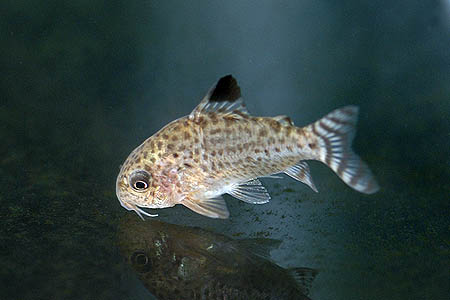
The Santa Cruz cory, Hoplisoma cruziense, long known as Corydoras cruziensis, is an armoured catfish from the Bolivian portion of the Río Madeira basin. The precise extent of its range is unclear and may include the Mamoré and Beni drainages. It is not well documented, but is said to differ from C. punctatus in having larger dark body markings, which form an irregular midlateral stripe in some specimens.
Etymology
Distribution
Aquarium size
Minimum base dimensi0ns of 80 ∗ 30 cm31 ∗ 12 in are recommended.
Maintenance
Ideally use a substrate of fine sand, although rounded gravel is an acceptable alternative provided it's kept scrupulously clean.
Other décor is largely down to personal choice, but some cover should be provided to give the fish security.
Water conditions
These recommendations come from this profile’s own figures. They contain affiliate links, so we may earn a commission.
Diet
Corydoras spp. are foraging omnivores and will accept most sinking dried foods, as well as small live and frozen varieties such as bloodworm, Tubifex, etc.
Feeding a varied diet will ensure the fish are in optimum condition.
Under no circumstances should they be expected to survive on 'left-overs' from other inhabitants of the aquarium or relied on to 'clean' the aquarium.
Behaviour and compatibility
Peaceful and gregarious. Should be maintained in a group of at least 4-6 individuals.
Sexual dimorphism
Females tend to grow larger, and sexually mature individuals are noticeably rounder and higher-bodied than males.
Notes
This species is not well-documented but is said to differ from the comparable C. punctatus by possessing larger dark markings on the body which may form an irregular midlateral stripe in some specimens.
Unfortunately diagnostic characters cannot be provided since we’ve been unable to obtain the type description, and little has been written about the species since it was published.
Until 2024 this species was placed in Corydoras, then among the largest catfish genera with over 150 valid species. Dias et al. (2024) divided it into five genera and moved this species to Hoplisoma.
It is included in the family Callichthyidae, of which members are often referred to collectively as 'armoured' or 'mailed' catfishes group due to the presence of bony plates in place of scales on the body.
Their taxonomy can be confusing, and numerous undescribed species are also thought to exist.
Fish of unconfirmed identification entering the aquarium hobby are therefore typically assigned a 'C' or 'CW' number for purposes of reference and organisation.
They are facultative air breathers and possess a modified, highly vascularised intestine which has evolved to facilitate uptake of atmospheric oxygen and aid survival in oxygen-deprived environments. In the aquarium you'll occasionally see them rising to the surface to take in gulps of air.
The stiffened pectoral-fin spines are capable of piercing human skin and a 'sting' can be very painful indeed, so care should be exercised when handling them.
It is thought that secretions from the axillary glands at the base of each spine may even be mildly toxic or venomous.
References
- Knaack, J. (2002). Ein weiterer neuer Panzerwels aus Bolivien: Corydoras cruziensis n. sp. (Pisces, Siluriformes, Callichthyidae). VDA aktuell 2002(3), 60-69
- Ferraris, C. J., Jr. (2007). Checklist of catfishes, recent and fossil (Osteichthyes: Siluriformes), and catalogue of siluriform primary types. Zootaxa 1418, 1-628
- Fuller, I. A. M., and H-G. Evers (2005). Identifying Corydoradinae Catfish. Verlag A.C.S. GmbH, 1-384
- Reis, R. E., S. O. Kullander and C. J. Ferraris, Jr. (eds) (2003). Check list of the freshwater fishes of South and Central America. CLOFFSCA. EDIPUCRS, Porto Alegre, i-xi + 1-729
Species images · 1
Used with the photographer’s permission. Not licensed for reuse.
How the name has changed
Moved from Corydoras cruziensis to Hoplisoma cruziense.
Distribution
Profile completeness21 of 24
Community
Questions about Hoplisoma cruziense?
Ask on Discord