River
Mamore
Only species with a profile on Seriously Fish are counted.
- Species
- 18
- Families
- 7
- Photographed
- 18 of 18
- Difficulty rated
- 18 of 18
Basin
Also in the Amazon basinspecies recorded from both
Shares fishes with rivers elsewherespecies recorded from both
Runs through
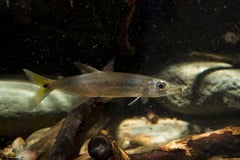
Acestrorhynchus microlepisPike Tetra
Acestrorhynchidae · Jardine, 1841
The pike tetra, Acestrorhynchus microlepis, is a predatory acestrorhynchid from northern Amazon drainages and the Orinoco. It also occurs in coastal rivers of Guyana, Suriname and French Guiana. A member of the A. microlepis group, it has a small blackish spot behind the gill cover and is separable from the very similar A. grandoculis only by counts. It tends to take smaller prey such as tetras, and acestrorhynchids are cannibalistic, so a group must be of comparable size.
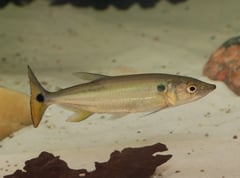
Acestrorhynchus pantaneiroPantanal Barracuda Tetra
Acestrorhynchidae · Menezes, 1992
The Pantanal barracuda tetra, Acestrorhynchus pantaneiro, is a predatory acestrorhynchid from the Paraná, Uruguay and de la Plata basins. It also occurs in the rio Mamoré in Bolivia. A member of the A. lacustris group with a round humeral spot, it is virtually impossible to tell from its relatives in the trade unless collection data is known. It lives in open water, and a group must be of comparable size because acestrorhynchids are cannibalistic.

Biotodoma cupidoCupid Cichlid
Cichlidae · Heckel, 1840
The cupid cichlid, Biotodoma cupido, is a geophagine cichlid from much of the Amazon basin, north to the Essequibo in Guyana and south to Bolivia. Also traded as the 'green-streaked eartheater', it varies in colour pattern and shape by locality, and most traded fish come from around Santarém in Pará state. Unless breeding it is surprisingly peaceful. Its relatively compact body and a dark flank blotch above the upper lateral line separate it from B. wavrini.
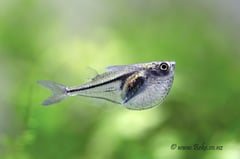
Carnegiella myersiPygmy Hatchetfish
Gasteropelecidae · Fernandez-Yepes, 1950
The pygmy hatchetfish, Carnegiella myersi, is a tiny freshwater hatchetfish from the Peruvian Amazon basin, with a second population in Bolivia. The smallest and most delicate of the nominal hatchetfishes, it has a shallower, rounded keel that gives it an elongate profile. It lives in small, shaded, shallow forest streams and must be kept in a group of at least six, away from active tankmates.
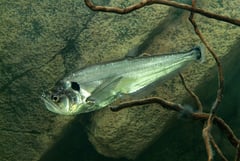
Cynodon gibbus
Cynodontidae · Agassiz, 1829
Cynodon gibbus is a cynodontid from much of the Amazon basin, the middle and lower Orinoco, and the Rupununi River in Guyana. A pelagic fish of main river channels and larger tributaries, it grows to around 280 mm SL. It is rare in the trade but arguably more suitable for the home aquarium than some of its better-known relatives, given its size and relatively docile behaviour. Being easily dominated, it is best kept alone or with similarly sized, non-aggressive fishes.
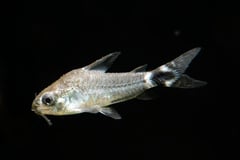
Gastrodermus hastatusTail-spot Pygmy Cory
Callichthyidae · (Eigenmann & Eigenmann, 1888)
The tail-spot pygmy cory, Gastrodermus hastatus, long known as Corydoras hastatus, is a tiny armoured catfish with a wide range across the Amazon and Río Paraguay basins. It is known from Brazil, Bolivia, Paraguay and northeastern Argentina. Unlike most congeners it swims in midwater, forming mixed schools with similarly patterned small characids such as Serrapinnus kriegi. It is frequently confused with G. pygmaeus, but has a dark, roughly diamond-shaped spot on the caudal peduncle where G. pygmaeus has a dark lateral stripe.

Geophagus megasema
Cichlidae · Heckel, 1840
Geophagus megasema is a cichlid from the upper rio Madeira basin, recorded from the Mamoré and Guaporé drainages in Bolivia and Brazil. Very rare in the aquarium hobby, it has been collected, bred and distributed by some private collectors. It has no dark preopercular or infraorbital markings, no bars on the flanks and a relatively large, roundish midlateral marking.
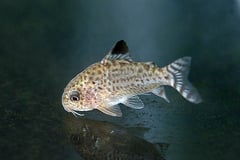
Hoplisoma cruzienseSanta Cruz Cory
Callichthyidae · (Knaack, 2002)
The Santa Cruz cory, Hoplisoma cruziense, long known as Corydoras cruziensis, is an armoured catfish from the Bolivian portion of the Río Madeira basin. The precise extent of its range is unclear and may include the Mamoré and Beni drainages. It is not well documented, but is said to differ from C. punctatus in having larger dark body markings, which form an irregular midlateral stripe in some specimens.
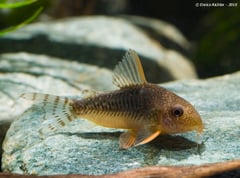
Hoplisoma gosseiPalespotted Cory
Callichthyidae · (Nijssen, 1972)
The palespotted cory, Hoplisoma gossei, long known as Corydoras gossei, is an armoured catfish from the rio Mamoré watershed in Rondônia state, northwestern Brazil. It is also likely to occur in northern Bolivia, since the Mamoré forms the border between the two countries at the type locality. Also known as 'smokey cory' and 'Gosse's cory', it shares its colour pattern with Brochis seussi from the same river, which has a noticeably prolonged snout. A form referred to as 'CW069' appears intermediate between the two.
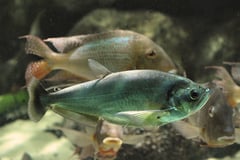
Hydrolycus scomberoidesVampire Tetra
Cynodontidae · Cuvier, 1819
The vampire tetra, Hydrolycus scomberoides, is a predatory dogtooth characin from the central and upper Amazon in Brazil, Bolivia, Peru and Ecuador. Also sold as 'scomb' and 'sabre tooth tetra', it is regularly confused with the much larger payara, H. armatus. At up to 300 mm it still needs a huge tank and specialist care, and newly-imported specimens often refuse anything but live food.

Megalamphodus megalopterusBlack Phantom Tetra
Characidae · (Eigenmann, 1915)
The black phantom tetra, Megalamphodus megalopterus, is a characid from the upper rio Madeira and upper rio Paraguai in Bolivia and Brazil. Most records are from the rio Guaporé (Río Iténez in Bolivia). Popular in the hobby and bred commercially in several countries, it is also available as a 'long-finned' strain. Adult males have black fins with the pelvic, dorsal and anal enlarged, while females are deeper-bodied with reddish pelvic, anal and adipose fins.
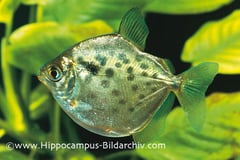
Metynnis maculatusSpotted Metynnis
Serrasalmidae · Kner, 1858
The spotted metynnis, Metynnis maculatus, is a silver dollar probably confined to the upper rio Madeira and upper rio Paraguai in Bolivia and Brazil. It is most often confused with M. argenteus and M. lippincottianus, but it has more midlateral scales and more spines on the ventral keel than either. It schools in nature and needs a very large tank with a group of six or more.

Mikrogeophagus altispinosusBolivian Ram
Cichlidae · Haseman, 1911
The Bolivian ram, Mikrogeophagus altispinosus, is a cichlid endemic to the upper rio Madeira basin in Bolivia and Brazil. Also traded as 'hi-fin ram' and 'Bolivian butterfly', it is larger and less colourful than M. ramirezi and lacks its blue iridescent markings, and it is arguably a better choice for less-experienced aquarists. A soft, sandy substrate is essential, and it needs pristine water quality.
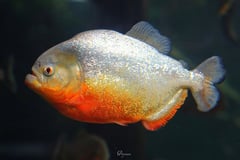
Pygocentrus nattereriRed Bellied Piranha
Serrasalmidae · Kner, 1858
The red bellied piranha, Pygocentrus nattereri, occurs through much of the Amazon basin and south into the Paraná and Uruguay river systems. Famed as a rapacious predator, it is among the most notorious freshwater fishes in the world. According to Herbert Axelrod (1976), the myth began with a feeding frenzy staged for Theodore Roosevelt in Brazil in 1913. Usually only juveniles form aggregations, and the species is relatively easy to breed in the aquarium.

Satanoperca pappaterraPantanal Eartheater
Cichlidae · Heckel, 1840
The Pantanal eartheater, Satanoperca pappaterra, is a cichlid from the rio Guaporé and upper rio Paraguai basins in Brazil, Bolivia and Paraguay. Relatively rare in the ornamental trade and much sought after, it is easily told from all known congeners by a series of prominent black blotches beneath the dorsal-fin and a well-defined dark band along the side of the body. It has been introduced to the upper rio Paraná in southeastern Brazil.
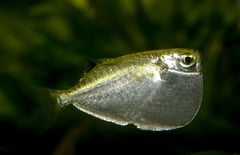
Thoracocharax stellatusSpotfin Hatchetfish
Gasteropelecidae · Kner, 1858
The spotfin hatchetfish, Thoracocharax stellatus, is the most widespread neotropical hatchetfish, recorded from much of South America. It is told from its only congener, T. securis, by a prominent dark spot in the dorsal fin, and is sometimes traded as 'platinum hatchetfish'. It feeds almost entirely on insects, and a tightly fitting cover is needed because it can clear several metres in one jump.
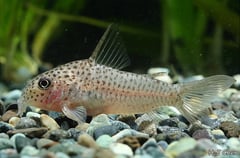
Hoplisoma albolineatumC056
Callichthyidae · (Knaack, 2004)
Hoplisoma albolineatum (C056), long known as Corydoras albolineatus, is an armoured catfish from the Río Iténez, or Guaporé, system in Bolivia and Brazil. It has a wide white longitudinal band and unmarked fins, and may be confused with the deeper-bodied H. xinguense. In the wild it forms aggregations of up to several thousand over sandy substrates and sand banks. It is not common in the hobby but is available occasionally.

Laetacara dorsigeraRedbreast Acara
Cichlidae · Heckel, 1840
The redbreast acara, Laetacara dorsigera, is a small cichlid from the Guaporé in Bolivia and Brazil, and the Paraná and Uruguay systems further south. Breeding males and females develop conspicuous red cheeks, opercula and belly, a feature L. curviceps lacks. A dark spot in the middle of the dorsal fin is shared only with L. curviceps and L. flamannellus. Populations vary in colour pattern, and it is a biparental substrate spawner growing to around 37 mm SL.