Hoplisoma lacrimostigmata
Formerly Corydoras lacrimostigmata
Last revised 2026Edit this page
On this page9 sections
Quick factsEdit
Difficulty5 of 8 measures
- Space
- medium tank
- Water
- unknown
- Temp
- flexible
- Diet
- unknown
- Temperament
- peaceful
- Social
- needs to be in a group
- Compatibility
- fine with others
Other demands
Each of these can raise the rating on its own, whatever the measures above say.
- Hardiness
- unknown
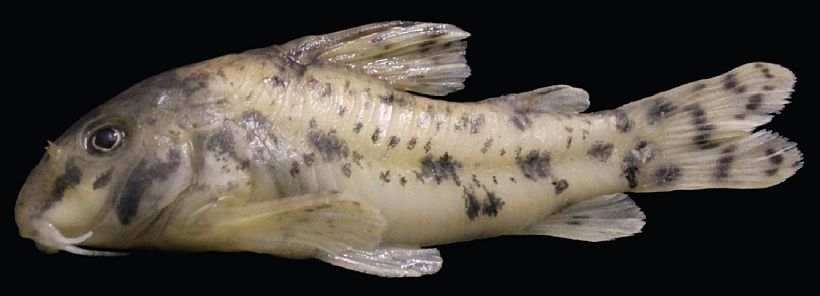
Hoplisoma lacrimostigmata, long known as Corydoras lacrimostigmata, is a small armoured catfish known only from the rio Ivaí basin, in the rio Paraná drainage of Paraná state, southern Brazil. It has three nasal pores and four to six small, rounded black blotches along the centre of the flank. It is most similar to H. flaveolum, but has fewer serrations on the pectoral- and dorsal-fin spines, a slightly pointed snout and a more slender body.
Etymology
EditCorydoras: from the Ancient Greek κόρυς (korus), meaning 'helmet', and δορά (dora), meaning 'skin, hide of an animal', in allusion to the rows of bony plates on the flanks of genus members.
lacrimostigmata: from the Latin lacrĭma, meaning 'tear', and 'stigmata', meaning 'marks', in allusion to the diffuse dark stripe between the corner of the mouth and anterior margin of the orbit, and the drop-shaped dark blotch on the posterior portion of the infraorbital, which resemble teardrops.
Distribution
EditAquarium size
Write a noteEditMinimum base dimensi0ns of 60 ∗ 30 cm24 ∗ 12 in or equivalent are recommended.
Water conditions
EditThese recommendations come from this profile’s own figures. They contain affiliate links, so we may earn a commission.
Diet
Write a noteEditCorydoras spp. are foraging omnivores, and most will accept sinking dried foods as well as small live and frozen varieties such as chironomid larvae (bloodworm), Tubifex, etc.
Feeding a varied diet will ensure the fish are in optimum condition.
Under no circumstances should they be expected to survive on 'left-overs' from other inhabitants of the aquarium or relied on to 'clean' the aquarium.
Behaviour and compatibility
Write a noteEditPeaceful and gregarious. Should be maintained in a group of at least 4-6 individuals.
Notes
EditThis species can be distinguished from all congeners by the following combination of characters: presence of three nasal pores; four to six small rounded black blotches along the centre of the flank.
It is most similar to Hoplisoma flaveolum Ihering 1911, but can be distinguished by possessing fewer serrations on the posterior margin of the pectoral-fin spine (16-19 vs. 27-36) and on the posterior margin of the dorsal-fin spine (7-10 vs. 15-22), and by the presence of weakly-developed (vs. well-developed) simple (vs. both and bifid) serrations on the posterior margin of the pectoral-fin spine. In Hoplisoma lacrimostigmata the snout is slightly pointed and dorsal profile of the head gradually concave (vs. roughly rounded and abruptly concave), the outer mental barbel is short and distant from the gill opening (vs. long, reaching or extending slightly beyond the anteroventral limit of the gill opening), the overall body shape is slender (vs. robust), the anterior internal process of the basipterygium is relatively thin (vs. relatively thick), the external anterior and the dorsal ischiac processes of the basipterygium are distant (vs. close together or even fused), dark spots are present only on the snout tip and dorsal surface of the head in some individuals (vs. always present from the snout tip to the dorsal-fin base), and the flanks, dorsal and caudal fins are weakly (vs. densely) patterned with spots and bars.
There is some evidence that H. lacrimostigmata has evolved a mimetic relationship with the syntopic crenuchid Characidium heirmostigmata Graça & Pavanelli 2008, with the two species possessing comparable colour patterns and forming mixed aggregations in nature.
Until 2024 this species was placed in Corydoras, then among the largest catfish genera with over 150 valid species. Dias et al. (2024) divided it into five genera and moved this species to Hoplisoma.
It is included in the family Callichthyidae, of which members are often referred to collectively as 'armoured' or 'mailed' catfishes group due to the presence of bony plates in place of scales on the body.
Their taxonomy can be confusing, and numerous undescribed species are also thought to exist. Fish of unconfirmed identification entering the aquarium hobby are therefore typically assigned a 'C' or 'CW' number for purposes of reference and organisation.
They are facultative air breathers and possess a modified, highly vascularised intestine which has evolved to facilitate uptake of atmospheric oxygen and aid survival in oxygen-deprived environments. In the aquarium you'll occasionally see them rising to the surface to take in gulps of air.
The stiffened pectoral-fin spines are capable of piercing human skin and a 'sting' can be very painful indeed, so care should be exercised when handling them.
It is thought that secretions from the axillary glands at the base of each spine may even be mildly toxic or venomous.
References
- Tencatt, L. F. C., M. R. Brtto and C. S. Pavanelli (2014). A new species of Corydoras Lacépède, 1803 (Siluriformes: Callichthyidae) from the upper rio Paraná basin, Brazil. Neotropical Ichthyology 12(1), 89-96
Species images · 3
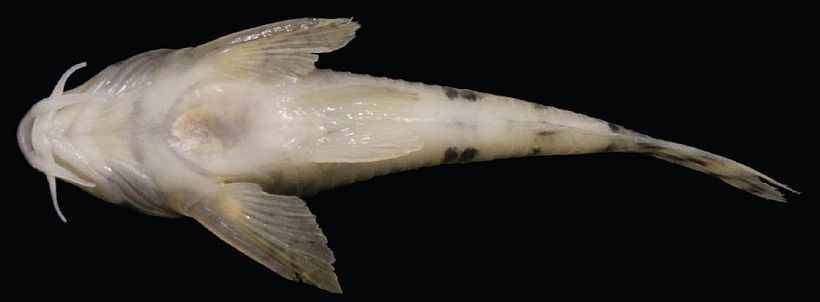
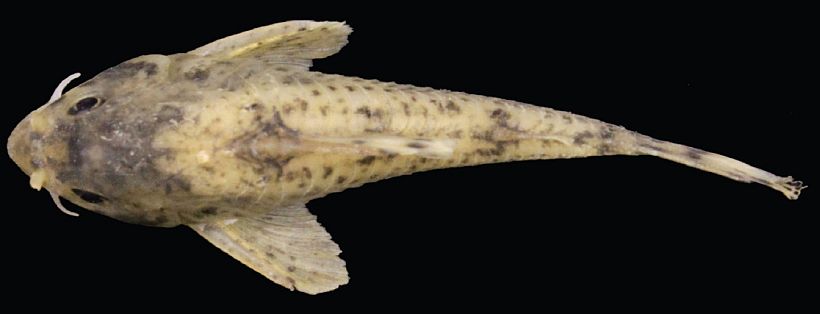
These photographs are used with each photographer’s permission.
Send a photographHow the name has changed
Moved from Corydoras lacrimostigmata to Hoplisoma lacrimostigmata.
Distribution
Profile completeness16 of 24
67% complete
Also missing: a common name, habitat, maintenance, water condition notes, sexual dimorphism, reproduction.
Community
Questions about Hoplisoma lacrimostigmata?
Ask on Discord