River
Paraná
Only species with a profile on Seriously Fish are counted.
- Species
- 37
- Families
- 13
- Photographed
- 36 of 37
- Difficulty rated
- 37 of 37
Basin
Also in the Parana basinspecies recorded from both
Shares fishes with rivers elsewherespecies recorded from both
Runs through
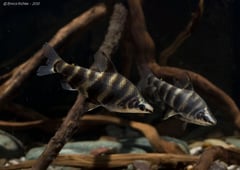
Abramites hypselonotusMarbled Headstander
Anostomidae · Günther, 1868
The marbled headstander, Abramites hypselonotus, is an anostomid from the Amazon, Orinoco and Paraguay-Paraná basins in South America. An ecological generalist, it occurs in turbid main river channels, minor tributaries and backwaters, and enters inundated zones during the annual floods. Best kept as a group in a large tank alongside cichlids, characins and catfishes, it may nip long or trailing fins and eat soft-leaved plants.
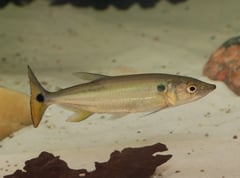
Acestrorhynchus pantaneiroPantanal Barracuda Tetra
Acestrorhynchidae · Menezes, 1992
The Pantanal barracuda tetra, Acestrorhynchus pantaneiro, is a predatory acestrorhynchid from the Paraná, Uruguay and de la Plata basins. It also occurs in the rio Mamoré in Bolivia. A member of the A. lacustris group with a round humeral spot, it is virtually impossible to tell from its relatives in the trade unless collection data is known. It lives in open water, and a group must be of comparable size because acestrorhynchids are cannibalistic.
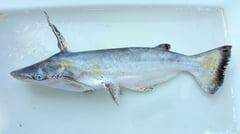
Ageneiosus inermisManduba
Auchenipteridae · Linnaeus, 1766
The manduba, Ageneiosus inermis, is a large auchenipterid catfish found throughout much of South America east of the Andes. At around 470 mm SL it would need an aquarium in excess of 400 x 120 cm as an adult and is largely unsuitable for private aquaria. An obligate carnivore, it can take surprisingly large prey, and the larger Ageneiosus species are often used as food fishes in their native countries.
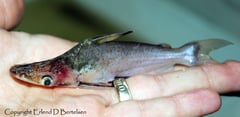
Ageneiosus ucayalensisDuck Catfish
Auchenipteridae · Castelnau, 1855
The duck catfish, Ageneiosus ucayalensis, is an auchenipterid catfish described from Peru and recorded across the Amazon, Orinoco and Guianas. Body patterning apparently varies with locality, and fish from black water habitats, particularly on the Guiana Shield, tend to be darker. Growing to around 290 mm SL and capable of taking large prey, it is safe only with similarly sized catfishes or large pelagic characins, mostly a combination for public aquaria.

Aphyocharax anisitsiBloodfin Tetra
Characidae · Eigenmann & Kennedy, 1903
The bloodfin tetra, Aphyocharax anisitsi, is a characid endemic to the Paraná River drainage in Brazil, Paraguay and Argentina. A hardy species that adapts to a wide range of conditions, it can even be kept unheated in a well-insulated house, though it is less colourful in cooler water. Captive specimens over ten years old are not unheard of. It may nip long-finned or slow-moving tankmates, and the tank needs a tight cover as it will jump.

Aphyocharax rathbuniGreen Fire Tetra
Characidae · Eigenmann, 1907
The green fire tetra, or Rathbun's bloodfin, Aphyocharax rathbuni, is a characid endemic to the Paraguay, Paraná and Uruguay river drainages. It is found in Brazil, Paraguay, Argentina and Uruguay, in streams and rivers shaded by floating or overhanging vegetation. Although suitable for a community aquarium, it has a reputation as a fin-nipper, and long-finned species such as many cichlids and anabantoids should be avoided as tankmates.

Apistogramma borelliiBorelli's Dwarf Cichlid
Cichlidae · Regan, 1906
Borelli's dwarf cichlid, Apistogramma borellii, is from southern Brazil, Paraguay, Argentina and Uruguay. Also known as the umbrella or yellow dwarf cichlid, it occurs in creeks and tributaries of the rio Paraguay, lower rio Paraná and Uruguay systems. Captive-raised fish are the recommended choice for the community aquarium, while wild examples are best kept alone or with small dither fishes.

Apistogramma commbraeA93
Cichlidae · Regan, 1906
The Corumbá dwarf cichlid, Apistogramma commbrae, is widespread in the Paraguay River watershed of Argentina, Bolivia, Brazil and Paraguay. One of the smallest members of the genus, it is told apart with the rest of the A. commbrae complex by a conspicuous double caudal peduncle spot. Its habitats cool seasonally to as low as 16 °C, and it should be kept cooler over winter.

Apistogramma trifasciataThree-striped Apisto
Cichlidae · Eigenmann & Kennedy, 1903
The three-striped apisto, Apistogramma trifasciata, is a dwarf cichlid from the Guaporé, Paraguay and middle Paraná basins. Found in Brazil, Paraguay and Argentina, it lives in sluggish creeks, tributaries and smaller rivers where leaf litter collects. A narrow third stripe from the pectoral-fin insertion to the anal fin helps separate it from congeners. The DATZ code is A204, with possibly conspecific forms from Argentina and the rio Guaporé coded A205 and A206.
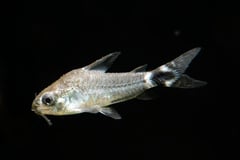
Gastrodermus hastatusTail-spot Pygmy Cory
Callichthyidae · (Eigenmann & Eigenmann, 1888)
The tail-spot pygmy cory, Gastrodermus hastatus, long known as Corydoras hastatus, is a tiny armoured catfish with a wide range across the Amazon and Río Paraguay basins. It is known from Brazil, Bolivia, Paraguay and northeastern Argentina. Unlike most congeners it swims in midwater, forming mixed schools with similarly patterned small characids such as Serrapinnus kriegi. It is frequently confused with G. pygmaeus, but has a dark, roughly diamond-shaped spot on the caudal peduncle where G. pygmaeus has a dark lateral stripe.

'Geophagus' brasiliensisPearl Cichlid
Cichlidae · Quoy & Gaimard, 1824
The pearl cichlid, Geophagus brasiliensis, comes from Atlantic-draining river systems of eastern and southern Brazil and Uruguay. It belongs to the 'G.' brasiliensis group, which still needs definitive classification. Colour and body shape vary with locality, and some coastal lagoon populations have evolved a degree of salt tolerance. Fish sold as Gymnogeophagus australis in Europe are more often this species, and non-native populations exist in several countries.
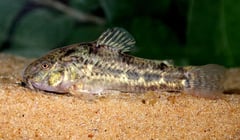
Hoplisoma gladysae
Callichthyidae · (Calviño & Alonso, 2010)
Hoplisoma gladysae, long known as Corydoras gladysae, is an armoured catfish known only from two localities in the Río Calchaquí watershed in Salta province, northwestern Argentina. The Calchaquí is a swift, snow-fed mountain river with hard water, and the species shows adaptations to life among rocks in flowing water, including a cryptic colour pattern, short fin spines and reduced body depth. It is unlikely to be collected for commercial purposes.
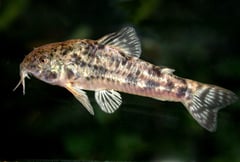
Hoplisoma petracinii
Callichthyidae · (Calviño & Alonso, 2010)
Hoplisoma petracinii, long known as Corydoras petracinii, is an armoured catfish known only from one ephemeral stream in the Río San Lorenzo watershed of Salta province, Argentina. It shows adaptations to life among rocks in flowing water, including a cryptic colour pattern, short dorsal and pectoral spines and reduced body depth. The stream runs almost dry for much of the year and is under great ecological pressure from the nearby city of Salta, road building and dumping of refuse.

Hyphessobrycon anisitsiBuenos Aires Tetra
Characidae · Eigenmann, 1907
The Buenos Aires tetra, Hyphessobrycon anisitsi, is a characid from the Paraná and Uruguay river systems in Brazil, Paraguay, Argentina and Uruguay. A popular and hardy aquarium fish, it is also available as a line-bred albino strain, sometimes traded as 'golden'. It has a reputation for fin-nipping, though mostly when too few are kept or space is limited, and a group of at least 8-10 is the minimum.

Hyphessobrycon flammeusFlame Tetra
Characidae · Myers, 1924
The flame tetra, Hyphessobrycon flammeus, is a small characid from Rio de Janeiro and São Paulo states in Brazil. Popular in the hobby, it is bred commercially in several countries and also sold as 'red', 'fire', 'rio' and 'Von Rio' tetra. In nature it is now uncommon or even extinct across much of its range, and the São Paulo populations may have been introduced by aquarists or breeders.
Lepidosiren paradoxaSouth American Lungfish
Lepidosirenidae · authority not recorded
The South American lungfish, Lepidosiren paradoxa, is found across the Amazon, Rio Paraguay and lower Paraná basins. The only lungfish known from South America, it is an obligatory air breather and survives the dry season by aestivating in a mucous cocoon inside a burrow in the mud. It can reach 125 cm and live for well over 20 years, so whether it should be considered an aquarium subject at all is debatable.
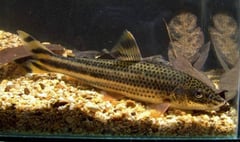
Leporellus vittatus
Anostomidae · Valenciennes, 1850
Leporellus vittatus is an anostomid with a huge natural range across the Amazon, Paraná-Paraguay, São Francisco and Orinoco river systems. Unlike most anostomids it is adapted to a benthic existence in flowing water and spends most of its time on or around the substrate. Occasionally exported, it requires quite specialised conditions, an aquarium of at least 210 by 60 cm and ideally a group of six or more.

Megalamphodus equesSerpae Tetra
Characidae · (Steindachner, 1882)
The serpae tetra, Megalamphodus eques, is a characid with an enormous range through much of the Amazon drainage and the Río Paraguay. Very common in the trade, it is also sold as the 'jewel', 'red minor', 'blood' or 'callistus' tetra, and ornamental strains include 'long-finned' and 'balloon' forms. It has a reputation for nipping the fins of tankmates, although this is most pronounced when too few are kept or space is limited.
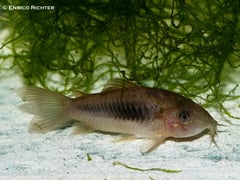
Osteogaster aeneaBronze Cory
Callichthyidae · (Gill, 1858)
The bronze cory, Osteogaster aenea, long known as Corydoras aeneus, is an armoured catfish described from Trinidad and accepted to occur across much of South America. That range looks more like a complex of similar, distinct species than a single one, and fish from outside Trinidad are of uncertain identity. Aquarium fish are almost all commercially farmed, and the names C. schultzei and C. venezuelanus are routinely misapplied to them.

Phenacogaster tegatus
Characidae · Eigenmann, 1911
Phenacogaster tegatus is a small characid from the upper rio Paraguay basin in Brazil and Paraguay and the Río Paraná in northeastern Argentina. It has been traded as 'six-eyed tetra', in reference to the two dark spots on each flank plus the eye. Peaceful but somewhat unsuitable for the general community aquarium, it is best kept in a group of at least 8-10 alongside similarly-sized characids and other small, non-predatory fishes.
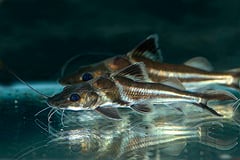
Pimelodus ornatusOrnate Pim
Pimelodidae · authority not recorded
The ornate pim, Pimelodus ornatus, is a pimelodid catfish recorded in major river systems from Colombia and Venezuela south to Paraguay and Argentina. One of the more sought-after pims imported with any regularity, it grows to 28 cm and is a predator that will eat smaller fish. It is scaleless, sensitive to many medications and often in poor shape when first imported, and its rigid fin spines can cause a painful sting.
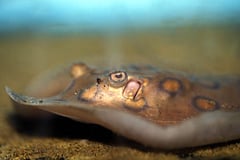
Potamotrygon motoroMotoro Stingray
Potamotrygonidae · authority not recorded
The motoro stingray, Potamotrygon motoro, is a freshwater stingray ranging across Colombia, Peru, Bolivia, Brazil, Paraguay, Uruguay and Argentina. It reaches about 50 cm across the disc. The patterning is highly variable, with some variants given P-numbers and others sold as 'blue', 'orange', 'black' or 'marbled'. Males are among the most violent when spawning and can seriously injure females.
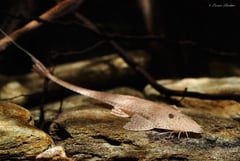
Pseudohemiodon laticepsGiant Whiptail Catfish
Loricariidae · Regan, 1904
The giant whiptail catfish, Pseudohemiodon laticeps, is a loricariid from the rios Uruguay, Paraná and Paraguay in Brazil, Paraguay and Argentina. Growing to 300 mm, it stays buried in soft substrate by day and emerges to feed at night, so a sandy substrate and very clean, stable water matter most. The male is a paternal 'lip brooder', carrying the eggs on his labial barbels for 12-14 days, and the species has been bred in aquaria.
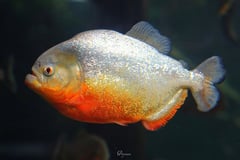
Pygocentrus nattereriRed Bellied Piranha
Serrasalmidae · Kner, 1858
The red bellied piranha, Pygocentrus nattereri, occurs through much of the Amazon basin and south into the Paraná and Uruguay river systems. Famed as a rapacious predator, it is among the most notorious freshwater fishes in the world. According to Herbert Axelrod (1976), the myth began with a feeding frenzy staged for Theodore Roosevelt in Brazil in 1913. Usually only juveniles form aggregations, and the species is relatively easy to breed in the aquarium.

Satanoperca pappaterraPantanal Eartheater
Cichlidae · Heckel, 1840
The Pantanal eartheater, Satanoperca pappaterra, is a cichlid from the rio Guaporé and upper rio Paraguai basins in Brazil, Bolivia and Paraguay. Relatively rare in the ornamental trade and much sought after, it is easily told from all known congeners by a series of prominent black blotches beneath the dorsal-fin and a well-defined dark band along the side of the body. It has been introduced to the upper rio Paraná in southeastern Brazil.
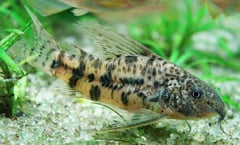
Scleromystax macropterusSailfin 'Cory'
Callichthyidae · Regan, 1913
The sailfin 'cory', Scleromystax macropterus, is an armoured catfish from coastal rivers of southern Brazil and the rio Paraná basin in Paraguay. Most have been collected from small blackwater streams draining directly into the Atlantic, but it also inhabits roadside ditches. Males are somewhat territorial towards one another and should not be kept together in smaller aquaria, and its stiffened pectoral-fin spines can give a painful 'sting'.
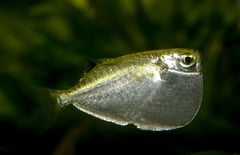
Thoracocharax stellatusSpotfin Hatchetfish
Gasteropelecidae · Kner, 1858
The spotfin hatchetfish, Thoracocharax stellatus, is the most widespread neotropical hatchetfish, recorded from much of South America. It is told from its only congener, T. securis, by a prominent dark spot in the dorsal fin, and is sometimes traded as 'platinum hatchetfish'. It feeds almost entirely on insects, and a tightly fitting cover is needed because it can clear several metres in one jump.
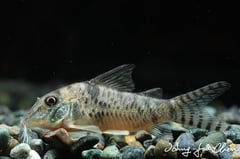
Corydoras aurofrenatusCW005
Callichthyidae · Eigenmann & Kennedy, 1903
Corydoras aurofrenatus is an armoured catfish from the Río Paraguay-Paraná system in Paraguay, also recorded in Argentina and Bolivia. It has been traded as C. sp. 'Corrientes' and CW005. Each flank carries two dark blotches, one behind the head and one below the adipose fin, and the caudal-fin lobes are long with the upper more extended. C. ellisae has been treated as a junior synonym, although this appears not to have achieved wide acceptance.
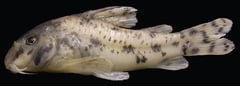
Hoplisoma lacrimostigmata
Callichthyidae · (Tencatt, Britto & Pavanelli, 2014)
Hoplisoma lacrimostigmata, long known as Corydoras lacrimostigmata, is a small armoured catfish known only from the rio Ivaí basin, in the rio Paraná drainage of Paraná state, southern Brazil. It has three nasal pores and four to six small, rounded black blotches along the centre of the flank. It is most similar to H. flaveolum, but has fewer serrations on the pectoral- and dorsal-fin spines, a slightly pointed snout and a more slender body.

Hyphessobrycon bifasciatusYellow Tetra
Characidae · Ellis, 1911
The yellow tetra, Hyphessobrycon bifasciatus, is a characid from coastal rivers of southeastern Brazil between Espírito Santo and Rio Grande do Sul. It also occurs in parts of the upper Paraná basin, in floodplain tributaries, lakes and streams, usually under forest cover. Two vertically elongate humeral spots, the front one more prominent, help separate it from similar congeners. Generally peaceful, it is best kept as a group of 8-10 or more.

Laetacara dorsigeraRedbreast Acara
Cichlidae · Heckel, 1840
The redbreast acara, Laetacara dorsigera, is a small cichlid from the Guaporé in Bolivia and Brazil, and the Paraná and Uruguay systems further south. Breeding males and females develop conspicuous red cheeks, opercula and belly, a feature L. curviceps lacks. A dark spot in the middle of the dorsal fin is shared only with L. curviceps and L. flamannellus. Populations vary in colour pattern, and it is a biparental substrate spawner growing to around 37 mm SL.
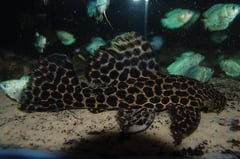
Megalancistrus parananusL113
Loricariidae · Peters, 1881
L113, Megalancistrus parananus, is a large suckermouth catfish from the rios Paraná, Paraguay and Uruguay in Brazil, Paraguay, Uruguay and Argentina. It was formerly thought to include L234, but only L113 appears native to these drainages, while L234 comes from the rio São Francisco. The largest recorded specimen measured 588 mm, and it can behave very aggressively in confined surroundings.
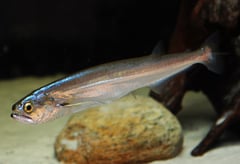
Rhaphiodon vulpinusBiara
Cynodontidae · Spix & Agassiz, 1829
The biara, Rhaphiodon vulpinus, is a dogtooth characin found from the Orinoco and Amazon basins south to the Río de la Plata in Argentina. The only member of its genus, it grows to 600 to 800 mm and is an obligate piscivore, and it is suitable only for public installations or the very largest private aquaria. Juveniles are seen for sale quite regularly, most often without adequate information on their long-term care.
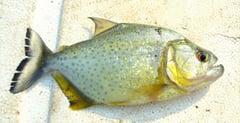
Serrasalmus maculatusMac
Serrasalmidae · authority not recorded
Serrasalmus maculatus, the mac, is a piranha from the Amazon, Paraguay and Paraná river systems, described from the rio Guaporé in western Brazil. It grows to a manageable size, is relatively hardy and is sometimes called the 'gold piranha' or 'golden mac' in the hobby. It has often been confused with S. spilopleura, and it should be considered a specimen fish that does not make a good tankmate for anything else.
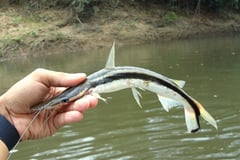
Sorubim limaDuckbill Catfish
Pimelodidae · authority not recorded
The duckbill catfish, Sorubim lima, is a pimelodid catfish recorded from rivers across South America, including the Amazon, Orinoco and Paraná. It is also known as the 'hockey stick catfish' and 'lima shovelnose', and S. elongatus is sometimes sold as it. Sorubim spp. often swim head-down among plants and roots as camouflage. It is quite peaceful but eats anything that fits in its mouth.

Hyphessobrycon auca
Characidae · Almirón, Casciotta, Bechara & Ruíz Díaz, 2004
Hyphessobrycon auca is a small characid known only from two ponds in the Esteros del Iberá wetlands of Corrientes province, northern Argentina. The ponds lie on a sand bar deposited by the Paraná during the Pleistocene and hold soft, mildly acidic, rain-fed water. It looks very similar to H. anisitsi and is told apart by its dentition and by the small hooks on the fins of males.

Hyphessobrycon balbus
Characidae · Myers, 1927
Hyphessobrycon balbus is a small characid known only from upper Paraná basin headwaters in the Federal District and Goiás, central Brazil. Most records come from the rio São Bartolomeu, including the Bananal, Santa Maria-Torto and Gama tributary systems.