Hoplisoma xinguense
Xingu Cory · Dust Cory
Formerly Corydoras xinguensis
On this page13 sections
Quick facts
Difficulty6 of 8 measures
More bars, more demanding. Hardiness is not averaged with the rest.
- Space
- modest tank
- Water
- tap water
- Temp
- steady heat
- Diet
- unknown
- Temperament
- peaceful
- Social
- shoal
- Compatibility
- community tank
Hardiness on its own can raise the rating, whatever the measures above say.
- Hardiness
- unknown
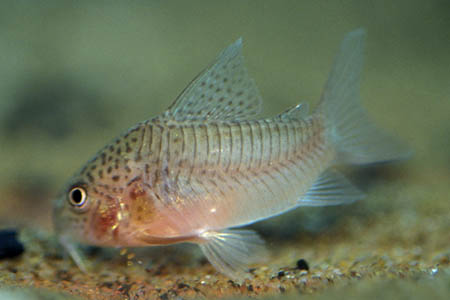
The Xingu cory, Hoplisoma xinguense, long known as Corydoras xinguensis, is a small spotted armoured catfish from creeks in the upper Rio Xingu basin in Mato Grosso, Brazil. It is also sold as the dust cory, and fish traded under the C-numbers C055 and C105 to C108 have all been identified as this species. Dias et al. (2024) moved it to Hoplisoma as Hoplisoma xinguense. One of the smaller corys, it is best kept in a group of ten or more.
Etymology
Corydoras: from the Ancient Greek κόρυς (korus), meaning 'helmet', and δορά (dora), meaning 'skin, hide of an animal', in allusion to the rows of bony plates on the flanks of genus members.
xinguensis: named for the Rio Xingu, where the type specimens were collected, with the Latin suffix -ensis denoting place.[1]
Distribution
Described from the upper Rio Xingu basin in Mato Grosso state, Brazil, and not reliably known from anywhere else.
Type locality is given as 'Suia Missú Creek, tributary of upper Rio Xingu near Posto Diauarum, about 11°15'S, 53°00'W, Mato Grosso State, Brazil'.
Museum collections also hold fish identified as this species from the lower Xingu in Pará and from the Tocantins and Tapajós drainages, but we've been unable to confirm those records, and several similar small spotted species occur in those rivers.[1][6]
Habitat
Collected from small creeks flowing into the upper Xingu, several of them in forest, and from tributaries of the Culuene and Batovi, two of the rivers that join to form the Xingu.
Aquarium size
A tank measuring 45 ∗ 38 ∗ 30 cm18 ∗ 15 ∗ 12 in is big enough for a group of this small species.
Maintenance
Use a substrate of fine sand so it can sift for food without damaging its barbels, and add smooth rocks and pieces of driftwood for cover. Some dense planting and a few floating plants to shade the tank are also appreciated.
Keep the water well oxygenated, with some movement at the surface. Like all corys it's sensitive to a dirty substrate and can lose its barbels in poor conditions, so keep the sand clean with regular water changes and don't use undergravel filtration.
Water conditions
These recommendations come from this profile’s own figures. They contain affiliate links, so we may earn a commission.
Diet
Behaviour and compatibility
Peaceful, and a good choice for a community of other small fishes such as small characins, pencilfish, rasboras and dwarf cichlids. It's one of the smaller corys, so avoid anything large or boisterous.
Keep it in a group, ideally of ten or more, as it's far more confident and active with plenty of its own kind around.
Sexual dimorphism
Females grow larger than males and are rounder and broader in the body, and the difference is easiest to see from above. Males tend to develop more pointed fin tips as they mature.[5]
Reproduction
It has been bred in the aquarium. Eric Bodrock spawned a group in April 1999 in a 38 litres10 US gal tank at pH 6.8 to 7.0 and 23 – 24.5 °C73 – 76 °F. He reported more than 120 eggs, and fry that grew very slowly.
Condition a group on live and frozen foods, ideally with two males to each female. Spawning in most corys is triggered by a large water change with slightly cooler water once the females are visibly full of eggs, repeated daily if nothing happens at first.
The male holds the female's barbels against his body with a pectoral fin, a posture known as the 'T-position'. In C. aeneus the female has been shown to drink the male's sperm. It passes quickly through her gut and is released over the eggs she holds in a pouch formed by her pelvic fins (Kohda et al., 1995). She then sticks the eggs to the glass or a plant leaf, a few at a time, and the process repeats.
The adults will eat the eggs, so either move them out after spawning or move the eggs to a separate container of the same water. The eggs are firm enough to roll gently off the glass with a finger. Remove any eggs that turn white with fungus. Once the fry have used up their yolk sacs they'll take microworm and newly hatched Artemia nauplii, and they do better over a thin layer of sand than in a bare container.[4][5]
Notes
Fish traded under the C-numbers C055, C105, C106, C107 and C108 have all been identified as this species. It's also sold as the dust cory.
Dias et al. (2024) split Corydoras into several genera using molecular and anatomical evidence, and placed this species in Hoplisoma. Its name there is Hoplisoma xinguense, with the ending changed to match the Latin grammar of the new genus name. The Catalog of Fishes and FishBase both follow them. This profile now follows Dias et al. (2024) in placing it in Hoplisoma.
Like all corys it can breathe air, taking oxygen through a modified, blood-rich section of its gut, so you'll see it dash to the surface now and then. More frequent trips than usual can be a sign that the water quality is falling.
The pectoral-fin spines are sharp, catch easily in a net and can give a painful jab, so take care when catching and handling it.[3][5][6]
References
- Nijssen, H. (1972). Records of the catfish genus Corydoras from Brazil and French Guiana with descriptions of eight new species (Pisces, Siluriformes, Callichthyidae). Netherlands Journal of Zoology 21(4), 412-433doi.org/10.1163/002829671x00078
- Reis, R. E., S. O. Kullander and C. J. Ferraris, Jr. (eds) (2003). Check list of the freshwater fishes of South and Central America. CLOFFSCA. EDIPUCRS, Porto Alegre, i-xi + 1-729
- Dias, Angelica C; Tencatt, Luiz F C; Roxo, Fabio F; Silva, Gabriel de Souza da Costa; Santos, Sérgio A; Britto, Marcelo R; Taylor, Martin I; Oliveira, Claudio (2024). Phylogenomic analyses in the complex Neotropical subfamily Corydoradinae (Siluriformes: Callichthyidae) with a new classification based on morphological and molecular data Zoological Journal of the Linnean Society 203(3)doi.org/10.1093/zoolinnean/zlae053
- Kohda, Masanori; Tanimura, Masayo; Kikue-Nakamura, Miyako; Yamagishi, Satoshi (1995). Sperm drinking by female catfishes: a novel mode of insemination Environmental Biology of Fishes 42(1), 1-6doi.org/10.1007/bf00002344
- Cat-eLog: Hoplisoma xinguense PlanetCatfishplanetcatfish.com/hoplisoma_xinguense
- Eschmeyer's Catalog of Fishes: Corydoras xinguensis California Academy of Sciencesresearcharchive.calacademy.org/research/ichthyology/catalog/fishcatget.asp?spid=4923
- Hoplisoma xinguense summary page FishBasefishbase.se/summary/Corydoras-xinguensis.html
Species images · 1
Used with the photographer’s permission. Not licensed for reuse.
How the name has changed
Moved from Corydoras xinguensis to Hoplisoma xinguense.
Distribution
Profile completeness24 of 24
This profile has everything we ask for. If you have kept one, your own experience still adds to it.
Community
Questions about Hoplisoma xinguense?
Ask on Discord