River
Tapajós
Only species with a profile on Seriously Fish are counted.
- Species
- 30
- Families
- 12
- Photographed
- 30 of 30
- Difficulty rated
- 30 of 30
Basin
Also in the Amazon basinspecies recorded from both
Shares fishes with rivers elsewherespecies recorded from both
Runs through
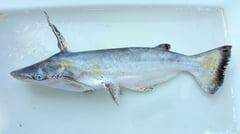
Ageneiosus inermisManduba
Auchenipteridae · (Linnaeus, 1766)
The manduba, Ageneiosus inermis, is a large auchenipterid catfish found throughout much of South America east of the Andes. At around 470 mm SL it would need an aquarium in excess of 400 x 120 cm as an adult and is largely unsuitable for private aquaria. An obligate carnivore, it can take surprisingly large prey, and the larger Ageneiosus species are often used as food fishes in their native countries.
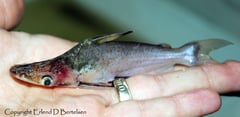
Ageneiosus ucayalensisDuck Catfish
Auchenipteridae · Castelnau, 1855
The duck catfish, Ageneiosus ucayalensis, is an auchenipterid catfish described from Peru and recorded across the Amazon, Orinoco and Guianas. Body patterning apparently varies with locality, and fish from black water habitats, particularly on the Guiana Shield, tend to be darker. Growing to around 290 mm SL and capable of taking large prey, it is safe only with similarly sized catfishes or large pelagic characins, mostly a combination for public aquaria.

Apistogramma bitaeniataTwo-Striped Dwarf Cichlid
Cichlidae · Pellegrin, 1936
The two-striped dwarf cichlid, Apistogramma bitaeniata, ranges across the Peruvian, Colombian and Brazilian Amazon, from the Marañón to the Tapajós. Also known as the banded dwarf cichlid, it occurs in several colour forms depending on locality, loosely grouped as 'red', 'blue', 'orange' and 'yellow' in the hobby. Many locality names are in use for these forms, and several are regularly applied incorrectly.

Astronotus ocellatusOscar
Cichlidae · (Agassiz, 1831)
The oscar, Astronotus ocellatus, is a large cichlid widely distributed in the Amazon region, recorded from Colombia and Venezuela south to Argentina. It grows to 350 mm SL and typically lives 10 to 20 years, both of which need taking into account before purchase. Most fish on sale come from commercial breeders in Eastern Europe or the Far East, in numerous ornamental strains, and genetic analyses suggest the genus contains additional, morphologically cryptic species.

Astyanax bimaculatusTwo Spot Astyanax
Characidae · (Linnaeus, 1758)
The two spot astyanax, Astyanax bimaculatus, is a characid ranging from Panama through most of the Amazon and Orinoco basins. It lives in a wide variety of biotopes, from swiftly-flowing rivers and streams to ponds, ditches and reservoirs. The name is currently applied to what is considered a species complex of at least four taxa, and aquarium fish most often arrive as contaminants among shipments of other species.
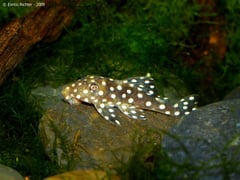
Baryancistrus sp. L142Big White Spot Pleco
Loricariidae · authority not recorded
The big white spot pleco, Baryancistrus sp. L142, is an undescribed suckermouth catfish from the rio Tapajós in Pará state, Brazil. It appears restricted to a short stretch of the river between Itaituba and Pimenta, in shallow, fast-flowing, warm water. The species is also traded as 'snowball pleco', a name first applied to Hypancistrus inspector and now used for several similar white- or yellow-spotted fishes. Males become highly intolerant of conspecifics as they age.

Biotoecus opercularis
Cichlidae · (Steindachner, 1875)
Biotoecus opercularis is a small geophagine cichlid from the middle Amazon basin in Brazil, including the lower Madeira, Tapajós and Negro. It favours shallow, slow-flowing water over sand with leaf litter and submerged wood, often stained with tannins. Several populations are traded, among them B. sp. 'rio Negro' from the rio Jauaperi and B. sp. 'Santarém' or 'Tapajós', though no scientific evidence shows them to be more than one species. It should not be mixed with other Biotoecus species or populations.
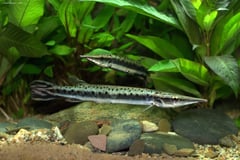
Boulengerella maculata
Ctenoluciidae · (Valenciennes, 1850)
Boulengerella maculata is a pelagic ctenoluciid found throughout much of the Amazon, Orinoco and Tocantins river systems. Colour pattern varies considerably, with some specimens much paler than others, and this may be correlated with water type. Random dark spots on the upper body, and a dark stripe only behind the eye when one is present, separate it from the similar B. lateristriga. It reaches 329 mm SL and needs an aquarium with base dimensions of 240 by 90 cm or more.

Colomesus asellusAmazon Puffer
Tetraodontidae · (Müller & Troschel, 1849)
The Amazon puffer, Colomesus asellus, is a freshwater puffer found throughout much of the Amazon basin, with records north to Guyana and Venezuela. Also traded as the South American puffer or 'SAP', it is told from congeners by a transverse row of dermal flaps across the chin. It lives mostly in well-oxygenated river habitats, is intolerant of organic waste, and forms loose aggregations, so a group of 6 or more is best, away from the general community.

Geophagus altifrons
Cichlidae · Heckel, 1840
Geophagus altifrons is a large cichlid from the middle-to-lower Amazon basin in Brazil, including the Xingu, Tapajós, Madeira, Negro and Purus. Despite being the type species it is among the most frequently-misidentified members of the genus, partly because populations from the Orinoco, the Guianas and the Tocantins are now species in their own right. In adults the dark midlateral marking is reduced to 1-2 scales or absent, a feature unique to the species, but juveniles are very difficult to identify.

Geophagus sp. 'orange head'
Cichlidae · authority not recorded
Geophagus sp. 'orange head' is an undescribed cichlid confined to the lower rio Tapajós in Brazil, including its tributary the rio Arapiuns. Now one of the more readily available members of the genus, it has suffered from commercial breeders who do not cull deformed fry. Two forms exist, one misleadingly traded as G. sp. 'Araguaia orange head', and the orange on the head is most extensive in dominant adult males.
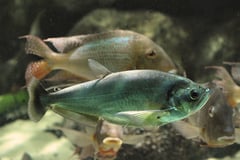
Hydrolycus scomberoidesVampire Tetra
Cynodontidae · (Cuvier, 1819)
The vampire tetra, Hydrolycus scomberoides, is a predatory dogtooth characin from the central and upper Amazon in Brazil, Bolivia, Peru and Ecuador. Also sold as 'scomb' and 'sabre tooth tetra', it is regularly confused with the much larger payara, H. armatus. At up to 300 mm it still needs a huge tank and specialist care, and newly-imported specimens often refuse anything but live food.
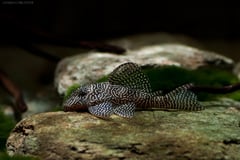
Hypancistrus sp.L260
Loricariidae · authority not recorded
L260, the queen arabesque pleco, is an undescribed Hypancistrus known only from the lower rio Tapajós in Pará state, northern Brazil. Among the most popular loricariids in the hobby, it is available on a regular basis. The larger L411 from the rio Jarí looks similar, but in L260 the white vermiculations are significantly finer. The area where it is collected would be largely destroyed should a planned hydroelectric project go ahead.

Hyphessobrycon heterorhabdusFlag Tetra
Characidae · (Ulrey, 1894)
The flag tetra, Hyphessobrycon heterorhabdus, is a characid from Pará and Maranhão states in eastern Brazil, also known as 'Belgian flag tetra'. Its name has been misapplied to similar fishes across much of the Amazon, the Orinoco and the Guianas, and the true species may reach no further upstream than the rio Tapajós. It lives almost exclusively in small, shaded forest streams called igarapés.

Hyphessobrycon pulchripinnisLemon Tetra
Characidae · Ahl, 1937
The lemon tetra, Hyphessobrycon pulchripinnis, is a characid from central Brazil, mostly recorded from the rio Tapajós basin. It is bred commercially in several countries, but the origin of the aquarium strain is questionable. Fish identical to it have been photographed in the lower Xingu, while a related 'orange red' form from the Tapajós may not be the same species.

Hyphessobrycon vilmae
Characidae · Géry, 1966
Hyphessobrycon vilmae is a small characid that appears to be endemic to the upper rio Tapajós basin in Amazonas and Mato Grosso states, Brazil. It is occasionally traded as 'chocolate neon tetra', and has a continuous, solid dark lateral stripe with no obvious humeral blotch. Generally peaceful, it is best kept in a mixed-sex group of at least 8-10.

Iguanodectes spilurusGreen Line Lizard Tetra
Iguanodectidae · (Günther, 1864)
The green line lizard tetra, Iguanodectes spilurus, is a characin found throughout the Amazon, Orinoco, Essequibo and Tocantins river systems. The most widespread Iguanodectes species, it has also been called the 'slender', 'spindle' or 'iguana' tetra, and differs from its congeners in its translucent dorsal and anal fins, lack of a red lateral stripe and prominent dark caudal-fin marking. It is sensitive to poor water conditions.
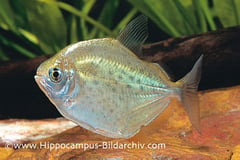
Metynnis lippincottianus
Serrasalmidae · (Cope, 1870)
Metynnis lippincottianus is a spotted silver dollar from Brazil and French Guiana, found in the lower and middle Amazon and the Oyapock system. It is occasionally seen for sale, sometimes as 'silver dollar', and its spotted pattern tells it apart from M. argenteus and M. hypsauchen. The spots are less pronounced than in M. maculatus, with which it shares a common name. The precise extent of its range is unclear.
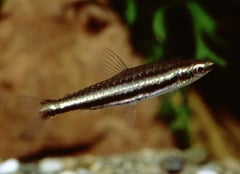
Nannostomus digrammusTwostripe Pencilfish
Lebiasinidae · (Fowler, 1913)
The twostripe pencilfish, Nannostomus digrammus, is a lebiasinid from the central Amazon basin in Brazil and the Rupununi basin in Guyana. Rare in the hobby, it usually arrives as bycatch among shipments of other fishes. It is most similar to N. bifasciatus but has an adipose-fin, and its small size and timid nature make it a poor community fish.
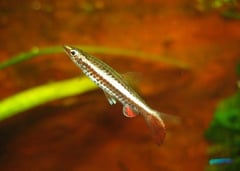
Nannostomus equesHockeystick Pencilfish
Lebiasinidae · Steindachner, 1876
The hockeystick pencilfish, Nannostomus eques, is a lebiasinid from the central and upper Amazon, the Orinoco drainage and rivers of Guyana. It swims at an oblique angle, a trait shared only with N. unifasciatus among congeners, and is also known as the 'rocket', 'diptail' or 'tubemouth' pencilfish. Genetic research on rio Negro populations raises the possibility that the species may be a complex of cryptic taxa.

Retroculus xinguensis
Cichlidae · Gosse, 1971
Retroculus xinguensis is a rheophilic cichlid from the rio Xingu basin in Brazil, with a handful of records from the Tapajós drainage. It occurs in rapids and fast-flowing stretches of clear water rivers, and differs from its congeners in having conspicuous dark bars on the caudal fin. It is available in the trade on a sporadic basis and needs a large set-up designed to resemble a flowing river, with water of 26 to 32 °C.

Satanoperca acuticepsSharphead Eartheater
Cichlidae · (Heckel, 1840)
The sharphead eartheater, Satanoperca acuticeps, is a cichlid from the central Amazon basin in Brazil, including the lower rio Negro and rio Branco. Relatively rare in the trade, it is sometimes confused with S. daemon and S. lilith but has three dark flank blotches (vs. two in S. daemon, one in S. lilith). Unless breeding it is surprisingly peaceful, and it is very rarely bred in aquaria.

Satanoperca lilith
Cichlidae · Kullander & Ferreira, 1988
Satanoperca lilith is an eartheater cichlid known only from Brazil, where it is widely distributed along the Solimões/Amazon main channel. Despite that extensive range it is uncommon in the ornamental trade, where it is sometimes called 'one-spotted demon fish' or 'one spot eartheater'. A single dark blotch on the flank separates it from the closely similar S. daemon, which has two.
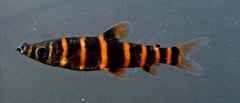
Synaptolaemus latofasciatus
Anostomidae · (Steindachner, 1910)
Synaptolaemus latofasciatus is a headstander from the upper Orinoco, the Casiquiare Canal and the middle-to-lower Amazon in Venezuela and Brazil. Described from a single specimen and placed in Leporinus until 2011, it was then recognised as the fish described as Synaptolaemus cingulatus. Alternating transverse bands of orange or yellow and dark brown or black run along the entire body, and snout shape and colour pattern vary with locality.

Aequidens tetramerusSaddle Cichlid
Cichlidae · (Heckel, 1840)
The saddle cichlid, Aequidens tetramerus, is a cichlid found across much of northern South America, from the Amazon and Orinoco basins to the Guianas. The type species of its genus, it occurs in several colour forms, and fish from Ecuador and Peru are sought after for the red or orange colouration on the lower head and belly. As currently recognised it is likely to represent a group of related fishes, some of which may be described as distinct species.
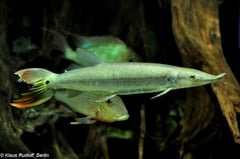
Boulengerella cuvieri
Ctenoluciidae · (Spix & Agassiz, 1829)
Boulengerella cuvieri is a pelagic ctenoluciid characin from much of the Amazon basin, the Río Orinoco and coastal drainages of the Guianas. The largest officially recorded specimen measured 675 mm, but it appears to grow larger, possibly beyond 800 mm. Given that size and its natural behaviour it is largely unsuitable for the home aquarium. Its entire dorsal-fin base lies ahead of the anal-fin origin, a character shared only with B. lucius and B. xyrekes among ctenoluciids.
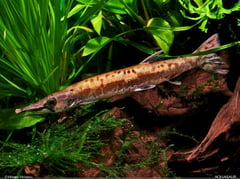
Boulengerella lucius
Ctenoluciidae · (Cuvier, 1816)
Boulengerella lucius is a large, pelagic ctenoluciid from the central Amazon region in Brazil and the Río Orinoco in Venezuela. Named for its resemblance to the northern pike, it grows to 420 mm and is largely unsuitable for the home aquarium. Juveniles and subadults are sometimes available in the trade, often misidentified as B. maculata. Dark patches between the median caudal-fin rays and random dark spots on the lower flanks separate it from B. cuvieri and B. xyrekes.

Laetacara araguaiae
Cichlidae · Ottoni & Costa, 2009
Laetacara araguaiae is a small cichlid from Brazil, known from the rios Tapajós, Xingu and Tocantins, right-bank tributaries of the lower Amazon. Known in the hobby as L. sp. 'Buckelkopf' before it was described, it grows to around 35 mm SL and is a biparental substrate-spawner. Some populations differ from one another in colour pattern, and 7-8 dorsal-fin rays separate it from all congeners.

Laetacara curvicepsDwarf Flag Cichlid
Cichlidae · Ahl, 1924
The dwarf flag cichlid, Laetacara curviceps, is a small cichlid from the lower Amazon basin in Brazil. An established aquarium favourite, it has also been called 'flag acara', 'smiling acara', 'sheepshead acara' and 'blunt-headed cichlid'. Populations differ in the degree of red and blue on the body and fins. It favours clear, slow-flowing water over leaf litter and is a biparental substrate-spawner.
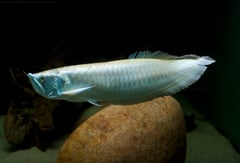
Osteoglossum bicirrhosumSilver Arowana
Osteoglossidae · (Cuvier, 1829)
The silver arowana, Osteoglossum bicirrhosum, is a large predator from the Amazon basin, plus river systems in Guyana and French Guiana. Reaching 80 cm, it is largely unsuitable for the home aquarium, and although juveniles are readily available, few private aquarists can house an adult long-term. Juveniles have a single dark lateral stripe, while in those of its only congener, O. ferreirai, most of the body and fins are dark.