Ilyodon furcidens
Goldbreast Goodeid
Last revised 2026Edit this page
On this page11 sections
Quick factsEdit
Difficulty4 of 8 measures
Rated moderate because it needs strong current.
- Space
- medium tank
- Water
- needs a steady pH
- Temp
- flexible
- Diet
- unknown
- Temperament
- peaceful
- Social
- unknown
- Compatibility
- unknown
Other demands
Each of these can raise the rating on its own, whatever the measures above say.
- Hardiness
- unknown
- Needs strong current, with the filter turning the tank over 8–12 times an hour
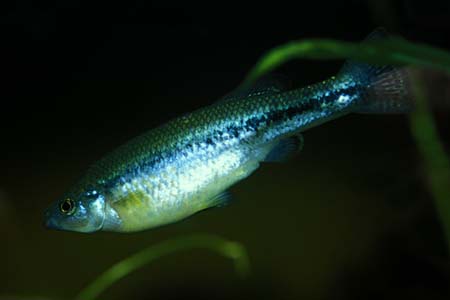
The goldbreast goodeid, Ilyodon furcidens, is a livebearer from Jalisco and Colima in Mexico, found in fast-flowing streams and small rivers. Also called the goldbreast splitfin, it is named for its fork-shaped teeth. Like other goodeids it nourishes its developing young through a trophotaenia, and females must be mated separately for each brood. A peaceful fish, it suits a community whose other species can cope with the lower temperatures it needs.
Distribution
EditThe states of Jalisco and Colima, Mexico.
Habitat
Write a noteEditInhabits fast-flowing streams and small rivers with varying biotopes.
Aquarium size
Write a noteEdit75 ∗ 30 ∗ 30 cm30 ∗ 12 ∗ 12 in
Maintenance
Write a noteEditA planted aquarium with some floating cover and a scattering of smooth rocks is ideal for I. furcidens. A good flow of water is also appreciated as these fish prefer well-oxygenated water.
Water conditions
EditTemperature: 18 – 24 °C64 – 75 °F
pH: 7.0-8.0
Hardness: 10-20 dH
These recommendations come from this profile’s own figures. They contain affiliate links, so we may earn a commission.
Diet
Write a noteEditOmnivorous and unfussy they will accept most foods offered. They do consume large amounts of algae in their natural habitat so some greenstuffs should be included in the diet.
Behaviour and compatibility
Write a noteEditA peaceful fish and can be kept in a community tank provided the other species can cope with the lower temperatures required. Males may squabble amongst themselves but physical damage is rare.
Sexual dimorphism
Write a noteEditMales are smaller, more colourful and possess an andropodium (this is a notched anal fin used for reproduction).
Reproduction
Write a noteEditEasy. Livebearer. Should be mated in a species aquarium and can be bred using a single pair or a group (flock spawning). The breeding tank should contain lots of plants. Goodeids breed in a slightly different way to other livebearers. Females do not store sperm as in many other livebearing species and must be mated separately for each brood of young. They also display no gravid spot.
Gestation takes between 7-8 weekss after which 5-50 huge (up to 1.5 cm0.6 in"!) fry are produced. Sometimes these may have what appears to be an umbilical cord attached. This is quite normal (see below) and will disappear in 2-3 days. The fry are large enough to accept the same foods as the adults from birth and will be bold and outgoing from the outset, competing for food with any other fish in the aquarium. The parents rarely predate on the fry.
Notes
EditThe species name 'furcidens' is derived from the interesting fork-shaped teeth of this fish. This species may develop a cervical hump as it matures. As with other goodeids, there is less of a size difference between the sexes than in many other livebearers. This is thought to be related to the relatively primitive structure of the andropodium, as the fish tend to choose mates that are of similar size so that the sex organs are synchronised.
Goodeids are unique among livebearers in that the developing young are nourished by a specialised structure known as the trophotaenia. This performs a similar function to the placenta in mammals and the remnants of it can often be seen attached to the young fish at birth. Male fish also possess an internal muscular structure known as a pseudophallus, which connects the sperm ducts to the genital opening, and is said to forcibly eject sperm.
Also referred to as the Goldbreast Splitfin.
Species images · 1
These photographs are used with each photographer's permission.
Send a photographProfile completeness18 of 24
75% complete
Also missing: a recorded distribution, taxonomic authority, etymology.
Community
Questions about Ilyodon furcidens?
Ask on Discord